
Forget everything you know about how memories get filed away in your brain. Seriously, bin it. Because for decades, neuroscientists told a tidy little story: the hippocampus is a temp worker. It scribbles down your experiences, hands the notes to the neocortex for long-term storage, and clocks out. Job done, no forwarding address. A lovely theory - neat, elegant, and increasingly wrong.
The Night Shift Nobody Expected
Here's what actually seems to be happening. A new review by Park and Kaang (2026) in Experimental & Molecular Medicine takes a hard look at the hippocampus's role in so-called "remote" fear memories - the kind that stick with you for weeks, months, or years. And the hippocampus, it turns out, never really hands in its resignation.
The old model - what the field calls Standard Consolidation Theory - imagined a clean handoff. Your hippocampus records a scary experience (say, that time a goose chased you in the park), replays it during sleep via sharp-wave ripples (those gorgeous little electrical bursts that synchronize half your brain at 150-250 Hz), and gradually transfers the whole package to the neocortex. At some point, the cortex can handle the memory solo, and the hippocampus washes its hands of the affair.
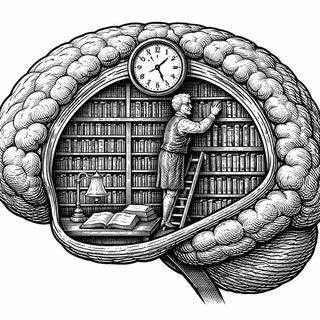
Except it doesn't. Multiple trace theory, championed by Nadel and Moscovitch, argued years ago that the hippocampus stays involved in vivid, context-rich memories indefinitely. And the evidence keeps piling up. Moscovitch and Gilboa (2022) went so far as to suggest we should stop calling the process "systems consolidation" altogether and rename it "systems reorganization" - because calling it consolidation implies a completion that never really arrives.
The Hippocampus Has a Side Hustle
So if the hippocampus isn't just a temporary filing clerk, what's it doing with old memories? According to Park and Kaang's review, it's running something closer to an ongoing editorial operation. As time passes, hippocampal engrams - those clusters of neurons that fire together to represent a specific memory - don't simply fade. They reorganize.
A stunning 2025 study by Ko and colleagues in Nature showed that hippocampal engram circuits physically rewire over time. Neurons that once encoded a precise fear memory start becoming "promiscuously active" (their word, and what a word it is), firing in response to related but non-identical situations. The result? Your memory of that specific goose in that specific park gradually blurs into a general wariness of all large birds in all green spaces.
What drives this rewriting? Adult neurogenesis - the birth of new neurons in the hippocampus. Block it, and memories stay crystalline. Boost it, and memories generalize faster. It's as if your brain is constantly editing its own autobiography, and the hippocampus is both the original author and the copy editor who keeps making "improvements" nobody asked for.
When the Editing Goes Wrong
This is where things get clinically interesting, and frankly a bit dark. Fear memory generalization isn't just an academic curiosity - it's one of the hallmarks of PTSD. A traumatic memory that should be tied to a specific context begins bleeding into everyday life. The sound of a car backfiring becomes indistinguishable from the original threat. Safe environments start feeling dangerous.
Pedraza and colleagues (2022) have argued that systems consolidation is itself a potential therapeutic target for trauma-related disorders. If generalization depends on hippocampal circuit reorganization, then intervening in that process - at the right time, in the right way - might help keep traumatic memories precise rather than letting them smear across a person's entire world. It's early days, but the logic is sound: if the hippocampus is the editor making unhelpful generalizations, perhaps we can have a word with the editor.
The Memory That Won't Clock Out
What Park and Kaang's review makes clear is that our picture of memory storage was too simple by half. The hippocampus isn't a waystation. It's a permanent staff member with its fingers in everything, quietly reshaping your memories for years after the original experience. Whether that's reassuring or slightly unsettling probably depends on what you're remembering.
One thing's certain: the next time someone tells you the hippocampus is only for recent memories, you can tell them the science has moved on. The hippocampus, it appears, is in it for the long haul - whether you like it or not.
References
-
Park, H., & Kaang, B.-K. (2026). Role of the hippocampus in systems consolidation of remote fear memory. Experimental & Molecular Medicine. DOI: 10.1038/s12276-026-01680-9. PMID: 41974891
-
Ko, S.Y., Rong, Y., Ramsaran, A.I., et al. (2025). Systems consolidation reorganizes hippocampal engram circuitry. Nature, 643(8072), 735-743. DOI: 10.1038/s41586-025-08993-1. PMID: 40369077
-
Lei, B., Kang, B., Hao, Y., et al. (2025). Reconstructing a new hippocampal engram for systems reconsolidation and remote memory updating. Neuron, 113(3), 471-485.e6. DOI: 10.1016/j.neuron.2024.11.010. PMID: 39689709
-
Moscovitch, M., & Gilboa, A. (2022). Has the concept of systems consolidation outlived its usefulness? Faculty Reviews, 11, 33. DOI: 10.12703/r/11-33. PMCID: PMC9720899
-
Pedraza, L.K., Sierra, R.O., & de Oliveira Alvares, L. (2022). Systems consolidation and fear memory generalisation as a potential target for trauma-related disorders. World Journal of Biological Psychiatry, 23(9), 653-665. DOI: 10.1080/15622975.2022.2027010. PMID: 35001808
Disclaimer: The image accompanying this article is for illustrative purposes only and does not depict actual experimental results, data, or biological mechanisms.