
For decades, neuroscience treated the neuron like a light switch - on or off, fire or don't fire. A tidy little dot on a diagram, dutifully adding up inputs and occasionally sending a signal down the wire. It was elegant. It was simple. It was, as it turns out, spectacularly incomplete.
Because those wispy, tree-like branches sprouting from every neuron - the dendrites - aren't just collecting signals like a rain gutter collects water. They're computing. Making decisions. Running their own little operations before the main office (the cell body) even gets the memo. A new review by Spyridon Chavlis and Panayiota Poirazi pulls together the evidence for this quiet revolution, and the picture it paints is something like discovering that every leaf on a tree has its own tiny brain (Chavlis & Poirazi, 2026).
The Branch Office That Runs the Company
Think of a neuron as an oak tree. The traditional story focused entirely on the trunk - the cell body and axon - where the "real" action supposedly happened. Dendrites were considered passive plumbing, pipes that delivered electrical signals from synapses to the soma, where the important decision of whether to fire got made.
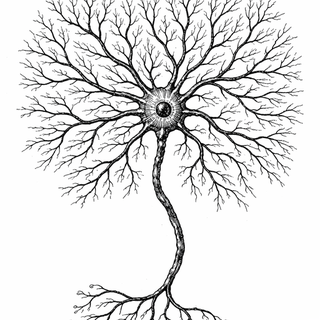
But here's what researchers have been catching dendrites doing when they bother to look closely: generating their own electrical spikes, performing nonlinear computations on incoming signals, and even running compartment-specific plasticity - meaning different branches of the same neuron can learn different things independently. It's like discovering that each branch of your oak tree is growing its own species of fruit.
These aren't subtle effects. Dendritic spikes - electrical events generated right there in the branches - come in several flavors: fast sodium spikes, slower calcium plateaus, and NMDA receptor-driven events that can last hundreds of milliseconds (Larkum et al., 2022). Each type supports different computations, from rapid coincidence detection to sustained signal amplification. Your dendrites aren't just receiving mail; they're reading it, writing responses, and sometimes starting entirely new conversations.
Watching Trees Think in Real Time
What makes this review particularly compelling is its focus on evidence from behaving animals - not neurons in a dish, but dendrites doing their thing in brains that are actively navigating mazes, recognizing objects, and forming memories.
In the hippocampus, for example, researchers using two-photon calcium imaging have watched dendritic activity unfold as mice explore their environments. The patterns of dendritic calcium events across branches predict how stable and precise a neuron's "place field" will be - its spatial map of the world (Bittner et al., 2015). Dendrites aren't passive recipients of spatial information; they're actively sculpting how the brain represents where you are.
In the cortex, the story gets equally interesting. Active dendritic currents in layer 5 pyramidal neurons - the big output cells of the cortex - gate whether sensory information actually reaches consciousness. The moment of perception, that instant when a faint touch on your skin becomes something you're aware of, appears to be causally linked to what's happening in the dendrites of these cells (Takahashi et al., 2020). Your awareness isn't just a product of neurons firing. It's a product of specific branches on specific neurons doing specific things.
One Neuron, Many Minds
Perhaps the most paradigm-shifting idea here traces back to work by Poirazi and Bartlett Mel showing that a single pyramidal neuron functions less like a simple switch and more like a two-layer artificial neural network (Poirazi et al., 2003). Each dendritic branch acts as an independent processing unit - a nonlinear subunit that transforms its inputs before passing results upstream. The cell body then combines these branch-level computations into a final output.
This means a single biological neuron might be doing the computational work that takes dozens or hundreds of units in a standard artificial neural network. It's an almost unsettling thought - that the basic building block of the brain is orders of magnitude more sophisticated than the basic building block of our most advanced AI systems.
Teaching Machines to Grow Branches
And that's exactly where the story gets practical. The review highlights a growing wave of research translating dendritic principles into artificial intelligence. Neural networks inspired by dendritic computation are showing improved accuracy, better robustness, and - critically - much greater parameter efficiency than traditional architectures (Pagkalos et al., 2024). They're also better at avoiding catastrophic forgetting, that frustrating tendency of AI systems to unlearn old tasks when trained on new ones.
There's a certain poetic justice to it. We spent decades simplifying neurons into point-like units to build artificial networks, and now we're circling back to the biology, hat in hand, realizing the features we stripped away were exactly what made the original system so powerful.
The Forest for the Trees
What strikes me most about this body of work isn't any single finding - it's the shift in perspective. For a long time, neuroscience was a bit like astronomy before telescopes got good enough to see planetary surfaces: we could map the stars, but we were guessing about the terrain. New imaging and recording technologies have let us zoom in on the dendrites of active, thinking brains, and the landscape is richer than anyone predicted.
Every neuron is not a dot. It's an ecosystem - a branching, computing, learning structure whose complexity we're only beginning to map. And if the history of science teaches us anything, it's that when you look more closely at something you thought was simple, you usually find a world.
References
-
Chavlis, S., & Poirazi, P. (2026). A dendro-centric view of cognition in the behaving brain. Annual Review of Neuroscience. DOI: 10.1146/annurev-neuro-090325-115846 | PubMed
-
Larkum, M.E., Wu, J., Bhatt, D.K., & Bhatt, D. (2022). The guide to dendritic spikes of the mammalian cortex in vitro and in vivo. Neuroscience, 489, 15-33. DOI: 10.1016/j.neuroscience.2022.02.009
-
Bittner, K.C., Grienberger, C., Vaidya, S.P., Milstein, A.D., Macklin, J.J., Suh, J., Tonegawa, S., & Magee, J.C. (2015). Calcium transient prevalence across the dendritic arbour predicts place field properties. Nature, 517, 200-204. DOI: 10.1038/nature13871 | PMCID: PMC4289090
-
Takahashi, N., Oertner, T.G., Bhatt, D.K., & Bhatt, D. (2020). Active dendritic currents gate descending cortical outputs in perception. Nature Neuroscience, 23, 1277-1285. DOI: 10.1038/s41593-020-0677-8
-
Poirazi, P., Brannon, T., & Mel, B.W. (2003). Pyramidal neuron as two-layer neural network. Neuron, 37(6), 989-999. DOI: 10.1016/S0896-6273(03)00149-1
-
Pagkalos, M., Makarov, R., & Poirazi, P. (2024). Leveraging dendritic properties to advance machine learning and neuro-inspired computing. Current Opinion in Neurobiology, 85, 102830. DOI: 10.1016/j.conb.2024.102830 | PMCID: PMC10312913
Disclaimer: The image accompanying this article is for illustrative purposes only and does not depict actual experimental results, data, or biological mechanisms.