
A neurologist walks into a bar and says, "I spent my day looking at mouse noses, and honestly they are more organized than my inbox." Fair. Because the big surprise in a new wave of smell research is that the nose is not tossing odor receptors around like confetti at a wedding. It is running a weirdly precise city-planning operation with neighborhoods, boundaries, and rules. [1]
The Nose Was Not Winging It
For years, the textbook version went something like this: each smell-sensing neuron in the nose picks one odor receptor out of a gigantic menu, and neurons with the same receptor wire up to the same spots in the olfactory bulb, the brain's first smell relay station. That part held up. The fuzzier bit was what happened in the nose itself. People knew there were broad zones, but the assumption was still kind of "organized-ish chaos."
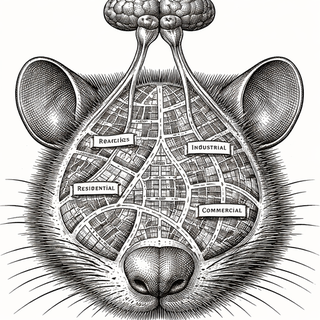
The new Cell study says: not so fast. Researchers mapped roughly 1,100 olfactory receptors in the mouse nose and found tightly regulated spatial patterns, not random scatter. A complementary atlas project also showed that the geometry of the nose lines up with the geometry of the smell map in the brain. In other words, your nose is pre-sorting the mail before the brain even opens the envelope. [1]
That matters because smell starts at the messy end of biology. Odors drift, swirl, dilute, stick to mucus, and generally behave like tiny chemical goblins. If the nose can impose order early, the brain gets a cleaner signal to work with.
Tiny Stripes, Big Consequences
One especially cool part is that these receptor maps seem to follow developmental rules. In the Datta lab study, a retinoic acid gradient helped steer which receptors show up where. That is a fancy way of saying cells in different parts of the nose get different positional instructions, like being handed a seating chart before the world's strangest dinner party. [1]
This does not come out of nowhere. A 2022 spatial transcriptomics study had already suggested the mouse olfactory mucosa was laid out in continuous, overlapping zones, and that receptor placement correlated with how easily odor molecules dissolve in nasal mucus. Yes, your mucus has opinions. [2]
Other recent work has also chipped away at the old "random choice" story by showing that receptor selection is constrained by spatial and epigenetic programs during development. So this 2026 result feels less like a bolt from the blue and more like the detective finally proving the yarn board was onto something. [3]
Why You Should Care, Even If You Are Not a Mouse
Look, this is mouse work. Your nose is not a mouse nose, and science has been humbled before.
But the implications are still juicy. Smell is tied to flavor, memory, hazard detection, mood, and quality of life. Lose it, and everyday life gets oddly flat and sometimes dangerous. Recent reviews have hammered home that olfaction touches emotion, diet, stress, and well-being far more than people give it credit for. [4]
That is why these maps matter beyond pure neuroscience nerdery. If researchers eventually understand how smell neurons choose receptors, wire to the right brain targets, and recover after injury, that could help efforts to treat smell loss after infection, environmental damage, or neurodegenerative disease. The 2026 work already points toward future human tissue studies and better repair strategies. [1]
There is also a practical lesson here: a lot of lab smell research may use odor concentrations that are way higher than what animals encounter in real life. A 2025 review argued that natural odor levels are often much lower than standard experimental setups, which means mapping the system is only half the battle. [5]
The Weird Beauty of a Well-Organized Nose
The fun of this story is that it makes smell feel less mystical without making it less cool. The old picture made the olfactory system seem like a lovable chaos gremlin. The new one suggests it is more like a secret bureaucracy with excellent filing habits.
And honestly, that tracks. The world throws a chemical soup at your face, and your nervous system has to decide whether that means dinner, danger, baby, forest, smoke, or "something in the fridge has achieved sentience." Building a detailed spatial map right at the entrance may be one of the tricks that makes that possible.
So no, your nose is not just a passive air filter with branding. It is more like an overqualified border agent checking molecular passports at high speed. Seeing that map in detail is a big step toward figuring out how a cloud of chemicals becomes a memory, a craving, or a very urgent decision to stop eating leftover sushi.
References
- Simms C. First detailed 'smell maps' reveal how noses track odours. Nature. 2026 Apr 28. DOI: https://doi.org/10.1038/d41586-026-00894-1. News coverage of: Brann DH, et al. Cell. 2026. DOI: https://doi.org/10.1016/j.cell.2026.03.051
- Ruiz Tejada Segura ML, Abou Moussa E, Garabello E, et al. A 3D transcriptomics atlas of the mouse nose sheds light on the anatomical logic of smell. Cell Reports. 2022;38(12):110547. DOI: https://doi.org/10.1016/j.celrep.2022.110547. PMCID: https://pmc.ncbi.nlm.nih.gov/articles/PMC8995392/
- Bashkirova EV, Klimpert N, Monahan K, et al. Opposing, spatially-determined epigenetic forces impose restrictions on stochastic olfactory receptor choice. eLife. 2023;12:RP87445. DOI: https://doi.org/10.7554/eLife.87445. PMCID: https://pmc.ncbi.nlm.nih.gov/articles/PMC10055043/
- Bratman GN, Bembibre C, Daily GC, et al. Nature and human well-being: The olfactory pathway. Science Advances. 2024;10(20):eadn3028. DOI: https://doi.org/10.1126/sciadv.adn3028. PMCID: https://pmc.ncbi.nlm.nih.gov/articles/PMC11063095/
- Li A, Nagappan S, Zhang J, et al. Recalibrating Olfactory Neuroscience to the Range of Naturally Occurring Odor Concentrations. Journal of Neuroscience. 2025;45(10):e1872242024. DOI: https://doi.org/10.1523/JNEUROSCI.1872-24.2024. PMCID: https://pmc.ncbi.nlm.nih.gov/articles/PMC11884396/
Disclaimer: The image accompanying this article is for illustrative purposes only and does not depict actual experimental results, data, or biological mechanisms.