
Tucked into the surface of nearly every neuron in your brain sits a bustling neighbourhood of receptors - histamine H1, serotonin 5-HT2A, dopamine D2, noradrenergic alpha-1 - each one a tiny molecular doorbell waiting to be rung. Navigate past the blood-brain barrier, hang a left at the limbic system, and you'll find yourself in a pharmacological postcode where the same drug molecule can knock on entirely different doors depending on how much of it shows up. A polite tap at a low dose? You get a sedative. A thunderous pounding at a high dose? Suddenly you've got an antidepressant. Same pill, different personality.
A team of international experts, led by Sasson Zemach and Joseph Zohar and published in The Lancet Psychiatry, has just given this phenomenon a proper name: Different Dosage, Different Pharmacology - or DDDP, because psychiatry apparently needed another acronym (Zemach et al., 2025).
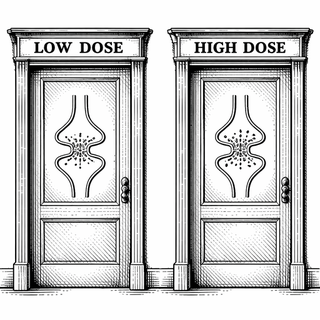
One Pill, Two Faces
Here's the thing most people don't realise about psychiatric medications: the dose isn't just "more equals stronger." For certain drugs, changing the dose is more like changing the channel entirely. Your brain's receptors have wildly different affinities for a given molecule, and as the concentration rises, new receptor populations get recruited into the conversation.
The authors identified ten drugs that pull off this pharmacological costume change: amisulpride, amitriptyline, aripiprazole, brexpiprazole, cariprazine, doxepin, mirtazapine, quetiapine, risperidone, and trazodone. Each one does something genuinely different at low versus high doses - not just "more of the same thing, but louder."
The Greatest Hits of Dose-Dependent Weirdness
Trazodone is the poster child. At 25-100 mg, it's basically a sleeping pill - it saturates 5-HT2A and histamine H1 receptors so thoroughly that your eyelids become non-negotiable. But push the dose to 150-600 mg, and suddenly it starts blocking the serotonin transporter too, moonlighting as a full antidepressant. Roughly half of your brain's 5-HT2A receptors are blocked by a mere 1 mg of the stuff, but you need substantially more to get any meaningful serotonin reuptake inhibition going (Stahl, 2009).
Amisulpride does something arguably stranger. At low doses (under 300 mg/day), it preferentially blocks presynaptic dopamine autoreceptors - the feedback sensors that tell neurons to ease off dopamine production. Block those sensors, and you increase dopamine transmission, which is why low-dose amisulpride helps with depression and the negative symptoms of schizophrenia. Crank it up to 400-1,200 mg/day, and it starts occupying postsynaptic D2 receptors instead, doing the opposite: dampening dopamine signalling to treat psychosis (Schoemaker et al., 1997).
Then there's mirtazapine, the drug that gets less sedating as you increase the dose. At 15 mg, its affinity for histamine H1 receptors dominates, and you'll sleep like you've been hit with a cartoon mallet. At 30-45 mg, noradrenergic transmission kicks in and partially counteracts the sedation. Telling a patient "we're increasing your dose and you'll actually be less drowsy" sounds like a prank, but it's just pharmacology being pharmacology (Anttila & Leinonen, 2001).
Why This Matters Beyond Cocktail Party Trivia
The DDDP concept slots into the Neuroscience-based Nomenclature (NbN), a system that classifies psychiatric drugs by what they actually do in the brain rather than by the conditions they were first approved to treat. Under the old system, quetiapine is an "antipsychotic" whether you're prescribing 50 mg for sleep or 800 mg for schizophrenia. Under NbN, those are recognised as pharmacologically distinct actions - receptor antagonism (D2, 5-HT2) at high doses, with histamine and alpha-1 blockade dominating at low doses (Caraci et al., 2017).
This matters for prescribers because pushing the dose of a partial dopamine agonist like aripiprazole past its sweet spot doesn't just risk side effects - it can actually reduce efficacy. The drug's therapeutic window isn't a gradient; it's a series of distinct pharmacological neighbourhoods, each with its own postcode and its own rules.
The Quiet Revolution in the Prescription Pad
For decades, psychiatric prescribing has relied on a somewhat medieval logic: if the drug isn't working, give more of it. DDDP formally acknowledges what seasoned clinicians have long suspected - that the relationship between dose and effect isn't a straight line but a winding road through different receptor landscapes. A dose increase isn't always an escalation. Sometimes it's a detour to an entirely different destination.
The real elegance of this framework is its simplicity. Rather than requiring clinicians to memorise receptor binding profiles, DDDP flags the drugs where dose-dependent switches are clinically significant. It's a cheat sheet for a brain that doesn't read package inserts.
Whether this changes how your GP writes prescriptions tomorrow is debatable. But it nudges psychiatry a little closer to something it's been chasing for a long time: prescribing based on what a drug does in the brain, rather than what category it was filed under in 1963. The brain, it turns out, was never reading those labels anyway.
References
-
Zemach, S., Zohar, J., Correll, C.U., Stahl, S.M., Drago, F., Goodwin, G.M., Moller, H.J., Uchida, H., Siafis, S., Santos, M., & Blier, P. (2025). Dose-dependent pharmacological mechanisms within the Neuroscience-based Nomenclature: a new concept to facilitate neuroscience-based prescribing. The Lancet Psychiatry. DOI: 10.1016/S2215-0366(25)00338-4. PMID: 41547365
-
Caraci, F., Enna, S.J., Zohar, J., Racagni, G., Zalsman, G., van den Brink, W., Kasper, S., Koob, G.F., Pariante, C.M., Bhugra, D., & Drago, F. (2017). A new nomenclature for classifying psychotropic drugs. British Journal of Clinical Pharmacology, 83(8), 1614-1616. DOI: 10.1111/bcp.13302. PMID: 28401576
-
Stahl, S.M. (2009). Mechanism of action of trazodone: a multifunctional drug. CNS Spectrums, 14(10), 536-546. DOI: 10.1017/S1092852900027560. PMID: 20095366
-
Schoemaker, H., Claustre, Y., Fage, D., Rouquier, L., Chergui, K., Curet, O., Oblin, A., Gonon, F., Carter, C., Benavides, J., & Scatton, B. (1997). Neurochemical characteristics of amisulpride, an atypical dopamine D2/D3 receptor antagonist with both presynaptic and limbic selectivity. Journal of Pharmacology and Experimental Therapeutics, 280(1), 83-97. PMID: 8996185
-
Siafis, S., Davis, J.M., & Leucht, S. (2023). Antipsychotic dose, dopamine D2 receptor occupancy and extrapyramidal side-effects: a systematic review and dose-response meta-analysis. Molecular Psychiatry, 28, 3267-3277. DOI: 10.1038/s41380-023-02203-y
Disclaimer: The image accompanying this article is for illustrative purposes only and does not depict actual experimental results, data, or biological mechanisms.