
You know that feeling when someone you love gently strokes your arm and your entire nervous system seems to exhale? Turns out your body has an entire class of nerve fibres dedicated to precisely that moment - and science is only now working out how the whole operation runs.
A sweeping new review by Ishmail Abdus-Saboor at Columbia University traces the full wiring diagram of social touch, from the nerve endings in your skin all the way up to the brain regions that make a hug feel like a hug and not, say, a particularly aggressive handshake (Abdus-Saboor, 2026). The picture that emerges is equal parts elegant and absurd: your body has built a bespoke telecommunications network just so you can enjoy a cuddle.
The Nerves That Only Care About the Nice Stuff
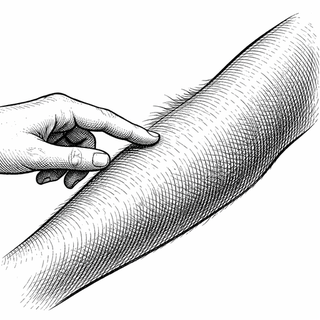
Buried in the hairy skin across most of your body sit C-tactile afferents - slow, unmyelinated nerve fibres that respond best to gentle stroking at roughly 3 centimetres per second. That happens to be almost exactly the speed at which humans naturally stroke a partner's arm or a parent caresses a baby's back. Coincidence? Absolutely not.
These fibres were first identified in the 1990s by Swedish physiologist Åke Vallbo, who patiently recorded from individual nerve fibres using a technique called microneurography - essentially eavesdropping on neurons one at a time. What he found was a population of nerves that didn't much care about sharp pokes or heavy pressure, but went wild for a slow, gentle brush (Schirmer et al., 2023). They are, in effect, your body's cuddle detectors.
Remarkably, a 2025 study revealed these touch neurones are physically coupled to hair follicles and respond to hair deflection - meaning the mystery of emotional touch was quite literally hiding hair-deep all along (Birznieks, 2025). One wonders what other secrets are lurking in places we forgot to look.
From Skin to Feelings: The Scenic Route Through Your Spinal Cord
What makes Abdus-Saboor's review particularly valuable is its insistence on following the complete circuit. When a C-tactile afferent fires, the signal doesn't take a motorway to the brain. It meanders through the spinal cord, where specific relay neurones decide what gets amplified and what gets filtered. The signal eventually arrives not at the brain's standard touch-processing centre (the somatosensory cortex), but at the insular cortex - a region associated with emotion, bodily awareness, and the general business of feeling things about things.
This is a completely different postal route than the one used by, say, the sensation of gripping a coffee mug. Your brain has separate infrastructure for "I am touching a thing" and "someone who matters is touching me." The engineering department really outdid itself.
Mice, Dopamine, and the Neurones That Make Touch Rewarding
In the mouse world, neurones expressing a receptor called MRGPRB4 appear to be the rodent equivalent of our cuddle detectors. Abdus-Saboor's own lab showed that these neurones are required for female mice to find social contact rewarding - remove them, and what was once a welcome touch becomes grounds for a fight. More strikingly, activating these neurones triggers dopamine release in the nucleus accumbens, the brain's reward centre (Elias et al., 2023).
So pleasant touch isn't just pleasant in some vague, hand-wavy sense. It is pharmacologically rewarding, running on the same neurotransmitter that makes food taste good and music sound brilliant. Your nervous system is effectively bribing you to maintain social bonds. Clever girl.
What Happens When the Touching Stops
If pleasant touch is neurochemical bribery, then touch deprivation is withdrawal - and the data bears this out. During COVID-19 lockdowns, reduced physical contact was associated with higher anxiety, greater loneliness, and a measurable craving for interpersonal touch that researchers compared to hunger (von Mohr et al., 2021). Mice deprived of touch neurone function early in life grow up to be more stress-vulnerable as adults, with dysregulated corticosterone responses that persist long after the deprivation ends.
The implications for neonatal care, elder care, and frankly anyone who has ever said "I'm not really a hugger" are worth sitting with for a moment.
Where This All Goes Next
Abdus-Saboor's review closes by highlighting the enormous gaps that remain. We still don't fully understand how many subtypes of touch neurones exist, how the spinal cord integrates social and non-social touch signals, or why the same stroke can feel comforting from one person and deeply unwelcome from another. Context, it seems, is everything - but the neural mechanisms encoding that context remain stubbornly opaque.
What is clear is that your body has invested extraordinary biological resources in making sure you can feel the difference between a handshake and a hand held. The circuitry is intricate, the chemistry is potent, and science is only just beginning to read the manual.
One suspects the manual is quite long.
References
1. Abdus-Saboor, I. (2026). Neurobiology of Social Touch. Annual Review of Neuroscience. DOI: 10.1146/annurev-neuro-102124-022220. PMID: 41770840.
2. Elias, L. J., Succi, I. K., Schaffler, M. D., et al. (2023). Touch neurons underlying dopaminergic pleasurable touch and sexual receptivity. Cell, 186(3), 577-590.e16. DOI: 10.1016/j.cell.2022.12.034. PMID: 36693373. PMCID: PMC9898224.
3. Schirmer, A., Croy, I., & Ackerley, R. (2023). What are C-tactile afferents and how do they relate to "affective touch"? Neuroscience & Biobehavioral Reviews, 151, 105236. DOI: 10.1016/j.neubiorev.2023.105236. PMID: 37196923.
4. von Mohr, M., Kirsch, L. P., & Fotopoulou, A. (2021). Social touch deprivation during COVID-19: effects on psychological wellbeing and craving interpersonal touch. Royal Society Open Science, 8(9), 210287. DOI: 10.1098/rsos.210287. PMID: 34527270. PMCID: PMC8424338.
5. Birznieks, I. (2025). C-tactile afferents: The mystery of human emotional touch has been hidden hair-deep. The Journal of Physiology, 603(16), 4441-4442. DOI: 10.1113/JP289528. PMID: 40735975. PMCID: PMC12369287.
Disclaimer: The image accompanying this article is for illustrative purposes only and does not depict actual experimental results, data, or biological mechanisms.