
Here's a party trick: the same spinal cord that lets a tadpole wiggle through a pond has to completely reinvent its cellular lineup before that tadpole can hop across a lily pad on four legs. Not a software update. Not a remix. A full re-pressing, with a 70-fold increase in one specific type of nerve cell. Nature didn't tweak the tracklist - it built an entirely new studio.
The Beat Before the Drop
To understand what's happening, you need to know about central pattern generators - the spinal cord's built-in rhythm section. These circuits of interneurons fire in coordinated loops to produce movement without your brain micromanaging every muscle twitch. Swimming? That's a simple, repeating beat. Left, right, left, right. One bassline, minimal production. But walking on four limbs? That's polyrhythmic jazz fusion. Flexors and extensors across multiple joints all need to fire in precisely staggered sequences, and the spinal cord needs way more players to pull it off.
A team led by Lora Sweeney at the Institute of Science and Technology Austria decided to watch this musical evolution happen in real time - inside a single animal. Their instrument of choice: the frog Xenopus laevis, which conveniently morphs from a swimming tadpole into a four-legged froglet during metamorphosis (Vijatovic et al., 2026).
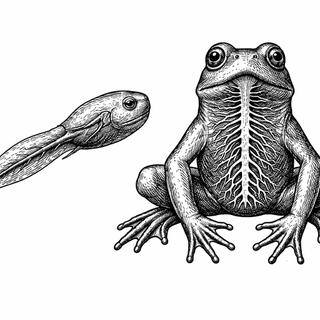
One Organism, Two Locomotor Albums
At the tadpole stage, the spinal cord is running lean. Motor neurons and interneurons are relatively few and transcriptionally homogeneous - everybody's playing the same note. The V1 inhibitory interneurons, a class marked by the transcription factor Engrailed1, exist in small numbers with minimal molecular variety. It's a stripped-down acoustic set.
Then limbs start budding, and the production goes absolutely massive.
Motor neurons multiply. But V1 inhibitory interneurons? They don't just multiply - they explode. About a 70-fold expansion in cell number, diversifying into dozens of transcriptionally distinct subtypes organized into four major clades defined by the transcription factors MafA, Pou6f2, FoxP2, and Sp8. What was once a single background vocalist became an entire choir section with specialized parts.
This mirrors what earlier work found in mice, where V1 interneurons fractionate into roughly 50 candidate cell types based on combinatorial expression of 19 transcription factors (Bikoff et al., 2016). The frog arrives at a strikingly similar molecular arrangement - same clades, similar proportions, conserved positioning - by the time its limbs are fully operational.
Why Inhibition Is the Real Producer
Here's the counterintuitive part. The biggest expansion isn't in the neurons that activate muscles. It's in the ones that silence them. Inhibitory interneurons are the unsung producers of movement - they sculpt motor output by suppressing the wrong muscles at the wrong time. Without them, every attempted step would be a full-body spasm.
V1 interneurons specifically regulate locomotor speed and coordinate flexor-extensor alternation - the fundamental back-and-forth that makes limbed walking possible (Britz et al., 2015). Think of them as the mixing board operators, cutting channels in and out to shape a clean output from raw neural noise. More complex movement demands more channels, more operators, more precision.
A cross-species review of spinal interneuron organization confirms this pattern: as vertebrates moved from water to land across evolutionary time, the biggest gains in circuit complexity came from subdividing existing interneuron classes into specialized subtypes (Wilson & Sweeney, 2023). Evolution didn't invent new instruments. It trained the existing ones to play more parts.
The Remix That Rewrote the Tracklist
The researchers went further, knocking out transcription factors that define specific emerging V1 and motor neuron populations. What they found was a clean molecular segregation between swim circuits and limb circuits - separate programs running on shared hardware. Disrupting the newer, limb-associated subtypes messed with coordinated limb movement while leaving swimming intact. The old tracks still played fine. The new ones needed their own producers.
This is evolution sampled in a single lifetime. A tadpole literally builds the neural infrastructure for terrestrial locomotion as it grows legs - the same transition that took vertebrates millions of years to pull off during the Devonian period.
Drop the Beat
The takeaway is almost poetic in its simplicity. Want to move in more complex ways? You need more ways to say "stop." The spinal cord's answer to the biomechanical demands of limbed locomotion wasn't louder signals or faster neurons. It was a massively expanded vocabulary of inhibition - more cell types, more molecular identities, more precise control over which muscles stay quiet and when. Silence, it turns out, is the most sophisticated part of the song.
References
-
Vijatovic, D., Toma, F. A., Ignatyev, Y., Harrington, Z. P. M., Sommer, C., Hauschild, R., ... & Sweeney, L. B. (2026). Multifold increase in spinal inhibitory cell types with emergence of limb movement. Cell Reports, 44(4), 117227. DOI: 10.1016/j.celrep.2026.117227. PMID: 41964955
-
Bikoff, J. B., Gabitto, M. I., Rivard, A. F., Drobac, E., Machado, T. A., Miri, A., ... & Bhatt, D. H. (2016). Spinal inhibitory interneuron diversity delineates variant motor microcircuits. Cell, 165(1), 207-219. DOI: 10.1016/j.cell.2016.01.027. PMCID: PMC4808435
-
Britz, O., Zhang, J., Grossmann, K. S., Dyck, J., Kim, J. C., Dymecki, S., ... & Bhatt, D. H. (2015). A genetically defined asymmetry underlies the inhibitory control of flexor-extensor locomotor movements. eLife, 4, e04718. DOI: 10.7554/eLife.04718
-
Wilson, A. C., & Sweeney, L. B. (2023). Spinal cords: Symphonies of interneurons across species. Frontiers in Neural Circuits, 17, 1146449. DOI: 10.3389/fncir.2023.1146449
-
Vijatovic, D., Toma, F. A., Harrington, Z. P. M., Sommer, C., Hauschild, R., Trevisan, A. J., ... & Sweeney, L. B. (2024). Spinal neuron diversity scales exponentially with swim-to-limb transformation during frog metamorphosis. bioRxiv. DOI: 10.1101/2024.09.20.614050. PMID: 39345366
Disclaimer: The image accompanying this article is for illustrative purposes only and does not depict actual experimental results, data, or biological mechanisms.