
A 58-year-old former marathon runner - let's call her Maria - sat in her oncologist's office staring at a scan of her lungs. Stage II adenocarcinoma. The tumor was small, caught early, theoretically beatable. But her immune system, a perfectly functional army of cancer-killing cells, was barely putting up a fight. Her doctors were puzzled. Her T cells were right there, surrounding the tumor, but acting like security guards who'd been told to stand down. Turns out, somebody had told them to stand down. And that somebody was her own brain.
The Sneakiest Phone Call in Biology
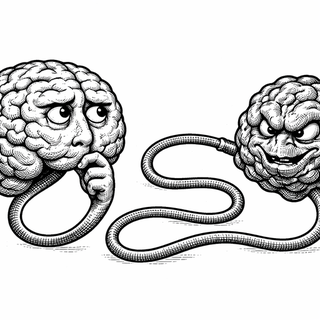
Here's something wild that researchers have just uncovered: lung tumors don't just sit there growing and hoping for the best. They literally hijack your vagus nerve - the longest nerve in your autonomic nervous system, running from your brainstem all the way down to your guts - and use it like a direct hotline to your brain. "Hey, brain? It's me, the tumor. Could you maybe tell the immune system to chill out?" And the brain, like a gullible receptionist, actually does it.
In a landmark study published in Nature, Wei, Yu, and colleagues at the University of Pennsylvania and Yale mapped out exactly how this works (Wei et al., 2026). The tumor activates a specific type of vagal sensory neuron - ones expressing a receptor called Npy2r - that sends signals up to the brainstem's nucleus tractus solitarius (the brain's internal mail room for body updates). The brainstem then cranks up sympathetic nerve activity right back in the tumor neighborhood.
Think of it as your tumor placing a collect call, and your nervous system not only accepting the charges but sending reinforcements to the wrong side.
Your Immune System Gets Ghosted
So what does all this extra sympathetic activity actually do? It floods the tumor microenvironment with noradrenaline, the same fight-or-flight chemical that surges when someone cuts you off in traffic. Except instead of making you honk aggressively, it lands on beta-2 adrenergic receptors sitting on alveolar macrophages - the immune cells that should be organizing the anti-tumor response.
These macrophages, now swimming in stress signals, basically switch teams. They stop rallying CD8+ T cells (your body's elite tumor assassins) and instead create an immunosuppressive environment. The T cells are still physically present, but they've been functionally benched. It's like having a fire department show up to a blaze and then just... stand there because someone told them it was a drill.
As principal investigator Rui Chang put it: "Tumors are really smart. They employ as many resources in the body they can get in touch with to promote their own growth."
Cutting the Line Works
Here's where it gets genuinely exciting. When the researchers disrupted this sneaky neural circuit - through vagotomy, genetic tricks, or chemogenetic tools - tumor growth dropped significantly. Cut the phone line, and the immune system wakes back up. The macrophages start doing their job again, CD8+ T cells re-engage, and tumors shrink.
A commentary on this work by Jin and Jin in Trends in Pharmacological Sciences highlights an even more tantalizing angle: beta-blockers (Jin & Jin, 2026). Propranolol, a cheap, widely available blood pressure medication your grandparents might be taking right now, blocks those same beta-2 adrenergic receptors. A recent systematic review found that propranolol may already improve cancer outcomes, particularly when given around the time of surgery (O'Logbon et al., 2025). Five clinical trials are currently testing beta-blockers alongside immunotherapy drugs like pembrolizumab and nivolumab across melanoma, digestive cancers, and urothelial cancers.
Why This Rewrites the Playbook
Cancer neuroscience is having a moment. Over the past few years, researchers have increasingly recognized that tumors don't grow in isolation - they recruit nerves, rewire circuits, and manipulate the nervous system like a parasite pulling strings (Pu et al., 2025). But this study is the first to map a complete round-trip circuit: tumor signals go up to the brain via sensory nerves, and immunosuppressive commands come back down via sympathetic nerves. It's bidirectional. It's specific. And it's targetable.
The implications stretch well beyond lung cancer. Every organ with vagal innervation - stomach, liver, pancreas, colon - could theoretically be running the same play. And if a 60-year-old blood pressure pill can jam the signal, we might be looking at one of the most cost-effective additions to cancer immunotherapy in decades.
For Maria and patients like her, the message is strange but hopeful: the problem wasn't that her immune system couldn't fight. It's that her tumor had found the off switch - routed through her own brain. Now that we know where the switch is, we can start flipping it back.
References
-
Wei, H.K., Yu, C.D., Hu, B., Zeng, X., Ichise, H., Li, L., Wang, Y., Wang, R.L., Germain, R.N., Chang, R.B., & Jin, C. (2026). Tumour-brain crosstalk restrains cancer immunity via a sensory-sympathetic axis. Nature, 650(8103), 1007-1016. DOI: 10.1038/s41586-025-10028-8. PMID: 41639447. PMCID: PMC12935554.
-
Jin, W.L., & Jin, M.Z. (2026). Targeting the sensory-sympathetic axis for cancer immunotherapy. Trends in Pharmacological Sciences. DOI: 10.1016/j.tips.2026.03.003. PMID: 41925428.
-
O'Logbon, J., Tarantola, L., Williams, N.R., Mehta, S., Ahmed, A., & Davies, E.A. (2025). Does propranolol have a role in cancer treatment? A systematic review of the epidemiological and clinical trial literature on beta-blockers. Journal of Cancer Research and Clinical Oncology, 151(7), 212. DOI: 10.1007/s00432-025-06262-2. PMID: 40652143. PMCID: PMC12255574.
-
Pu, T., Sun, J., Ren, G., & Li, H. (2025). Neuro-immune crosstalk in cancer: mechanisms and therapeutic implications. Signal Transduction and Targeted Therapy, 10(1), 176. DOI: 10.1038/s41392-025-02241-8. PMID: 40456735. PMCID: PMC12130251.
Disclaimer: The image accompanying this article is for illustrative purposes only and does not depict actual experimental results, data, or biological mechanisms.