
What if I told you that your cancer isn't just growing - it's calling your nervous system for backup? And not in some vague, hand-wavy way. We're talking a full-blown interorgan phone tree where the tumor dials up your pain-sensing neurons, those neurons ring up your lymph nodes, and your lymph nodes basically tell your immune cells to stand down. It's the biological equivalent of a burglar calling the cops and convincing them everything's fine.
The Heist: How Tumors Pull It Off
Here's the setup. A team led by Zhang and colleagues cracked open one of the wildest escape routes cancer has ever been caught using. Published in Cell in late 2025, their work revealed a multi-step neural circuit that tumors exploit to dodge your immune system - and it starts with pain.
When your immune cells attack a tumor (good job, T cells), the cancer cells get stressed. Fair enough. But instead of just dying like they should, they activate a stress protein called ATF4, which flips on production of a molecule called SLIT2. Now, SLIT2 is normally an axon guidance molecule - it helps wire your nervous system during development. But tumors have repurposed it. They're basically sending a distress flare to the pain-sensing neurons that have grown into the tumor.
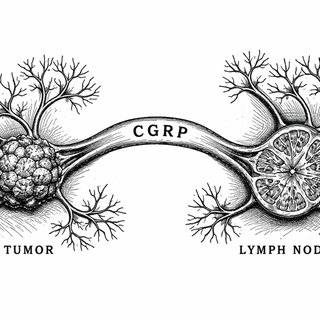
Those nociceptive neurons pick up the signal and do what pain neurons do: they fire. But here's where it gets really devious. That activation doesn't just make you hurt (though it does that too). It propagates through neural circuits to nociceptive neurons innervating your tumor-draining lymph nodes, where those nerve endings start dumping out a neuropeptide called CGRP.
CGRP: The Immunological Off Switch
CGRP, or calcitonin gene-related peptide, is normally associated with migraines. But in your lymph nodes, it acts like a chemical gag order on your immune system. It suppresses a chemokine called CCL5, which pushes macrophages toward an M2-like "stand down" state instead of their tumor-fighting M1 mode. The result? Your T cells lose their edge, and the tumor keeps growing while your immune system sits on its hands.
Think about that for a second. The tumor is under attack, so it hijacks your pain circuits to send a message to a completely different organ - your lymph nodes - telling your immune system to chill out. It's not local immunosuppression. It's systemic. The tumor is running a remote operation.
Zhang et al. demonstrated this across clinical data from head and neck squamous cell carcinoma patients and three separate mouse models of oral cancer. This isn't one lucky finding in one system. The circuit held up everywhere they looked.
Wait, It Gets Better: Your Migraine Pill Might Fight Cancer
Here's the part that should make you sit up. CGRP is the exact target of a class of drugs you may have already heard of: the gepants, used to treat migraines. One of them, rimegepant, is already FDA-approved and sitting in pharmacies right now. In Zhang's preclinical models, rimegepant did double duty - it blocked CGRP signaling at the lymph node, restored T-cell function, and reduced cancer pain. A migraine drug that fights cancer and eases cancer pain simultaneously. You can't make this stuff up.
This isn't the first time nociceptor-CGRP signaling has been caught red-handed in cancer. Balood et al. showed in 2022 that nociceptor neurons drive CD8+ T cell exhaustion in melanoma through CGRP, and that ablating those neurons nearly tripled survival in mice. More recently, Zhi et al. (2025) demonstrated a similar CGRP-RAMP1 axis driving gastric tumor progression. And Darragh et al. (2024) showed CGRP from sensory nerves directly suppresses tumor-infiltrating lymphocytes in head and neck cancers. The evidence is stacking up across cancer types like a very alarming Jenga tower.
Why This Changes the Game
The field of cancer neuroscience is still young, but findings like these are rewriting what we think immunotherapy can target. Right now, checkpoint inhibitors work by removing molecular "brakes" on T cells. But what if those T cells are being suppressed by a neural circuit that no antibody can reach? You'd need to cut the phone line, not just hand the T cells a megaphone.
As Cao highlights in the Trends in Cancer commentary on this work, the ATF4-SLIT2-CGRP axis represents a fundamentally new category of immune evasion - one that operates through the nervous system rather than through the usual suspects of checkpoint ligands and regulatory immune cells. And critically, it's druggable with medications that already exist.
The next questions are the obvious ones: does this circuit operate in other cancer types? Can rimegepant or next-gen CGRP antagonists be combined with existing immunotherapies in clinical trials? And how many other neural circuits are tumors exploiting that we haven't found yet?
Your nervous system and your immune system have been talking behind your back. Turns out, cancer has been listening - and it learned the language.
References:
-
Cao, C. (2026). Nociceptive neuroimmune circuit drives immune evasion. Trends in Cancer, 12(3), 212-214. DOI: 10.1016/j.trecan.2026.01.003 | PMID: 41775602
-
Zhang, Y., Guo, Y., Liu, Z., et al. (2025). Cancer cells co-opt an inter-organ neuroimmune circuit to escape immune surveillance. Cell, 188(24), 6754-6773.e29. DOI: 10.1016/j.cell.2025.09.029 | PMID: 41138728
-
Balood, M., Ahmadi, M., Eichwald, T., et al. (2022). Nociceptor neurons affect cancer immunosurveillance. Nature, 611(7935), 405-412. DOI: 10.1038/s41586-022-05374-w | PMID: 36323780
-
Zhi, X., Wu, F., Qian, J., et al. (2025). Nociceptive neurons promote gastric tumour progression via a CGRP-RAMP1 axis. Nature, 640(8059), 802-810. DOI: 10.1038/s41586-025-08591-1 | PMID: 39972142
-
Darragh, L.B., Martel Matos, A.A., Eskew, K.T., et al. (2024). Sensory nerve release of CGRP increases tumor growth in HNSCC by suppressing TILs. Med, 5(3), 254-270.e8. DOI: 10.1016/j.medj.2024.02.002 | PMID: 38423011
-
Amit, M., Eichwald, T., Roger, A., et al. (2025). Neuro-immune cross-talk in cancer. Nature Reviews Cancer, 25(8), 573-589. DOI: 10.1038/s41568-025-00831-w | PMID: 40523971
Disclaimer: The image accompanying this article is for illustrative purposes only and does not depict actual experimental results, data, or biological mechanisms.