
Picture this: you're a neuron, minding your own business, firing off signals, keeping the body running like a well-oiled machine. Then along comes a tumor cell, sidles up next to you, and starts raiding your fridge, borrowing your car, and - I kid you not - physically ripping out your power generators and walking away with them.
Welcome to the wild world of cancer neuroscience, where tumors have turned out to be the worst roommates your nervous system never asked for.
The Heist Nobody Saw Coming
For decades, we thought of tumors as rogue blobs of cells doing their own chaotic thing. Turns out, they're running a sophisticated con. A new review in Trends in Cancer by Shin and colleagues lays out how cancers don't just grow near nerves - they actively hijack the entire neural playbook, rewiring metabolism in both directions like some kind of biological identity theft scheme (Shin et al., 2025).
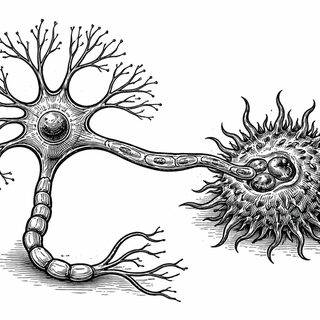
The crosstalk works through three principal modes. First, neural signals reshape how cancer cells burn fuel - tweaking their glycolysis, oxidative phosphorylation, and lipid metabolism. Second, tumors pilfer neuronal nutrients when times get tough. And third - the real showstopper - cancer cells literally steal mitochondria from neurons through tiny tunneling nanotubes, like cellular straws sucking up someone else's smoothie.
The Mitochondria Robbery
This last one deserves its own moment. A landmark 2025 study in Nature showed that breast cancer cells extend microscopic tubes toward nearby neurons and siphon off their mitochondria - those little powerhouses your high school biology teacher wouldn't shut up about (Nature, 2025). The neurons, overachievers that they are, actually ramp up mitochondria production in response, essentially manufacturing power packs for the very cells trying to kill the host.
Here's where the numbers get unsettling. In primary tumors, only about 5% of cancer cells carried stolen neuronal mitochondria. But among cancer cells that had metastasized to the lungs? Twenty-seven percent. The brain? Forty-six percent. The cells best equipped for the journey were the ones packing stolen goods. Think of it as molecular carjacking with a cross-country road trip.
Your Nervous System: Unwitting Accomplice
The metabolic manipulation runs deeper than outright theft. When nerves infiltrate pancreatic tumors, they release glutamate - the brain's main excitatory signal - which cranks up glycolysis in nearby cancer cells. In lung cancer, serotonin flips on the PI3K/Akt/mTOR pathway, a metabolic switch that supercharges the Warburg effect, that bizarre trick where cancer cells gorge on glucose even when oxygen is plentiful (Zhang et al., 2025).
Meanwhile, oral cancer cells under nutrient stress have learned to send out nerve growth factor (NGF) like a distress flare, prompting pain-sensing neurons to secrete CGRP - a neuropeptide that triggers protective autophagy, essentially teaching cancer cells to eat their own components to survive starvation. Your pain neurons are being conned into keeping tumors alive. I've seen some manipulative behavior in my career, but this takes the cake.
Tumors Form Synapses Now, Apparently
If metabolic theft wasn't enough, cancer cells have been caught forming actual synaptic connections with neurons. Brain metastases from breast cancer build "pseudo-tripartite synapses," eavesdropping on neuronal chatter and using glutamate signals to fuel their growth. Glioblastoma cells develop neuron-like properties, plugging themselves into existing brain circuits like uninvited guests on a conference call (Wang et al., 2025). Small-cell lung cancer cells even form functional synapses with neurons, blurring the line between what's a cancer cell and what's pretending to be a neuron (Zhang et al., 2026).
Cutting the Wires
The silver lining in all this audacity? Every new connection is a potential target. Researchers are exploring beta-blockers (yes, the heart medication) to disrupt sympathetic nerve signaling that feeds tumors. NMDA receptor antagonists could block the synaptic eavesdropping. Drugs that prevent nanotube formation might cut off the mitochondria pipeline. Even vagus nerve stimulation - already used for epilepsy and depression - shows promise in rebooting anti-tumor immunity.
The challenge, as always, is surgical precision. Block the wrong neural signal and you're trading cancer therapy for neurological side effects. But the framework is there, and it reframes cancer not as a localized rebellion but as a system-wide hijacking of the body's own communication network.
Your neurons have been drafted into a war they didn't sign up for. The least we can do is give them some backup.
References
-
Shin S, Myoung SY, Cho HJ, Kim S, Lee N, Park SJ. Neural hijacking in cancer metabolism: from nutrients to organelles. Trends in Cancer. 2025. DOI: 10.1016/j.trecan.2025.11.006. PMID: 41318256.
-
Nerve-to-cancer transfer of mitochondria during cancer metastasis. Nature. 2025. DOI: 10.1038/s41586-025-09176-8. PMID: 40562940.
-
Zhang Y, Liao Q, Wen X, Fan J, Yuan T, Tong X, Jia R, Chai P, Fan X. Hijacking of the nervous system in cancer: mechanism and therapeutic targets. Molecular Cancer. 2025. DOI: 10.1186/s12943-025-02246-5. PMCID: PMC11800603.
-
Wang YF, Dong ZK, Jin WL. Hijacking homeostasis: the brain-body neural circuitry in tumor pathogenesis and emerging therapeutic frontiers. Molecular Cancer. 2025. DOI: 10.1186/s12943-025-02396-6. PMCID: PMC12291512.
-
Zhang et al. Cancer neuroscience: signaling pathways and new therapeutic strategies for cancer. Signal Transduction and Targeted Therapy. 2026;11:66. DOI: 10.1038/s41392-025-02364-y. PMCID: PMC12926231.
Disclaimer: The image accompanying this article is for illustrative purposes only and does not depict actual experimental results, data, or biological mechanisms.