
If you're a neuron in the hippocampus, you have two choices: keep quietly filing away memories like the diligent librarian you are, or moonlight as an unwitting accomplice in one of biology's most elaborate heists. Because it turns out, cancer doesn't just grow - it networks. And your nervous system? It's been drafted as the telecommunications department.
The Body's Worst Group Chat
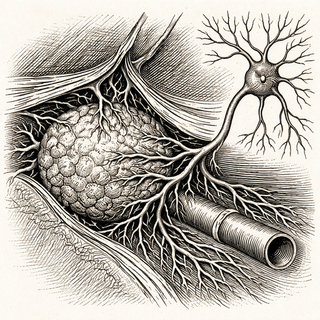
Here's something that would've gotten you laughed out of a cancer biology conference fifteen years ago: tumors are innervated. As in, nerve fibers physically grow into tumors the way roots creep toward a water pipe. Sympathetic nerves, parasympathetic nerves, sensory neurons - they're all showing up uninvited, and cancer is putting every single one of them to work.
A sweeping new review in Cell Metabolism by Zhang et al. (2026) lays out just how deep this rabbit hole goes. The paper introduces the concept of "neuroimmunometabolic co-evolution" - a term that sounds like it was generated by smashing three textbooks together, but actually captures something elegant: your nervous system, immune system, and metabolism aren't just overlapping in tumors. They're co-evolving in real time, each one reshaping the others to create a environment where cancer thrives (Zhang et al., 2026).
The Micro and the Macro (No, Not Your Diet)
The review splits this story into two theaters of operation. At the tumor microenvironment level - the immediate neighborhood around cancer cells - peripheral nerves are pulling strings like a puppet master with too many hands. Sympathetic nerves dump norepinephrine into the mix, which slaps beta-adrenergic receptors on immune cells and basically tells your T cells to take a coffee break. Your natural killer cells? Also benched. Meanwhile, immunosuppressive cells like regulatory T cells and myeloid-derived suppressor cells get promoted to management (Amit et al., 2025).
Parasympathetic nerves play a weirder game. Acetylcholine - the same neurotransmitter that helps you remember where you parked - shows up in tumors with a dual personality. Through nicotinic receptors, it dampens inflammation. Through muscarinic receptors, it can sometimes fight the tumor. It's the neurochemical equivalent of that coworker who's helpful on Mondays and chaotic on Fridays.
Then there's the tumor macroenvironment - the whole-body picture. This is where it gets properly unsettling. Cancer cells don't just mess with their local wiring; they send signals all the way up to the brain, hijacking the hypothalamic-pituitary-adrenal axis to flood your system with stress hormones. Cortisol then suppresses anti-tumor immunity system-wide. Your tumor is essentially calling your brain's HR department and getting your immune system written up for "excessive enthusiasm" (Mancusi & Monje, 2023).
Sensory Neurons: The Double Agents
Sensory nerves deserve their own subplot. These are the neurons that normally tell your brain, "Hey, that's hot" or "Please stop stubbing that toe." In tumors, they release neuropeptides like CGRP and substance P. Substance P is pro-inflammatory - the loudmouth that riles up your macrophages. But CGRP? It quietly exhausts your CD8+ T cells, the very assassins your immune system sends to kill cancer cells. It's like sending your best soldiers into battle and then slipping them sleeping pills.
Recent work has shown that blocking CGRP can actually re-energize exhausted T cells, which opens a genuinely exciting therapeutic door (Winkler et al., 2023).
So What Do We Do About It?
The most mind-bending part of Zhang et al.'s review is the therapeutic angle. Beta-blockers - yes, the blood pressure pills your uncle takes - might enhance immunotherapy by blocking sympathetic nerve signaling in tumors. SSRIs, normally prescribed for depression, can boost CD8+ T cell function. Even GABA receptor blockers show promise when combined with checkpoint inhibitors.
We're essentially raiding the medicine cabinet for cancer drugs, and it's working. Not because these drugs were designed for oncology, but because cancer has been exploiting the same neural pathways these drugs already target (Hanahan & Monje, 2023).
The Bottom Line
Cancer isn't a loner. It's a social engineer that recruits your own nervous system, rewires your immune responses, and reprograms your metabolism - all while your brain thinks everything is fine. Understanding this three-way conversation between nerves, immunity, and metabolism isn't just academically cool. It's the foundation for an entirely new class of cancer therapies that might already be sitting in your pharmacy.
Your nervous system built a communication network over millions of years of evolution. Cancer just figured out the password.
References
-
Zhang, Y., Zhuang, W., Zhu, H., Meng, F., Chen, M., Guo, Y., Fan, J., Sun, Y., & Ji, T. (2026). Neuroimmunometabolic co-evolution in the tumor micro- and macroenvironment. Cell Metabolism, 38(4), 655-672. DOI: 10.1016/j.cmet.2026.02.001 | PubMed: 41763196
-
Mancusi, R., & Monje, M. (2023). The neuroscience of cancer. Nature, 618(7965), 467-479. DOI: 10.1038/s41586-023-05968-y | PMCID: PMC11146751
-
Hanahan, D., & Monje, M. (2023). Cancer hallmarks intersect with neuroscience in the tumor microenvironment. Cancer Cell, 41(3), 573-580. DOI: 10.1016/j.ccell.2023.02.012 | PubMed: 36917953
-
Winkler, F., Venkatesh, H. S., Amit, M., Batchelor, T., Demir, I. E., Deneen, B., ... & Monje, M. (2023). Cancer neuroscience: State of the field, emerging directions. Cell, 186(8), 1689-1707. DOI: 10.1016/j.cell.2023.02.002 | PubMed: 37059069
-
Amit, M., Eichwald, T., Roger, A., Anderson, J., Chang, A., Vermeer, P. D., Dixon, K. O., Scheff, N. N., & Talbot, S. (2025). Neuro-immune cross-talk in cancer. Nature Reviews Cancer, 25(8), 573-589. DOI: 10.1038/s41568-025-00831-w | PubMed: 40523971
Disclaimer: The image accompanying this article is for illustrative purposes only and does not depict actual experimental results, data, or biological mechanisms.