
Let's play a game. Imagine you could freeze your brain in the exact instant it learns something annoying, like that the "harmless little shortcut" home actually dumps you into twelve minutes of traffic and one emotional support stoplight. Now imagine you could dust that moment for molecular fingerprints. Not vague vibes. Actual proteins. That is basically what a new C. elegans study tried to do, except the brain belongs to a worm the size of a comma, and the scientists used a protein-labeling trick called TurboID instead of a detective in a trench coat (Rahmani et al., 2026).
That is a surprisingly big deal. Learning is one of biology's favorite magic tricks: an animal meets the world, the world bonks back, and somehow a nervous system changes future behavior. We know a lot about genes and neurons involved in memory, but catching the exact proteins present during learning is harder than it sounds. Brains are busy. Cells are messy. Neurons do not pause politely for your proteomics pipeline.
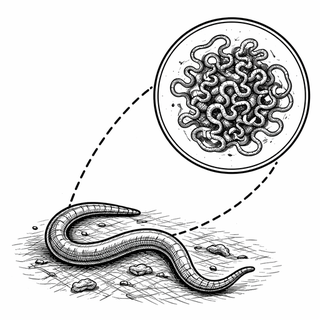
Tiny Worm, Big Drama
The animal here is Caenorhabditis elegans, a transparent soil worm about 1 millimeter long that has become neuroscience's favorite minimalist set. It has only about 300 neurons, but it can still learn associations between cues and outcomes. In this case, the cue was salt. Worms normally like salt when it predicts dinner. Train them under different conditions, and that preference can flip. Which is, honestly, relatable. Most of us also stop loving things once they become emotionally complicated.
Associative learning just means linking one thing to another. Bell means food. Smell means trouble. Salt means lunch, or maybe not lunch, depending on how the day is going. In worms, these little behavioral shifts give researchers a clean way to ask a very big question: what changes inside neurons while an animal is learning?
TurboID: The Molecular Glitter Bomb
Rahmani and colleagues used TurboID, a proximity-labeling enzyme that biotin-tags nearby proteins. Think of it as tossing microscopic glitter into the nervous system. Anything close enough gets marked, and later you can fish those proteins out and identify them by mass spectrometry. Subtle? No. Useful? Extremely.
The team expressed TurboID across the worm nervous system during a salt associative learning task, then compared trained worms with controls. After subtracting background labeling and control proteins, they found 706 proteins unique to the trained animals' neuronal proteome during learning. That is not one smoking gun. That is an entire suspicious group chat (Rahmani et al., 2026).
Better yet, they did not stop at a giant list and call it character building. They tested candidate hits and validated several proteins that actually matter for appetitive salt learning, including cholinergic receptor subunits ACC-1, ACC-3, and LGC-46, the protein kinase A regulator KIN-2, and a putative arginine kinase called F46H5.3. F46H5.3 also altered aversive salt learning, which hints it may help with memory encoding more broadly, not just one oddly specific worm mood.
Why This Is More Interesting Than "Worm Paper Number 9,000"
One of the nicest things about this paper is that it dodges the usual candidate-gene tunnel vision. Instead of starting with "we have a favorite molecule and would like reality to agree," the researchers took a more open-ended snapshot of what neurons were actually stocked with during training. That matters because memory is rarely the work of one heroic molecule in a cape. It is more like weather. Signals move in, pressure shifts, conditions change, and then suddenly the whole landscape behaves differently.
That broader view fits with recent worm work showing memory is distributed across circuits, not tucked neatly into a single neuron like a spare key under the mat. In 2023, researchers reported that associative memories in C. elegans are represented across multiple sensory neurons and interneurons rather than one tidy storage locker (Pritz et al., 2023). Another 2023 study showed salt learning can even reshape circuit anatomy through asymmetric insulin signaling, which is a sentence that sounds fake until you remember biology has no editor (Tang et al., 2023). And in 2024, work in Nature Communications suggested some worm associative memories can leave traces that echo into the next generation, because apparently even worms can hand down baggage (Deshe et al., 2023).
So What?
If this approach keeps working, it could help researchers build a much more complete map from experience to molecule to circuit to behavior. That matters well beyond worms. Many pathways involved in learning are conserved across animals, and the whole point of using a small nervous system is that it lets you catch principles before the vertebrate brain arrives with forty extra plotlines and a budget crisis.
There is also a practical angle. Proteomic snapshots could eventually help identify overlooked drug targets for memory disorders or reveal why some learning processes fail with aging or disease. Not because a worm is secretly a tiny person in a tube sock, but because evolution loves reusing decent ideas.
There are limits, of course. TurboID labels nearby proteins, not just the ones doing the important work, so every hit still needs validation. The study also captures a training window, not the full saga of encoding, consolidation, retrieval, and forgetting. In other words, this is not the whole movie. It is a very good freeze-frame.
Still, it is a strong one. The paper shows that if you want to understand learning, you do not always need to start by guessing which molecule is the star. Sometimes you let the scene unfold, flick on the molecular blacklight, and see who was actually in the room when the brain changed its mind.
References
Rahmani A, McMillen A, Allen E, Ansaar R, Green R, Johnson ME, Poljak A, Chew YL. Identifying regulators of associative learning using a protein-labelling approach in Caenorhabditis elegans. eLife. 2026. DOI: 10.7554/eLife.108438. PubMed: 41603369.
Pritz C, Itskovits E, Bokman E, Ruach R, Gritsenko V, Nelken T, Menasherof M, Azulay A, Zaslaver A. Principles for coding associative memories in a compact neural network. eLife. 2023;12:e74434. DOI: 10.7554/eLife.74434. PMCID: PMC10159626.
Tang LTH, Lee GA, Cook SJ, Ho J, Potter CC, Bülow HE. Anatomical restructuring of a lateralized neural circuit during associative learning by asymmetric insulin signaling. Current Biology. 2023;33(18):3835-3850.e6. DOI: 10.1016/j.cub.2023.07.041.
Deshe N, Eliezer Y, Hoch L, Itskovits E, Bokman E, Ben-Ezra S, Zaslaver A. Inheritance of associative memories and acquired cellular changes in C. elegans. Nature Communications. 2023;14(1):4232. DOI: 10.1038/s41467-023-39804-8. PMCID: PMC10349803.
Ripoll-Sánchez L, Watteyne J, Sun H, Fernandez R, Taylor SR, Weinreb A, Bentley BL, Hammarlund M, Miller DM 3rd, Hobert O, Beets I, Vértes PE, Schafer WR. The neuropeptidergic connectome of C. elegans. Neuron. 2023;111(22):3570-3589.e5. DOI: 10.1016/j.neuron.2023.09.043. PubMed: 37935195.
Lin A, Qin S, Casademunt H, Wu M, Hung W, Cain G, Tan NZ, Valenzuela R, Lesanpezeshki L, Venkatachalam V, Pehlevan C, Zhen M, Samuel ADT. Functional imaging and quantification of multineuronal olfactory responses in C. elegans. Science Advances. 2023;9(9):eade1249. DOI: 10.1126/sciadv.ade1249.
Disclaimer: The image accompanying this article is for illustrative purposes only and does not depict actual experimental results, data, or biological mechanisms.