
Forget everything you know about neuromyelitis optica, or NMO, because the usual version of the story is a little too tidy. The classic plot says the immune system makes antibodies against aquaporin-4, a water-channel protein on astrocytes. Antibodies show up, astrocytes get hit, myelin falls apart, and everyone has a bad time. Accurate enough, sure, but this new paper argues that the astrocytes are not just passive victims. They are injured, annoyed, and then fully capable of making the whole situation worse, like a smoke alarm that also throws matches. (Xu et al., 2025)
The Support Staff Were Absolutely Not Supporting
NMO, now usually discussed under the broader label NMOSD, is an autoimmune disease that often attacks the optic nerves and spinal cord. In many patients, antibodies target aquaporin-4 on astrocytes. That matters because astrocytes help keep the neighborhood stable: they manage water balance, support the blood-brain barrier, and help neurons and myelin-producing cells do their jobs. (Wikipedia: Neuromyelitis optica spectrum disorder, Wikipedia: Astrocyte, Wikipedia: Aquaporin-4)
The mystery has been what happens between "antibody hits astrocyte" and "myelin gets wrecked." That gap matters. If you know the middle steps, you know where to jam a wrench into the machinery.
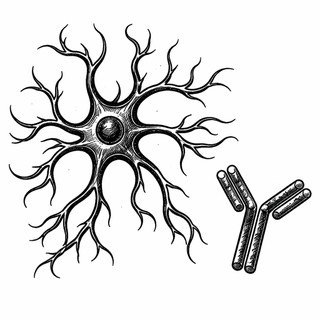
This study points hard at CHI3L1, also called YKL-40, a protein already known as a biomarker in several inflammatory brain conditions. The authors used mouse and slice-culture models of NMO, plus astrocyte-specific knockout mice, to show that CHI3L1 does not just tag along as a bystander. It actively worsens demyelination and inflammation. In plain English: the protein is not merely smoke. It is helping feed the fire. (Xu et al., 2025)
A Very Rude Cellular Feedback Loop
Here is the mechanistic chain, minus the usual journal fog machine.
First, NMO-linked AQP4 antibodies hit astrocytes. That activates STAT3, a transcription factor that acts a bit like a panicky middle manager sending all-caps emails. STAT3 then drives production and secretion of CHI3L1. Once outside the cell, CHI3L1 binds back onto astrocytes through RAGE, the receptor for advanced glycation end products, which is somehow both a real molecule and the name of an excellent metal band. That turns on NF-kB, one of the immune system's favorite inflammation switches. The result is reactive gliosis, more inflammatory signaling, more complement activity, and worse myelin damage. (Xu et al., 2025, Wikipedia: STAT3, Wikipedia: RAGE)
The especially interesting bit is that this is astrocyte-intrinsic. The astrocytes are not simply being mugged by the immune system. They are helping create a self-reinforcing inflammatory loop after the first hit lands. Plot twist: the "support cells" were running their own chaotic side quest the whole time.
The team then blocked parts of this pathway. Removing CHI3L1 specifically from astrocytes helped rescue demyelination. Blocking RAGE or inhibiting STAT3 also reduced pathology, and the STAT3 inhibitor WP1066 improved motor behavior in the mouse model. That does not mean a treatment is around the corner. Mouse papers are the scientific equivalent of a movie trailer: exciting, suggestive, and not the full feature. Still, it is a meaningful clue about where the damage gets amplified. (Xu et al., 2025)
Why This Lands Right Now
Recent NMOSD literature has focused heavily on diagnosis, relapse prevention, and biomarker monitoring. A 2024 Nature Reviews Neurology review lays out how the field is evolving across AQP4-positive NMOSD, MOGAD, and seronegative cases. A 2024 update from the Neuromyelitis Optica Study Group summarized the modern treatment era, where AQP4-positive disease already has multiple approved preventive immunotherapies. And a 2025 JAMA Neurology study showed that blood biomarkers such as serum GFAP and neurofilament light can help track disease activity after attacks. Meanwhile, long-term trial data in The Lancet Neurology continue to refine how well targeted biologics hold relapses down. (Uzawa et al., 2024, Jarius et al., 2024, Kim et al., 2025, Cree et al., 2024)
That is the backdrop that makes this paper interesting. Current treatments are getting better at stopping future immune attacks, but this study asks a nastier question: once the attack has started, what local brain circuitry turns injury into a pileup? CHI3L1 looks like one of those amplifiers.
If this pathway holds up in human tissue and clinical studies, the real-world payoff could be sharper therapies that do more than just calm the immune system broadly. You could imagine targeting the astrocyte feedback loop itself, potentially reducing inflammation and protecting myelin before the spinal cord and optic nerves pay the bill. The brain, as usual, has produced a system of absurd elegance in which a water-channel-targeting antibody sets off a glial gossip cascade that ends with stripped insulation on nerve fibers. Beautiful, terrible, and very on brand for biology.
References
Xu H, Jiang W, Xu L, et al. Astrocyte-intrinsic signaling of chitinase-like protein CHI3L1 drives inflammation and amplifies demyelination in neuromyelitis optica. J Clin Invest. 2025. DOI: https://doi.org/10.1172/JCI195506
Uzawa A, Oertel FC, Mori M, Paul F, Kuwabara S. NMOSD and MOGAD: an evolving disease spectrum. Nat Rev Neurol. 2024;20(10):602-619. DOI: https://doi.org/10.1038/s41582-024-01014-1
Jarius S, Aktas O, Ayzenberg I, et al. Update on the diagnosis and treatment of neuromyelitis optica spectrum disorders (NMOSD) - revised recommendations of the Neuromyelitis Optica Study Group (NEMOS). Part II: Attack therapy and long-term management. J Neurol. 2024;271(1):141-176. PMCID: https://pmc.ncbi.nlm.nih.gov/articles/PMC10770020/
Kim S-H, et al. Blood-Based Biomarkers for Identifying Disease Activity in AQP4-IgG-Positive Neuromyelitis Optica Spectrum Disorder. JAMA Neurol. 2025;82(2):168-175. DOI: https://doi.org/10.1001/jamaneurol.2024.4400
Cree BAC, Kim HJ, Weinshenker BG, et al. Safety and efficacy of inebilizumab for the treatment of neuromyelitis optica spectrum disorder: end-of-study results from the open-label period of the N-MOmentum trial. Lancet Neurol. 2024;23(6):588-602. DOI: https://doi.org/10.1016/S1474-4422(24)00077-2
Rodin RE, Chitnis T. Soluble biomarkers for Neuromyelitis Optica Spectrum Disorders: a mini review. Front Neurol. 2024;15:1415535. PMCID: https://pmc.ncbi.nlm.nih.gov/articles/PMC11137173/
Jiang W, Zhu F, Xu H, et al. CHI3L1 signaling impairs hippocampal neurogenesis and cognitive function in autoimmune-mediated neuroinflammation. Sci Adv. 2023;9(39):eadg8148. DOI: https://doi.org/10.1126/sciadv.adg8148
Disclaimer: The image accompanying this article is for illustrative purposes only and does not depict actual experimental results, data, or biological mechanisms.