
Before this kind of work, epilepsy researchers often had two bad options: test drugs in healthy animals after forcing an artificial seizure, or wait around in chronically epileptic animals for the "real" seizures to show up like a flaky friend who says "five minutes away" and then arrives next Thursday. After this study, there is a third option - trigger a seizure on demand in an already epileptic mouse brain, which sounds like science fiction and terrible customer service at the same time.
The old problem: realism versus speed
This paper, by Chen and colleagues in eLife, tackles a classic epilepsy-research headache: the best screening models are often either fast but fake-ish, or realistic but painfully slow. Acute seizure models are convenient, but they happen in brains that were not already remodeled by epilepsy. Chronic models are more realistic, but spontaneous seizures can be sparse, so researchers wind up waiting for enough events to test anything properly [1].
That matters because epilepsy is not just "brain electricity, but louder." In chronic epilepsy, circuits have been structurally and chemically altered. The hippocampus - a region heavily involved in temporal lobe epilepsy - can become a neural neighborhood where too many smoke alarms are wired to too many espresso machines [6][7].
Light, mice, action
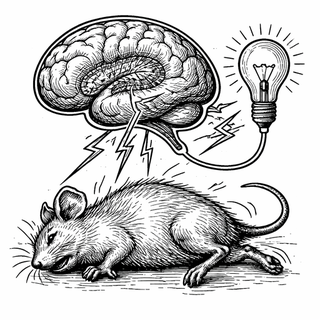
The team built what they call the Opto-IHK model. In plain English, they used mice with chronic epilepsy created by intrahippocampal kainic acid, then used optogenetics to briefly activate principal neurons in the CA1 region of the hippocampus with blue light. Optogenetics is one of neuroscience's stranger superpowers - give selected cells light-sensitive proteins, shine light, and boss them around with suspicious precision [1][6].
These were not healthy mice pretending to have a seizure for a lab demo. These were mice with an already diseased epileptic circuit. When the researchers nudged that circuit, they could reliably provoke stereotyped behavioral seizures on demand. Better yet, those induced seizures resembled the animals' spontaneous seizures in EEG feature space, which suggests this was not just a flashy lab trick. It was tapping into something the epileptic brain was already primed to do [1].
There was also a useful contrast with naive animals. Early on, the same stimulation did not produce the same behavioral seizure pattern in healthy brains. So the light is not the whole story. It is pressing a doorbell, but the epileptic brain is the one deciding to throw a full backyard wrestling event.
Why this is actually a big deal
The practical win is speed. If you can trigger seizures when you need them, you can test anti-seizure drugs or devices much more efficiently. That matters in a field where roughly 30% of patients still do not get adequate control from current antiseizure medications, and where researchers want treatments that are smarter than "turn the whole brain down and hope for the best" [2][3][4].
Chen and colleagues also showed that two familiar antiseizure drugs - levetiracetam and diazepam - reduced the induced seizures in this model [1]. That gives the setup credibility as a screening tool. It is the experimental equivalent of checking whether your new smoke detector can, in fact, detect smoke and not just become decorative wall art.
This also connects neatly to the broader push toward closed-loop therapies. Devices like responsive neurostimulation already act a bit like a brain pacemaker - they listen for suspicious activity and respond when needed rather than blasting stimulation all day [8]. A model that lets researchers trigger seizures at predictable times could make it much easier to test timing, targets, and stimulation settings.
The fine print, because the brain loves fine print
This is still a mouse study. Nobody should read this and assume neurologists are about to start flipping seizure switches in people next month. Chronic epilepsy in humans is messy, diverse, and rude about fitting neatly into one experimental framework. Different epilepsy syndromes involve different circuits, causes, and treatment responses [2][4].
Still, that is exactly why this paper is interesting. It tries to split the difference between speed and biological realism instead of settling for one and shrugging about the other. If future studies show that this approach works across more therapies and more epilepsy models, it could help researchers sort promising treatments from duds much faster - not just drugs, but stimulation strategies and other precision treatments now moving through the pipeline [3][4][8].
For now, the headline is simple: scientists found a way to make an epileptic mouse brain reveal its bad habits on schedule. In neuroscience terms, that is extremely useful. In normal-person terms, it is like finally getting the world's most chaotic coworker to misbehave during business hours, where everyone can take notes.
References
- Chen Y, Litt B, Vitale F, Takano H. On-demand seizures facilitate rapid screening of therapeutics for epilepsy. eLife. 2024;13:RP101859. DOI: https://doi.org/10.7554/eLife.101859
- Klein P, Kaminski RM, Koepp M, Löscher W. New epilepsy therapies in development. Nature Reviews Drug Discovery. 2024;23(9):682-708. DOI: https://doi.org/10.1038/s41573-024-00981-w. PubMed: https://pubmed.ncbi.nlm.nih.gov/39039153/
- Ravizza T, Scheper M, Di Sapia R, et al. mTOR and neuroinflammation in epilepsy: implications for disease progression and treatment. Nature Reviews Neuroscience. 2024;25:334-350. DOI: https://doi.org/10.1038/s41583-024-00805-1
- Riley VA, Danzer SC. Preclinical testing strategies for epilepsy therapy development. ILAR Journal. 2025. DOI: https://doi.org/10.1177/15357597241292197. PubMed: https://pubmed.ncbi.nlm.nih.gov/39539399/
- Kalilani L, Sun X, Pelgrims B, Noack-Rink M, Villanueva V. The epidemiology of drug-resistant epilepsy: a systematic review and meta-analysis. Neurology. 2021;96(17):e805-e817. DOI: https://doi.org/10.1212/WNL.0000000000011839. PubMed: https://pubmed.ncbi.nlm.nih.gov/33722992/
- Optogenetics - Wikipedia. https://en.wikipedia.org/wiki/Optogenetics
- Hippocampus - Wikipedia. https://en.wikipedia.org/wiki/Hippocampus
- What is Responsive Neurostimulation? Epilepsy Foundation. https://www.epilepsy.com/node/2456481
Disclaimer: The image accompanying this article is for illustrative purposes only and does not depict actual experimental results, data, or biological mechanisms.