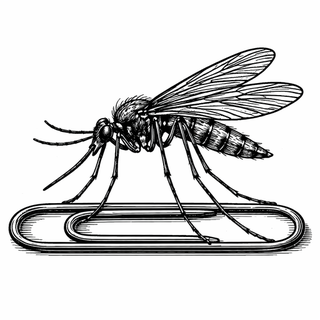
5.6 billion people at risk plus one mosquito the size of a paper clip equals a wildly unfair math problem. Ladies and gentlemen of the readership, the evidence is in: Aedes aegypti is not just a daytime biter with bad manners. According to a 2025 Cell Reports paper, after a blood meal this mosquito reprograms its schedule, flips into a nighttime egg-laying mission, and does it with help from its internal clock [1].
Female Aedes aegypti need blood to make eggs. That part was already on the public record. What this paper adds is the timing twist. After feeding, the females go quiet while digesting blood and developing eggs. Then, around day 3, they snap into a hyperactive state - nearly double their usual activity in some assays [1].
That would already be odd for a species famous for biting during the day. But the really juicy evidence is that these egg-loaded females start doing key reproductive chores at night. They seek humidity, hunt for places to lay eggs, and lay them after dark [1]. In other words, the mosquito that spent the day acting like a diurnal menace suddenly starts working the night shift like a raccoon with a reproductive deadline.
Why the nocturnal pivot? The authors argue that dusk and nighttime conditions protect eggs from drying out and UV damage. Fresh mosquito eggs are vulnerable little drama queens. Lower temperatures and higher humidity give them a better shot at survival [1].
Exhibit B: the body clock runs the operation
This is where the neuroscience gets deliciously weird. The study points to a core circadian clock gene called cycle as a key piece of the scheme. When the researchers looked at mosquitoes lacking a working cycle gene, the whole timing program started to wobble. These mutants did not show the same nocturnal hyperactivity, and their humidity-seeking and egg-laying timing fell apart [1].
That matters because behavior is not just about whether an animal can do something. It is about whether it does the right thing at the right time. Recent work also shows that circadian systems tune host-seeking behavior, including how persistently Aedes aegypti responds to carbon dioxide, one of the biggest "there is a human nearby" clues in the business [2]. If your brain is a planner, the mosquito brain is a planner with a bloodstained calendar.
The broader neuroscience angle is that mosquitoes are becoming a good model for studying how internal state changes perception and action [3].
Cross-examination: why should anyone outside mosquito Twitter care?
Because this is not a cute quirk. Aedes aegypti is a major vector for dengue, Zika, chikungunya, and yellow fever. The World Health Organization says dengue alone puts about 5.6 billion people at risk, and from January through July 2025 more than 4 million cases were reported to WHO from 97 countries [4]. CDC has also warned that dengue activity remained unusually high in 2024 and 2025, raising the risk of travel-associated and local transmission in places where Aedes mosquitoes are present [5].
So when scientists figure out how mosquitoes switch from "find a person" mode to "find a nursery" mode, that is not trivia. That is a map of vulnerabilities. If this timing program can be disrupted, you may not need to kill every mosquito. You may only need to make her fail at the most important item on her to-do list: laying viable eggs in a good spot.
That idea fits with other recent work showing that mosquito behavior is highly state-dependent. A 2022 review in Trends in Parasitology lays out how human-seeking depends on coordinated sensory cues like carbon dioxide, heat, and skin odor [6]. A 2022 eLife paper showed that host-seeking can persist as a long-lasting internal state after a brief cue [7]. The insect is not a wind-up toy. It is making context-sensitive decisions with a brain roughly the size of a typo.
Closing argument
The most interesting part of this paper is not that mosquitoes lay eggs. We knew that. It is that reproduction appears to depend on a temporary behavioral rewrite - a clock-controlled switch that tells a normally day-active insect to become a nighttime hunter for damp, safe real estate [1]. When that switch breaks, the mosquito lays fewer eggs in the right places and wastes more effort on bad ones.
That gives mosquito control researchers a sharper question to prosecute: not just how to stop bites, but how to sabotage the sequence of decisions that turns one blood meal into the next generation. For an animal that has spent centuries making humans look unprepared, that is a satisfying line of cross-examination.
Disclaimer: The image accompanying this article is for illustrative purposes only and does not depict actual experimental results, data, or biological mechanisms.
References
-
Dong L, Bradford EF, Barnett JM, Duvall LB. Post-biting behavioral reprogramming underlies reproductive efficiency in Aedes aegypti mosquitoes. Cell Reports. 2025;44(12):116663. DOI: 10.1016/j.celrep.2025.116663. PubMed: 41379618.
-
Dong L, Hormigo R, Barnett JM, Greppi C, Duvall LB. Time-of-day modulation in mosquito response persistence to carbon dioxide is controlled by Pigment-Dispersing Factor. Proceedings of the National Academy of Sciences USA. 2025;122(46):e2520826122. DOI: 10.1073/pnas.2520826122. PMCID: PMC12646304.
-
Weiss L, McBride CS. Mosquitoes as a model for understanding the neural basis of natural behaviors. Current Opinion in Neurobiology. 2024;87:102897. DOI: 10.1016/j.conb.2024.102897. PubMed: 39002351.
-
World Health Organization. Dengue and severe dengue. Updated 2025. https://www.who.int/news-room/fact-sheets/detail/dengue-and-severe-dengue
-
Centers for Disease Control and Prevention. Ongoing Risk of Dengue Virus Infections and Updated Testing Recommendations in the United States. Health Alert Network HAN00523. August 2024. https://www.cdc.gov/han/php/notices/han00523.html
-
Coutinho-Abreu IV, Guimarães de Lima M, Gillette WK, Ray A. Human attractive cues and mosquito host-seeking behavior. Trends in Parasitology. 2022;38(3):246-264. DOI: 10.1016/j.pt.2021.09.012.
-
Sorrells TR, Pandey A, Rosas-Villegas A, Vosshall LB. A persistent behavioral state enables sustained predation of humans by mosquitoes. eLife. 2022;11:e76663. DOI: 10.7554/eLife.76663. PMCID: PMC8985357.