
Legs need brakes. I have been thinking about how smooth movement depends not just on cells shouting "go, go, go," but on other cells stepping in like a very competent bouncer before the dance move becomes a face-plant.
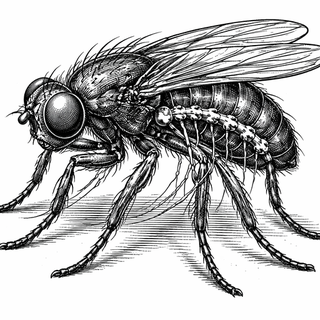
That is the basic charm of a new eLife paper on fruit fly grooming: the nervous system does not control leg motion with acceleration alone. It also uses inhibition - neurons whose whole job is to tell other neurons to pipe down - to shape, alternate, and even rhythmically generate leg movements in Drosophila (Syed et al., 2026). The brain, apparently, is not just a gas pedal. It is also a brake pedal and occasionally a backseat driver.
The Tiny Choreographers in the Nerve Cord
The study zooms in on the fly ventral nerve cord, the insect version of a spinal movement hub. The authors focused on about 120 GABAergic inhibitory neurons from two lineages, 13A and 13B. Using connectomics, they mapped how these cells wire onto motor neurons that control flexion and extension at leg joints. Then they tested those ideas in real flies with optogenetics and high-resolution tracking during grooming.
Why grooming? Because it is repeatable, structured, and frankly a little obsessive. A dusty fly performs neat foreleg sweeps over the head and body like a tiny cat with a productivity app. That makes it a good system for asking how nervous systems build coordinated action from smaller motor pieces.
The punchline is that these inhibitory neurons do more than provide generic "less activity." Some suppress one set of motor neurons while freeing their antagonists. Some help create alternation between flexors and extensors. And some appear capable of helping generate the rhythm itself. People often treat inhibition as stage crew while excitation gets cast as the star. Here, inhibition is clearly in the spotlight.
Not Just Stop Signs - More Like Conductors
One reason this paper lands so well is that it pushes against the simple cartoon version of motor control. In the cartoon, excitatory circuits assemble the movement and inhibitory circuits just keep things from exploding. Real biology, because it enjoys being annoying, is subtler.
Syed and colleagues show inhibitory motifs that can organize muscle synergies, switch between opposing muscle groups, and support repeated rhythmic actions. In other words, inhibitory neurons are not merely veto buttons. They look more like conductors shaping timing and turn-taking inside the motor orchestra.
This idea fits with a broader wave of work on fly motor systems. Two 2024 connectomics papers mapped the ventral nerve cord and premotor architecture at remarkable detail, giving researchers wiring diagrams for circuits that link neurons to muscles (Azevedo et al., 2024; Lesser et al., 2024). The field has gone from "the fly moves somehow" to "we can point at the circuit and ask which wire is being weird."
Why You Should Care, Even If You Are Not a Fly
The bigger point is not grooming etiquette for insects. The architecture of antagonistic motor control - flexors versus extensors, one muscle group contracting while the other relaxes - is shared across animals. The paper argues that inhibitory motifs in flies resemble solutions seen in vertebrate locomotor systems, where inhibition helps produce alternating rhythms and coordinated movement (Leiras et al., 2022).
That does not mean a fly grooming paper immediately cures gait disorders. Science is not a movie montage. But if these principles hold up, they could sharpen how we think about spinal motor circuits, neuroprosthetics, and rehabilitation after injury. When movement fails, the problem may not be that the "go" signal is missing. Sometimes the pattern collapses because the braking, gating, or alternation logic has gone sideways.
There is also a practical challenge this work helps address: movement is built from many overlapping parts at once. Sensory feedback, descending commands, local premotor neurons, and muscle biomechanics all pile into the same dance. Untangling that mess is hard in any animal. Fly systems help because they are genetically tractable, stereotyped, and increasingly mapped neuron by neuron.
The Messy, Honest Part
There are still limits. This study focuses on grooming, not the full catalog of leg behaviors. Connectomes show who can talk to whom, not always what they say in every behavioral moment. And computational models can reproduce major features without being the final truth.
Still, the result is a strong one: inhibition is not just there to prevent chaos. It helps write the movement itself. Your nervous system, and the fly's, seems to rely on carefully arranged silence as much as activity. Every good sketch needs empty space. Every decent conversation needs someone who knows when to stop talking. Neurons, alas, are still working on that last part.
References
- Syed DS, Ravbar P, Simpson JH. Inhibitory circuits control leg movements during Drosophila grooming. eLife. 2026;14:RP106446. DOI: https://doi.org/10.7554/eLife.106446. PMCID: https://pmc.ncbi.nlm.nih.gov/articles/PMC12844901/
- Azevedo AW, Lesser E, Phelps JS, et al. Connectomic reconstruction of a female Drosophila ventral nerve cord. Nature. 2024;631:360-368. DOI: https://doi.org/10.1038/s41586-024-07389-x
- Lesser E, Azevedo AW, Phelps JS, et al. Synaptic architecture of leg and wing premotor control networks in Drosophila. Nature. 2024;631:369-377. DOI: https://doi.org/10.1038/s41586-024-07600-z. PMCID: https://pmc.ncbi.nlm.nih.gov/articles/PMC11356479/
- Agrawal S, Dickinson ES, Sustar A, et al. Central processing of leg proprioception in Drosophila. eLife. 2020;9:e60299. DOI: https://doi.org/10.7554/eLife.60299
- Azevedo AW, Dickinson ES, Gurung P, et al. A size principle for recruitment of Drosophila leg motor neurons. eLife. 2020;9:e56754. DOI: https://doi.org/10.7554/eLife.56754
- Leiras R, Cregg JM, Kiehn O. Brainstem circuits for locomotion. Annual Review of Neuroscience. 2022;45:63-85. DOI: https://doi.org/10.1146/annurev-neuro-082321-025137
Disclaimer: The image accompanying this article is for illustrative purposes only and does not depict actual experimental results, data, or biological mechanisms.