
You're using this right now - or at least the part of your nervous system that quietly translates the room's background racket into useful information while you pretend to focus. Every rustle, fan hum, and suspicious floorboard creak depends on microscopic hardware in your inner ear. And one of its star employees is a protein called prestin, which sounds like a law firm but behaves more like a nanoscopic piston.
The ear's least chill overachiever
Prestin lives in outer hair cells, the long skinny cells in the cochlea that act like built-in amplifiers. Sound bends hair bundles, voltage changes across the cell membrane, and prestin responds by making the cell rapidly change shape. Not "eventually." Fast enough to help boost the sound wave in real time. Mammalian hearing is, in part, a story about weaponized cell fidgeting.
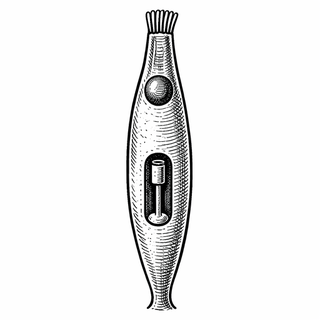
The weird part is where prestin came from. It belongs to the SLC26 family, a group mostly known for transporting ions across membranes. In birds, reptiles, and fish, prestin-like proteins behave much more like regular transporters. In mammals, prestin basically quit that job and became a motor. Same protein family. Very different attitude.
That is the question behind a new paper by Fuentes-Ugarte and colleagues: how does evolution turn an ion shuttle into a voltage-driven shape-changing machine without blowing up the whole protein and starting over? (doi, PMCID)
Evolution did not invent a new gadget
The authors used ancestral sequence reconstruction, structural modeling, and molecular dynamics simulations to walk prestin backward through vertebrate history and then forward again toward placental mammals. What they found is classic biology. There was no single dramatic "aha, here is the magic motor mutation" moment.
Instead, more than 200 amino acid changes accumulated along the mammalian line. Early changes clustered in prestin's transmembrane region, where the protein sits in the membrane. Later changes piled up in the STAS domain, especially a floppy bit called the IVS loop. That loop seems to adopt a mammal-specific shape that places a negatively charged patch near the chloride access pathway. Translation: the same old protein scaffold got a long series of small renovations until it started behaving like a motor.
Evolution, as usual, worked like a landlord doing suspiciously incremental remodeling. No new building. Same wiring. Suddenly the kitchen is a podcast studio.
Why people keep obsessing over prestin
This paper lands in a field that has been slowly cornering prestin from multiple angles. Cryo-EM studies over the last few years showed that prestin keeps the overall transporter-like architecture of its relatives even while doing something much stranger with it (Ge et al., 2021; Butan et al., 2022, PMCID). Later work tied prestin's motion to elevator-like shifts of one protein domain relative to another, which is exactly the kind of sentence that makes structural biologists grin and everyone else ask whether the protein is unionized (Kuwabara et al., 2023, PMCID). Another 2023 study argued that chloride binding helps stabilize a prestin configuration linked to electromotility, giving the field a sharper view of how voltage sensing and shape change might couple together (Lin et al., 2023, PMCID).
Fuentes-Ugarte and colleagues add the missing evolutionary logic. They show how mammalian prestin may have become special without abandoning its ancestral frame. That matters because outer hair cells do not just detect sound. They feed energy back into the system, making faint sounds audible and sharpening frequency selectivity. Remove that amplifier and hearing gets a lot duller, fast.
Why this matters outside the protein-nerd bunker
If prestin fails, outer hair cells stop doing their tiny gym routine, and hearing suffers. That is not academic wallpaper. Prestin-related dysfunction already sits in the orbit of inherited hearing loss, and newer work keeps tying outer-hair-cell mechanics to real hearing problems. Tiny parts. Expensive consequences.
The bigger payoff is conceptual. If we want better ways to diagnose cochlear damage, interpret hearing-loss variants, or someday protect and restore the ear's amplifier, we need to know not just what prestin looks like, but why it works in mammals and not in the rest of the vertebrate neighborhood. This paper says the answer is distributed tuning across a conserved scaffold. In other words, evolution did not build a rocket. It hot-rodded a station wagon until it started winning drag races.
That is also a useful reminder that biology loves exaptation. Structures built for one job get repurposed for another. Feathers were not born dreaming of flight. Prestin was not born dreaming of becoming the cochlea's twitchy little power tool. Yet here we are, hearing because a transporter apparently took the role change personally.
References
- Fuentes-Ugarte N, Ruiz-Rojas T, Garcia-Olave F, Ruiz-Fernandez A, Garate JA, Castro-Fernandez V, Araya-Secchi R. From transporter to motor: Evolutionary and structural insights into the emergence of prestin's area-motor activity in mammals. Protein Science. 2025;35:e70531. DOI | PMCID
- Ge J, Elferich J, Dehghani-Ghahnaviyeh S, Zhao Z, Meadows M, von Gersdorff H, Tajkhorshid E, Gouaux E. Molecular mechanism of prestin electromotive signal amplification. Cell. 2021;184(18):4669-4679.e13. DOI | PMCID
- Butan C, Song Q, Bai JP, Tan WJT, Navaratnam D, Santos-Sacchi J. Single particle cryo-EM structure of the outer hair cell motor protein prestin. Nature Communications. 2022;13:290. DOI | PMCID
- Kuwabara MF, Haddad BG, Lenz-Schwab D, Hartmann J, Longo P, Huckschlag BM, Fuss A, Questino A, Berger TK, Machtens JP, Oliver D. Elevator-like movements of prestin mediate outer hair cell electromotility. Nature Communications. 2023;14:7145. DOI | PMCID
- Lin X, Haller PR, Bavi N, Faruk N, Perozo E, Sosnick TR. Folding of prestin's anion-binding site and the mechanism of outer hair cell electromotility. eLife. 2023;12:RP89635. DOI | PMCID
Disclaimer: The image accompanying this article is for illustrative purposes only and does not depict actual experimental results, data, or biological mechanisms.