
That is the situation. A millimeter-long worm with a brain you could lose in a comma still manages to sniff out better food. Not just any food - food richer in leucine, an essential amino acid animals need but cannot make themselves. In the new eLife paper on Caenorhabditis elegans, researchers identified an olfactory receptor called SNIF-1 that helps the worm detect odor cues linked to leucine-enriched diets and adjust its foraging accordingly. Tiny animal. Tiny nose. Suspiciously competent logistics operation.
Situation report: why a worm’s lunch choices matter
At first glance, this sounds like the kind of niche science that only three people and one very committed nematode would care about. But hold position. The core question is big: how do animals use smell to find the nutrients they actually need?
That matters because eating is not just about calories. Bodies need specific raw materials - amino acids, fats, vitamins, minerals - and the nervous system has to help match appetite to supply. If odor can steer an animal toward nutrient-rich food before the first bite, that is a serious tactical advantage. No labels. No spreadsheets. Just chemistry in the air and a nervous system making judgment calls.
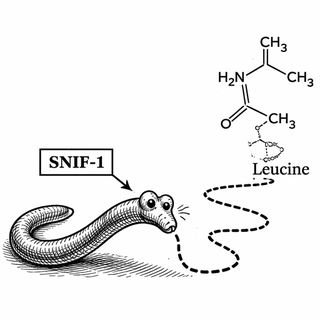
In this study, the team focused on leucine, one of the branched-chain amino acids. Leucine helps support protein synthesis and metabolism across animals, including humans. The idea is simple but elegant: if certain smells reliably predict leucine-rich food, evolution may build sensory machinery to treat those smells like a flashing “valuable supplies here” beacon.
Meet SNIF-1, the worm’s tiny recon unit
The star of the operation is SNIF-1, an olfactory receptor. Receptors like this sit on sensory neurons and act like molecular locks waiting for the right chemical key. When the right odor shows up, the neuron fires and behavior changes. In plain English: smell hits receptor, receptor alerts command, worm heads for chow.
The researchers found that SNIF-1 helps C. elegans forage for diets enriched in leucine. The receptor appears to respond to odor cues associated with those diets, linking airborne information to nutrient-seeking behavior. That is the clever part. The worm is not chemically measuring leucine with a tiny clipboard. It is using odor proxies - scent signals that correlate with useful food.
This fits with what we already know about olfaction. Smell is often less about identifying “rose” or “garlic” in some abstract way and more about making decisions: approach, avoid, eat, run, possibly regret. In worms, as in larger animals, odor-guided behavior depends on G-protein-coupled receptors, or GPCRs - the massive receptor family that also includes many targets for modern drugs (Pierce et al., 2002).
The weirdly sophisticated nose-brain-food alliance
What makes this paper fun is the sheer audacity of the system. A worm with 302 neurons is out there using odor information to optimize nutrient acquisition. Meanwhile, many of us have stared directly at a bag of spinach and chosen crackers. The worm, frankly, has a tighter operation.
More broadly, this work supports an idea that has been gaining traction: sensory systems do not just detect the world - they help solve metabolic problems. Animals may be wired to prefer smells that predict missing nutrients, and that preference can shift with internal state. Reviews over the past few years have emphasized how smell and taste interact with nutrient sensing, feeding circuits, and the microbiome in surprisingly dynamic ways (Yarmolinsky et al., 2023; Briers and de Araujo, 2022).
There is also a microbiology angle here. Microbes generate many of the odor compounds animals encounter around food. So in real ecosystems, “smells good” can mean “microbes made a chemical signature that predicts a useful nutrient profile.” That turns foraging into a three-way negotiation among animal, diet, and microbiota - which sounds very elegant until you remember the negotiator is a worm navigating bacterial lawns.
Why this could matter beyond worm world
No, this does not mean your nose has a built-in leucine radar. At least not one with a user manual. But the logic may scale. Across species, the nervous system must link external cues to internal needs. Understanding how that mapping works could help explain appetite, food preference, malnutrition risk, and maybe even how modern food environments hijack ancient sensory circuits.
This study also addresses a basic challenge in neuroscience: how specific molecules in the environment become meaningful behavior. You need to identify the receptor, the neurons, the signal, and the outcome. That is hard. This paper gives a clean example of that chain.
If the result holds up and expands, it could push researchers to ask sharper questions in other animals. Are there smell pathways tuned to protein need? To vitamin deficiency? To microbial states that signal edible versus risky food? The brain loves a shortcut, and odor is one of its fastest advance scouts.
Assessment
Mission accomplished: this paper gives us a neat mechanistic link between an olfactory receptor and nutrient-directed foraging in C. elegans. It is a reminder that even very small nervous systems can perform impressively strategic behavior. The worm is not just wandering. It is conducting supply acquisition under chemical guidance.
Which, if we are being honest, is more organized than most grocery trips.
References
Siddiqui R, Mehta N, Ranjith G, Félix MA, Chen C, Singh V. The olfactory receptor SNIF-1 mediates foraging for leucine-enriched diets in Caenorhabditis elegans. eLife. 2025. DOI: 10.7554/eLife.101936
Yarmolinsky DA, Zuker CS, Ryba NJP. Taste, smell, and the control of food intake. Annual Review of Neuroscience. 2023. DOI: 10.1146/annurev-neuro-112422-015238
Briers C, de Araujo IE. Nutrient sensing and the neural control of appetite. Trends in Neurosciences. 2022. DOI: 10.1016/j.tins.2022.03.004
Riera CE, Dillin A. Emerging role of sensory perception in aging and metabolism. Current Biology. 2015. DOI: 10.1016/j.cub.2015.05.011
Pierce KL, Premont RT, Lefkowitz RJ. Seven-transmembrane receptors. Nature Reviews Molecular Cell Biology. 2002. DOI: 10.1038/nrm908
Disclaimer: The image accompanying this article is for illustrative purposes only and does not depict actual experimental results, data, or biological mechanisms.