
The evidence is in: when a storm front rolls through the brain, somebody has to decide whether to keep doing yesterday's dumb idea or admit the weather changed. This paper points to a tiny cluster of neurons called the locus coeruleus as part meteorologist, part bailiff - barging into the orbitofrontal cortex and shouting, "New evidence, counselor, maybe stop pressing the same lever."
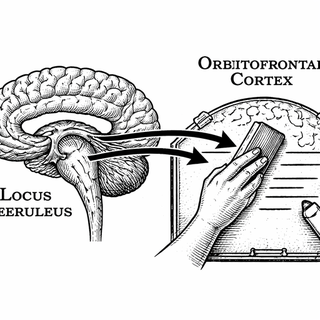
The case here is behavioral flexibility, which is science-speak for your brain's ability to pivot when the world stops cooperating. You expected reward A, got reward B, and now the old plan belongs in the recycling bin. That pivot depends heavily on the orbitofrontal cortex, or OFC, a frontal region that tracks what actions mean and what outcomes they should produce. Think of it as the courtroom whiteboard where the brain updates the current theory of the case.
Ogg and colleagues asked a sharper question: who helps the OFC rewrite that whiteboard when the facts change? Their suspect was the locus coeruleus, or LC, a small brainstem hub that sends norepinephrine all over the brain. Small structure, huge personality. In mice learning a reward task, the team tracked LC activity and imaged OFC neurons while the rules flipped midstream. The result: LC activity tracked surprising outcomes, and the OFC's internal map got scrambled during reversal and then rebuilt around the new rules [1].
That "map" matters. The OFC is not just counting treats like a tiny accountant. It represents task states - what situation the animal thinks it is in, what choice currently makes sense, and what outcome should follow. When the map is wrong, behavior gets sticky.
Exhibit A: The Brain's Reset Button Is Not Subtle
Here is the prosecution's strongest evidence. When the researchers silenced LC norepinephrine neurons during reversal, mice had trouble remapping those OFC representations and kept repeating the old behavior. Fair enough. But when the team pushed LC activity too hard in the other direction, that also caused problems. The new map would not stabilize properly, and reversal performance suffered again [1].
That is a nice twist, because it argues against the cartoon version of neuroscience where more neuromodulator equals more better. The brain wants the right amount of norepinephrine at the right time. Too little, and the system will not budge. Too much, and the update becomes noisy, like trying to rewrite a legal brief while three people spray espresso directly into your face.
This fits neatly with related work. A 2022 Cell Reports study found that higher baseline LC activity helped mice switch rules faster [2]. A 2023 eLife paper showed that noradrenergic signaling inside rodent OFC is needed to update goal-directed actions when outcomes change [3]. A newer eLife study linked LC input to altered prefrontal population dynamics during attentional switching [4].
Cross-Examination: Why Should Anyone Outside a Mouse Care?
Because flexible behavior is one of the brain's least glamorous superpowers. You use it when traffic reroutes your commute, when a conversation goes sideways, or when a habit stops serving you. Lose that flexibility and life gets rigid fast.
That is why this line of work matters beyond mice doing lab tasks for snacks. Problems with cognitive flexibility show up across disorders that involve compulsive, repetitive, or poorly updated behavior, including OCD, addiction, ADHD, and some forms of age-related cognitive decline. Recent reviews keep circling the same point: the LC-norepinephrine system helps tune brain states for learning and adaptation, while the OFC helps represent the current task and expected outcomes [5,6]. Put differently, one system may announce that the world has changed, and the other rewrites the internal case file.
Now, let the court record show: this is not a treatment paper. Nobody should be freebasing norepinephrine for self-improvement. The study was done in mice, and the circuits behind human flexibility are messier than any clean cartoon diagram.
Closing Argument
What makes this study interesting is not just that the LC matters. People have suspected that for years. It is that the paper connects LC signals to the remapping of specific OFC population codes during behavioral reversal. In plain English: the work starts to show how a brain notices that reality has betrayed its expectations and then rewrites the neural script.
That is the real intrigue. Flexible behavior is not magic or pure willpower. It looks more like a negotiated settlement between circuits that detect surprise, store the current model of the world, and decide whether to stick or switch. The LC may be one of the officials stamping "reconsider immediately" on the file.
And honestly, that feels relatable. Most of us do not need help having a bad habit. We need help noticing the evidence has changed before we turn that habit into a closing argument.
References
- Ogg MC, Lansdell BJ, Franks HT, Hughes AC, Lee J, Nolen HG, Shirinifard A, Schwarz LA. Locus coeruleus norepinephrine neurons facilitate orbitofrontal cortex remapping and behavioral flexibility. Cell Reports. 2025. https://doi.org/10.1016/j.celrep.2025.116687
- McBurney-Lin J, Vargova G, Garad M, Zagha E, Yang H. The locus coeruleus mediates behavioral flexibility. Cell Reports. 2022;41(4):111534. https://doi.org/10.1016/j.celrep.2022.111534
- Cerpa JC, Piccin A, Dehove M, Lavigne M, Kremer EJ, Wolff M, Parkes SL, Coutureau E. Inhibition of noradrenergic signalling in rodent orbitofrontal cortex impairs the updating of goal-directed actions. eLife. 2023;12:e81623. https://doi.org/10.7554/eLife.81623
- Nigro M, Silva Tortorelli L, Garad M, Zlebnik NE, Yang H. Locus coeruleus modulation of single-cell representation and population dynamics in the mouse prefrontal cortex during attentional switching. eLife. 2026. https://doi.org/10.7554/eLife.105911
- Breton-Provencher VB, Drummond GT, Sur M. Locus Coeruleus Norepinephrine in Learned Behavior: Anatomical Modularity and Spatiotemporal Integration in Targets. Frontiers in Neural Circuits. 2021;15. https://doi.org/10.3389/fncir.2021.638007
- van den Brink RL, O'Reilly JX, Phillips JM. Toward a computational role for locus coeruleus/norepinephrine arousal systems. Current Opinion in Behavioral Sciences. 2024;59:101407. https://doi.org/10.1016/j.cobeha.2024.101407
Disclaimer: The image accompanying this article is for illustrative purposes only and does not depict actual experimental results, data, or biological mechanisms.