
"I saw a waterfall."
"Cool," said the other neuron. "Can you file that in a format the humans can actually use?"
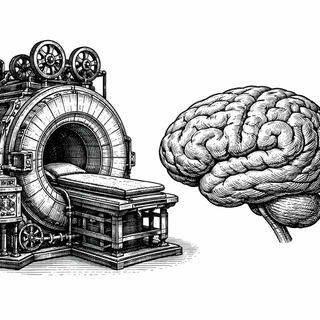
That, in a less adorable accent, is the problem Tomoyasu Horikawa tackles in a new Science Advances paper on "mind captioning" [1]. The mission is not to decode spoken words from the brain. It is stranger than that. The system tries to turn patterns of brain activity into descriptive text about what a person is seeing or recalling. In other words, it asks whether the brain can be coaxed into writing its own rough captions.
Not telepathy. More like semantic field intel.
The study used fMRI, which tracks blood-oxygen changes across the brain. That means the signal is useful, broad, and slow in the way a giant government office is slow.
Participants watched videos while the system learned a mapping between their brain activity and the semantic features of captions describing those videos. Then the model tried to evolve candidate sentences until their language-model features matched the features decoded from the brain. This is the clever bit. Instead of forcing the brain signal to choose from a rigid caption menu, the method keeps rewriting text until it better lines up with the neural evidence.
Horikawa reports that the resulting captions could capture structured visual meaning and even generalize to recalled content, not just content on a screen [1]. That matters because mental life is rarely a single object floating in a void like a sad stock photo. It is scenes, relations, actions, memory, context, and the brain's constant habit of overcomplicating everything.
The sneaky big deal
Here is the part that should make neuroscientists put down their coffee for a second: the method did not depend on the canonical language network in the usual way [1]. That suggests the brain may represent scene meaning in a more distributed, nonverbal format that can still be translated into language later. The words are not necessarily sitting in the brain waiting like labeled boxes in a warehouse. The meaning seems to be there first, and language is the negotiator sent in afterward.
That idea fits nicely with broader work on neural decoding. Tang and colleagues showed in 2023 that noninvasive recordings could reconstruct aspects of continuous language meaning from fMRI, although with heavy subject-specific training and obvious practical limits [2]. Reviews in 2024 also emphasized that communication BCIs are advancing fast, but mostly through painstaking engineering, huge training demands, and very specialized hardware, not magic wizard helmets you buy next to AirPods [3,4].
So no, this is not a machine that can casually read your private thoughts while you wait in line for tacos. It needs cooperative participants, lots of training data, and an fMRI scanner, which is about as portable as a disappointed rhinoceros. Recent coverage and outside experts have made the same point: impressive science, terrible spy gadget.
Why regular people should care anyway
Because if this line of work keeps improving, it could become an alternate communication route for people who cannot easily produce language. Think aphasia, severe paralysis, or other conditions where the mind still has cargo but the usual roads are cratered. A brain-to-text path that leans on distributed semantic representations rather than intact speech output could be a real strategic advantage [1,3].
There is also a basic-science payoff here. Mind captioning offers a useful probe for asking what the brain is actually representing. Is it objects? Events? Relationships? The gist of a scene? Something between image and sentence? Neuroscience has spent years trying to infer mental content from activation blobs that often look like weather reports for the frontal lobe.
The awkward part nobody gets to skip
The headlines around this field tend to sprint toward "mind reading," because apparently sobriety gets fewer clicks. But the sober version is more interesting. These systems decode constrained, trained, noisy correlates of mental content. They do not extract a pristine inner monologue from the soul's secret basement.
Still, privacy matters. If brain data become easier to collect and decode, rules need to arrive before the sales deck does. Recent ethics coverage has pushed exactly that concern: autonomy, consent, and neural data protection should not be treated as optional accessories thrown in at checkout. Humanity does not need a new category of data breach where the leak is your daydream.
Horikawa's paper is exciting because it advances the field without pretending the battlefield is already won. The brain has supply lines for meaning that do not map neatly onto language, and this study shows we can start tracing them in words. Messily, imperfectly, and with a lot of scanner time. Which, for neuroscience, counts as a pretty dramatic dispatch.
References
- Horikawa T. Mind captioning: Evolving descriptive text of mental content from human brain activity. Science Advances. 2025;11(45):eadw1464. DOI: 10.1126/sciadv.adw1464. PubMed: 41191769.
- Tang J, LeBel A, Jain S, Huth AG. Semantic reconstruction of continuous language from non-invasive brain recordings. Nature Neuroscience. 2023;26(5):858-866. DOI: 10.1038/s41593-023-01304-9. PMCID: PMC11304553.
- Silva AB, Littlejohn KT, Liu JR, Moses DA, Chang EF. The speech neuroprosthesis. Nature Reviews Neuroscience. 2024;25(7):473-492. DOI: 10.1038/s41583-024-00819-9. PMCID: PMC11540306.
- Erichsen CT, Li D, Fan L. Decoding human brain functions: Multi-modal, multi-scale insights. Innovation (Camb). 2024;5(1):100554. DOI: 10.1016/j.xinn.2023.100554. PMCID: PMC10794116.
- Fedorenko E, Ivanova AA, Regev TI. The language network as a natural kind within the broader landscape of the human brain. Nature Reviews Neuroscience. 2024;25(5):289-312. DOI: 10.1038/s41583-024-00802-4. PubMed: 38609551.
Disclaimer: The image accompanying this article is for illustrative purposes only and does not depict actual experimental results, data, or biological mechanisms.