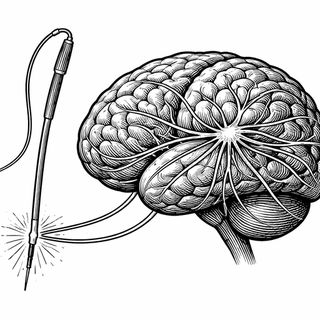
No, scientists did not build a tiny Swiss Army knife and start whittling mouse brains like deranged Etsy artisans. What they actually built is stranger and better: a single fiber-like neural probe that can listen to electrical activity, deliver electrical stimulation, shine light for optogenetics, read fluorescent signals, detect neurochemicals, and even deliver drugs or genes - all in vivo, all from one platform.[1]
That is the headline from a new paper by Nicolette Driscoll and colleagues, and the reason it matters is simple. The brain does not communicate in one clean channel. It is sparks, chemicals, timing, feedback loops, and the occasional biological equivalent of "who sent this group text?" If your tool only catches one stream, you get a slice of the story. Useful, sure. Complete? Not even close.
The Brain Has More Than One Group Chat
A lot of neuroscience tools are specialists. Electrophysiology catches fast electrical signals. Fiber photometry tracks bulk fluorescent activity from genetically encoded sensors. Fast-scan cyclic voltammetry can catch rapid chemical changes such as dopamine release with a carbon-fiber electrode.[2][3] Each method is powerful. Each has blind spots. The brain, because it enjoys being difficult, rarely sticks to one language at a time.
That is the core problem this paper tries to solve. Driscoll and colleagues designed a polymer-based fiber probe with carbon-based conductors that combines electrical, optical, and chemical functions in one implant.[1] One probe can record neural signals, stimulate tissue, run optogenetics, do fiber photometry, deliver compounds, and monitor neurotransmitter-related chemistry through voltammetry. Fewer implants. Better signal alignment.
Why This Is More Than Gadget Flexing
The team tested the probes in the mesolimbic reward pathway, including the ventral tegmental area and nucleus accumbens - two regions heavily involved in motivation, reward, and drug response.[1] That is a smart demo zone because reward circuitry is where electricity and chemistry refuse to stay in their lanes. If you want to understand how a stimulant changes brain function, you do not just want spikes. You want the chemical soundtrack too.
The probes are also made from non-magnetic, carbon-based conductors, which makes them compatible with MRI.[1] Translation: researchers can stimulate locally while also watching broader, whole-brain responses. That opens a bridge between detailed rodent circuit work and the larger-scale imaging logic used in translational and clinical research. Tiny probe, big map.
Recent reviews have been pushing exactly this direction. A 2025 review in Nature Reviews Electrical Engineering argues that multimodal interfaces matter because no single recording method captures the full dynamics of neural circuits.[4] A 2024 Accounts of Chemical Research review makes a similar point from the materials side.[5]
The Real Win: Less Frankenstein, More Integration
Neuroscience has spent years doing experimental cable management. One implant for recording. Another for light. Another for chemical delivery. Then a separate imaging setup. Then a prayer. Integrated probes cut down on that patchwork.
Other groups are clearly racing in the same direction. In 2024, Pollmann and colleagues described a subdural CMOS optical device for bidirectional neural interfacing in Nature Electronics.[6] In 2022, Wu and colleagues reported wireless optofluidic microsystems for programmable optogenetics and photopharmacology in Nature Communications.[7] Recent reporting from Harvard and Rice shows the same broader push toward softer, longer-lasting, more multifunctional devices.[8][9]
If a probe can last longer, irritate tissue less, and measure several kinds of signals at once, you get cleaner experiments and better questions. Instead of asking, "Did neurons fire?" you can ask, "Which neurons fired, what chemistry changed, and how did stimulation reshape the circuit?" That is moving from a door peephole to an actual window.
The Catch, Because There Is Always a Catch
This is still a mouse study, not a plug-and-play human therapy. Multifunctional probes are harder to fabricate, validate, and keep stable over long timescales. Signal crosstalk is a real concern when one device tries to do several jobs at once. Fiber photometry also gives pooled signals rather than single-cell precision, and chemical sensing in living tissue remains technically finicky.[2][3]
Still, the direction is hard to ignore. The NIH BRAIN 2025 vision explicitly called for tools that integrate multiple capabilities - electrical and optical, recording and stimulation - and for methods that can scale from animal studies toward human relevance.[10] This paper fits that playbook well, because it treats brain activity as what it actually is: electrochemical, distributed, messy, and uninterested in our tidy categories.
So no, this is not one magic probe that explains the brain. That would be absurd. The brain barely explains itself. But it is a serious step toward tools that can sample the full remix instead of listening to one lonely track at a time.
References
- Driscoll N, Antonini MJ, Cannon TM, et al. Multifunctional Neural Probes Enable Bidirectional Electrical, Optical, and Chemical Recording and Stimulation In Vivo. Advanced Materials. 2024:e2408154. DOI: https://doi.org/10.1002/adma.202408154
- Fast-scan cyclic voltammetry. Wikipedia. https://en.wikipedia.org/wiki/Fast-scan_cyclic_voltammetry
- Fiber photometry. Wikipedia. https://en.wikipedia.org/wiki/Fiber_photometry
- Ramezani M, Fisher TG, Maes C, et al. Innovating beyond electrophysiology through multimodal neural interfaces. Nature Reviews Electrical Engineering. 2025;2:42-57. DOI: https://doi.org/10.1038/s44287-024-00121-x
- Gao Y, Lau K, Luo X. Multifunctional Nanomaterials for Advancing Neural Interfaces: Recording, Stimulation, and Beyond. Accounts of Chemical Research. 2024. DOI: https://doi.org/10.1021/acs.accounts.4c00138
- Pollmann EH, Yin H, Uguz I, et al. A subdural CMOS optical device for bidirectional neural interfacing. Nature Electronics. 2024;7:829-841. DOI: https://doi.org/10.1038/s41928-024-01209-w
- Wu Y, Wu M, Vazquez-Guardado A, et al. Wireless multi-lateral optofluidic microsystems for real-time programmable optogenetics and photopharmacology. Nature Communications. 2022;13:5571. DOI: https://doi.org/10.1038/s41467-022-32947-0
- Harvard John A. Paulson School of Engineering and Applied Sciences. A long-lasting neural probe. January 26, 2024. https://seas.harvard.edu/news/long-lasting-neural-probe
- Rice University News. Rice neuroscientists to build state-of-the-art neural recording system. July 24, 2024. https://news.rice.edu/news/2024/rice-neuroscientists-build-state-art-neural-recording-system
- NIH BRAIN Initiative. BRAIN 2025: A Scientific Vision. See discussion of hybrid arrays integrating electrical and optical recording/stimulation and multiple capabilities. https://braininitiative.nih.gov/sites/default/files/documents/brain2025_508c.pdf
Disclaimer: The image accompanying this article is for illustrative purposes only and does not depict actual experimental results, data, or biological mechanisms.