
What if the difference between a relatively stable neuron and a slow-motion genetic meltdown was basically one typo in a stretch of DNA that already looks like your keyboard got stuck? That is the energy of this new Huntington's disease paper, and honestly, the genome could stand to be less dramatic.
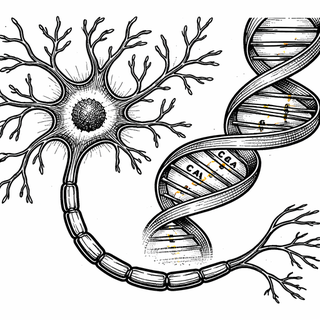
Huntington's disease happens when the HTT gene contains too many CAG repeats, a three-letter DNA pattern. For years, the simple version was: more repeats, worse disease. True, but incomplete. Scientists now think the real menace is not just the repeat length you inherit at birth. It is the repeat's tendency to keep expanding inside vulnerable cells over time. The mutation is not content to be bad. It keeps editing itself into a worse sequel.
In this new Cell Reports study, researchers built a human stem-cell platform called CAGinSTEM to test a deceptively simple question: does the exact DNA spelling inside the HTT repeat change how unstable it becomes in neurons? Yes, a lot. And that matters because instability is increasingly tied to when Huntington's shows up and how hard it hits. [1]
The Brain Hates A Copy Error
Here is the background without the textbook voice. CAG and CAA are different DNA codons, but both encode the same amino acid, glutamine. So if you only look at the protein, they can seem interchangeable. Biology, however, loves making things rude and complicated. The DNA sequence itself still matters.
This team used CRISPR-engineered human embryonic stem cells, turned them into neurons, and tracked repeat length with long-read sequencing. They found that small changes in the repeat structure changed how unstable the HTT repeat became. In particular, a naturally occurring CAA interruption near the end of the canonical sequence strongly altered instability. Even more striking, adding four internal CAA interruptions shut down CAG instability altogether in their human neuron model and reversed disease-related features, including abnormal striatal fate acquisition and messed-up nuclear organization. [1]
That is the plot twist. The paper is not just saying "repeat length matters." It is saying repeat composition matters. Same protein output, different DNA behavior. Huntington's is not only a protein story. It is also a DNA architecture story.
When The Repeat Starts Freelancing
This paper lands at a moment when the field is getting unusually specific about somatic expansion. A 2025 Cell study looked directly in human brain tissue and found that striatal projection neurons can accumulate massive HTT expansions over a lifetime. Many neurons seemed okay until repeats crossed roughly 150 CAGs, after which gene expression went sideways and the cells started losing their identity. That is less "gradual decline" and more "everything was fine until the group chat exploded." [2]
Another 2025 study in Nature Medicine found that somatic CAG expansion measured in blood was associated with biomarkers of neurodegeneration about 23 years before predicted clinical motor diagnosis. So this is no longer an obscure side quest in Huntington's biology. It is part of the main plot. [3]
That is why the new CAGinSTEM result matters. If specific interruptions in the repeat can calm instability in human neurons, researchers may have a direct handle on an upstream driver rather than just cleaning up the mess later.
A Therapy Angle That Is Not Sci-Fi Nonsense
This is also where the paper gets practical. Other recent studies already hint that making the repeat less expansion-prone could be therapeutic. In 2024, researchers showed that base editing CAG to CAA in HTT could reduce somatic expansion, and CAA-interrupted repeats abolished expansion in Huntington's mouse models. [4] Separate 2025 work showed that lowering MSH3, a DNA mismatch repair protein, reduced somatic CAG expansion in patient-derived striatal neurons without obvious disruption of major DNA repair pathways. [5]
Put that together with CAGinSTEM and the message is pretty sharp: maybe you do not need to erase the whole mutation to make it less dangerous. Maybe you can make it behave worse less efficiently.
There are still real caveats. This new study used engineered stem-cell-derived human neurons, not living human brains. "Abolished instability" in a dish is exciting, but it is not the same thing as proving long-term benefit in people. Editing repeats inside the brain safely is also a brutal delivery problem. Still, the logic is stronger than a lot of speculative gene-therapy chatter. The intervention targets a mechanism that human genetics, human neurons, mouse models, and postmortem brains are all starting to point at from different angles. [2,4-6]
The big takeaway is weirdly elegant: in Huntington's disease, the exact spelling of a repetitive DNA stretch can help decide whether neurons keep their act together or spiral into genetic chaos. One letter swap does not sound like much. Then again, neither does "reply all," until it ruins everybody's afternoon.
References
- Zobel M, Damaggio G, Mignogna ML, et al. A human CAGinSTEM platform for decoding HTT repeats' somatic instability links CAG interruption to HD pathology in neurons. Cell Reports. 2025;44(12):116685. DOI: 10.1016/j.celrep.2025.116685. PubMed: https://pubmed.ncbi.nlm.nih.gov/41389205/
- Handsaker RE, Kashin S, Reed NM, et al. Long somatic DNA-repeat expansion drives neurodegeneration in Huntington's disease. Cell. 2025;188(3):623-639.e19. DOI: 10.1016/j.cell.2024.11.038. PMCID: PMC11822645
- Scahill RI, Farag M, Murphy MJ, et al. Somatic CAG repeat expansion in blood associates with biomarkers of neurodegeneration in Huntington's disease decades before clinical motor diagnosis. Nature Medicine. 2025. DOI: 10.1038/s41591-024-03424-6. PubMed: https://pubmed.ncbi.nlm.nih.gov/39825149/
- Choi DE, Shin JW, Zeng S, et al. Base editing strategies to convert CAG to CAA diminish the disease-causing mutation in Huntington's disease. eLife. 2024;12:RP89782. DOI: 10.7554/eLife.89782. PMCID: PMC11175616
- Bunting EL, Donaldson J, Ko SY, et al. Antisense oligonucleotide-mediated MSH3 suppression reduces somatic CAG repeat expansion in Huntington's disease iPSC-derived striatal neurons. Science Translational Medicine. 2025. DOI: 10.1126/scitranslmed.adn4600. PubMed: https://pubmed.ncbi.nlm.nih.gov/39937881/
- Cattaneo E, Scalzo D, Zobel M, et al. When repetita no-longer iuvant: somatic instability of the CAG triplet in Huntington's disease. Nucleic Acids Research. 2025;53(1):gkae1204. DOI: 10.1093/nar/gkae1204. PMCID: PMC11724284
Disclaimer: The image accompanying this article is for illustrative purposes only and does not depict actual experimental results, data, or biological mechanisms.