Boomers are hitting the age where Parkinson's and vision loss start barging in uninvited. Millennials are old enough to realize "brain health" is no longer something you outsource to Future You. Gen Z, meanwhile, got handed a world where people casually discuss gene therapy on TikTok. So this new optogenetics roadmap lands at a perfect moment: it asks whether a technology famous for controlling neurons with light can grow up from brilliant lab stunt to actual human help.[1]
If you have ever watched a toddler "help" with laundry by throwing socks into a random corner, you already understand part of neuroscience. The brain has a lot of moving pieces, many of them making a mess, and all of them connected to everybody else's business. Optogenetics lets scientists stop poking the whole pile and start testing specific cell types one by one.[1][2]
The Fancy Version of "Who Started It?"
Think of optogenetics as a brutally efficient way to ask the brain, "Which cells are causing the scene right now?" Researchers put light-sensitive proteins called opsins into selected cells, shine light, and watch behavior or physiology shift in real time. That precision matters because if you stimulate everything at once, you learn very little except that biology enjoys chaos.
This new Nature Neuroscience review makes a smart distinction. There is direct translation, where optogenetics itself becomes the treatment in humans. Then there is indirect translation, where optogenetics maps the guilty circuits so doctors can build other therapies - drugs, brain stimulation strategies, gene therapies - that hit the right targets without literally installing the full optogenetic setup in someone's brain.[1]
That second route may sound less flashy, but it is probably the near-term workhorse.
The Blindness Plot Twist
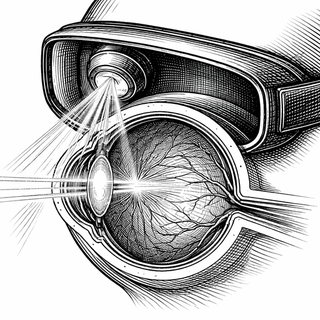
The reason people are taking direct translation seriously at all is that it already worked, at least as a proof of principle, in blindness. In a 2021 Nature Medicine report, a man with retinitis pigmentosa regained partial visual function after receiving an optogenetic therapy plus engineered light-stimulating goggles. He could detect, locate, count, and touch objects using the treated eye while wearing the goggles. That is not normal vision, but it is absolutely not nothing.[3]
Recent reviews on visual restoration make the same point in less dramatic language and more figures per square inch: the eye is currently the most realistic clinical doorway for optogenetics because it is accessible, already built for light, and easier to target than deep brain structures.[4][5] If optogenetics were a kid learning to ride a bike, the retina is the nice empty parking lot. The rest of the central nervous system is downtown traffic.
Why the Brain Is a Much Pickier Customer
Moving from retina to brain is where the paper gets admirably unromantic. To use optogenetics directly in people, you need at least three things to go right: get the right genes into the right cells, get enough light to the right place, and pick a disease where that extra precision is worth all the hassle.[1]
That first problem usually means viral delivery, often with adeno-associated virus, and the immune system does not always greet that plan like a polite host.[1] The second problem is physical. Light has to reach a dense, delicate, folded organ wearing a skull like medieval armor. The third is clinical common sense. If an ordinary drug or a decent stimulation strategy can do the job, no regulator is going to say, "Sure, let's bring in the laser gene package just for the vibes."
The ethical issues are not decoration here. The review explicitly flags indication selection, safety, specificity, and regulatory navigation as central problems, not fine print.[1]
The Less Sci-Fi, More Useful Future
The most interesting part of this paper is that it refuses to treat "direct use in humans" as the only victory condition. Optogenetics has already been hugely useful for figuring out which circuits matter in movement disorders, mood, reward, sleep, and perception.[1][2][6] That causal knowledge can sharpen deep brain stimulation, improve neuromodulation targets, and inspire treatments that are much easier to deploy clinically.
Medicine often knows where the trouble is only in the vaguest neighborhood sense. Optogenetics helps narrow the address. Not "somewhere in this city," but "third floor, loud apartment, guy in the red shirt." For disorders like Parkinson's disease, that kind of circuit-level clarity can make existing therapies smarter instead of merely stronger.[6]
So no, this is not a story about everyone getting brain lasers next year. It is a story about a tool maturing. Sometimes the future of medicine arrives as a very nerdy map that finally tells us where to stop guessing. In brain science, that might be the more useful superpower anyway.
References
- Lüscher C, Emiliani V, Farahany N, Gittis A, Gradinaru V, High KA, Roska B, Sahel JA, Yizhar O, Zeng H, Deisseroth K. Roadmap for direct and indirect translation of optogenetics into discoveries and therapies for humans. Nature Neuroscience. 2025. DOI: 10.1038/s41593-025-02097-9
- Adesnik H, Abdeladim L. Probing neural codes with two-photon holographic optogenetics. Nature Neuroscience. 2021;24(10):1356-1366. DOI: 10.1038/s41593-021-00902-9. PMCID: PMC9793863
- Sahel JA, Boulanger-Scemama E, Pagot C, Arleo A, Galluppi F, Martel JN, et al. Partial recovery of visual function in a blind patient after optogenetic therapy. Nature Medicine. 2021;27:1223-1229. DOI: 10.1038/s41591-021-01351-4
- Lindner M, Gilhooley MJ, Hughes S, Hankins MW. Optogenetics for visual restoration: From proof of principle to translational challenges. Progress in Retinal and Eye Research. 2022;91:101089. DOI: 10.1016/j.preteyeres.2022.101089
- Gilhooley MJ, Lindner M, Palumaa T, Hughes S, Peirson SN, Hankins MW. A systematic comparison of optogenetic approaches to visual restoration. Molecular Therapy Methods & Clinical Development. 2022;25:111-123. DOI: 10.1016/j.omtm.2022.03.003. PMCID: PMC8956963
- Gittis AH, Yttri EA. Translating insights from optogenetics to therapies for Parkinson's disease. Current Opinion in Biomedical Engineering. 2018;8:14-19. DOI: 10.1016/j.cobme.2018.08.008. PMCID: PMC6941740
Disclaimer: The image accompanying this article is for illustrative purposes only and does not depict actual experimental results, data, or biological mechanisms.