
Start at the spinal cord, slide out along the sensory wiring to the dorsal root ganglia, and follow those nerves down toward the pancreas - a tucked-away organ that usually minds its own digestive business. In this new study, those sensory neurons look less like bystanders and more like terrible enablers. They appear to form synapse-like contacts with pancreatic cancer cells and feed them glutamate, which sounds fake until biology reminds you it never cared about normal.
The weird part is the point
Pancreatic ductal adenocarcinoma, or PDAC, is one of the nastiest cancers around. In the United States, the overall 5-year survival rate still sits around 13% according to the American Cancer Society (ACS, 2026). Scientists have known for years that pancreatic tumors love hanging around nerves. Usually that story gets told as invasion - cancer creeping along nerve fibers like a burglar who also studied anatomy.
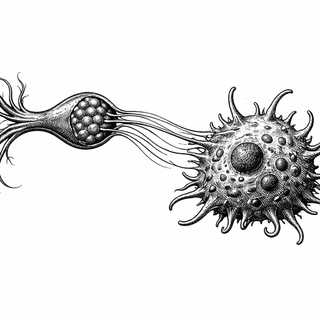
This paper argues something more active. Lei Ren and colleagues report that sensory nerve endings in PDAC can make pseudo-synapses with cancer cells. At those contact points, the cancer cells pile up a glutamate receptor subunit called GRIN2D, part of the NMDA receptor family. In plain English: the tumor seems to install neuronal listening equipment so it can hear what nearby nerves are saying - and use that chatter to grow and spread (Ren et al., 2025).
When cancer cells start acting like bad neurons
Glutamate is the main excitatory neurotransmitter in the nervous system. NMDA receptors help cells respond to it, largely through calcium signaling. Wikipedia is actually useful here: NMDA receptors are glutamate-gated ion channels that let calcium flood in when conditions are right, which is great for learning and memory and less great when a tumor starts cosplaying as a neuron (Wikipedia: NMDA receptor).
Ren and colleagues found that sensory innervation boosts glutamate availability, which helps maintain GRIN2D expression on a subset of pancreatic cancer cells. Those cells become calcium-responsive when neurons are nearby. The whole setup looks like a feedforward loop: nerves provide glutamate, tumor cells get better at receiving it, and that signal helps drive progression.
This did not come out of nowhere
The study lands in a research area that has been getting louder for a while. A 2024 review in Nature Reviews Drug Discovery describes the peripheral neural-tumor microenvironment as a real therapeutic target, not a biological side quest (Yaniv et al., 2024; PMCID: PMC12123372). A pancreatic cancer-specific review the same year laid out how tumor-nervous-system crosstalk shapes pain, invasion, metabolism, and treatment resistance in PDAC (Xu et al., 2024). And a 2023 study had already shown that nerve-derived glutamate can promote perineural invasion in pancreatic cancer through NMDA receptor signaling and metabolic rewiring (Li et al., 2023).
So this paper is not a random UFO sighting. It is more like somebody finally got clean footage of the raccoon that has been raiding the lab fridge for months.
Why this matters outside the microscope
If these pseudo-synapses hold up across more models and, eventually, patients, they create a tempting target. The obvious idea is not "turn off the whole nervous system," because that would be a deeply inconvenient way to spend an afternoon. The smarter approach would be to interrupt the specific glutamate-GRIN2D signaling axis, or the tumor states that depend on it.
That matters because pancreatic cancer is very good at dodging therapies by leaning on its neighborhood - fibroblasts, immune cells, extracellular matrix, and now, increasingly, nerves. Recent expert coverage in Nature framed the nervous system as one reason PDAC is so evasive, and the paper strengthens that case by showing that interfering with glutamate-GRIN2D signaling improved survival in vivo (Dattaro, 2025).
That does not mean a nerve-silencing pancreatic cancer drug is around the corner. It means the map just got better. And with PDAC, better maps are a big deal because this disease has spent decades behaving like it read the escape room answers in advance.
The catch, because there is always a catch
Pancreatic tumors are messy ecosystems, and not every cancer cell is doing the same thing. One important nuance here is that the neuron-responsive state showed up in a subset of PDAC cells, not all of them. That raises the practical question: how do you identify the patients whose tumors really depend on this pathway, and how do you block it without causing collateral damage?
Still, the central idea is sharp. Sensory neurons are not just nearby. They may be directly coaching the tumor through synapse-like contacts, handing over glutamate like tiny biological hype men. That is a grim thought, yes, but also a useful one. Once you know who is whispering in the cancer's ear, you can at least try to cut the line.
References
- Ren L, Liu C, Cifcibasi K, et al. Sensory neurons drive pancreatic cancer progression through glutamatergic neuron-cancer pseudo-synapses. Cancer Cell. 2025;43(12):2241-2258.e8. DOI: https://doi.org/10.1016/j.ccell.2025.09.003
- Yaniv D, Mattson B, Talbot S, Gleber-Netto FO, Amit M. Targeting the peripheral neural-tumour microenvironment for cancer therapy. Nat Rev Drug Discov. 2024;23(10):780-796. DOI: https://doi.org/10.1038/s41573-024-01017-z PMCID: https://pmc.ncbi.nlm.nih.gov/articles/PMC12123372/
- Xu W, Liu J, Zhang J, Lu J, Guo J. Tumor microenvironment crosstalk between tumors and the nervous system in pancreatic cancer: Molecular mechanisms and clinical perspectives. Biochim Biophys Acta Rev Cancer. 2024;1879(2):189032. DOI: https://doi.org/10.1016/j.bbcan.2023.189032
- Li F, He C, Yao H, et al. Glutamate from nerve cells promotes perineural invasion in pancreatic cancer by regulating tumor glycolysis through HK2 mRNA-m6A modification. Pharmacol Res. 2023;187:106555. DOI: https://doi.org/10.1016/j.phrs.2022.106555
- Jiang J, Xu Z, Qu D, et al. Targeting sensory nerves in the tumor microenvironment: a new vulnerability in cancer therapy. Cell Commun Signal. 2026;24(1):131. DOI: https://doi.org/10.1186/s12964-025-02637-7 PMCID: https://pmc.ncbi.nlm.nih.gov/articles/PMC12924496/
- Dattaro L. Pancreatic cancer is evasive. Is the nervous system the reason why? Nature. Published December 10, 2025. https://www.nature.com/articles/d41586-025-03943-3
- American Cancer Society. Survival Rates for Pancreatic Cancer. Updated 2026. https://www.cancer.org/cancer/types/pancreatic-cancer/detection-diagnosis-staging/survival-rates.html
Disclaimer: The image accompanying this article is for illustrative purposes only and does not depict actual experimental results, data, or biological mechanisms.