
One researcher looks at pancreatic cancer and says, "This monster is hiding from drugs and the immune system." Another looks at the same tumor and says, "Sure, but what if it is also getting coaching and snacks from nearby nerves?" Honestly, both can be right. A 2025 Nature feature pulled together a growing idea in cancer neuroscience: pancreatic tumors might not just sit next to nerves like a bad neighbor blasting music at 2 a.m. They may actively recruit, rewire, and exploit them to survive [1].
Not just a lump - more like a scheming roommate
Pancreatic ductal adenocarcinoma, or PDAC, is one of the nastiest cancers in medicine. In the United States, SEER estimates 67,530 new cases and 52,740 deaths in 2026, with a 5-year relative survival of 13.7% based on 2016-2022 data [7]. The American Cancer Society lists 5-year survival at 44% if the disease is still localized, 17% once it is regional, and 3% when it has spread far away [8].
Part of the problem is location. The pancreas sits deep in the abdomen, tucked among major blood vessels and a dense web of nerves. Symptoms often show up late, and the tumor builds a thick, hostile neighborhood around itself - scar tissue, immune cells, fibroblasts, the whole cursed homeowners association [2,6].
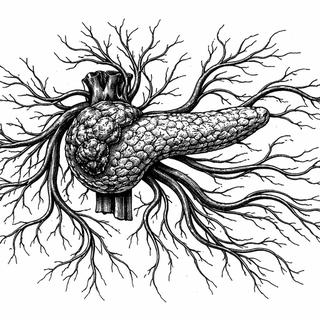
Now add nerves to the guest list.
When cancer starts texting the nervous system
For years, pathologists have known that pancreatic cancer commonly shows perineural invasion, meaning cancer cells creep around and sometimes into nerves. That usually signals more aggressive disease. What has changed is the interpretation. Researchers no longer see nerves as innocent bystanders. More and more, nerves look like active participants in the chaos [1,3].
Recent work suggests pancreatic tumors can reshape nearby sensory, sympathetic, and parasympathetic nerve fibers. In a 2025 Nature study, researchers mapped neurons connected to pancreatic tumors and found widespread nerve sprouting plus a distinct "pancreatic-cancer nerve" gene program - basically neurons that had been talked into behaving differently by the tumor [4]. That is not just creepy. It hints that the cancer is editing its surroundings in a very targeted way.
Another 2025 paper in Cancer Cell pushed the idea further. The authors reported that sensory neurons can form glutamatergic pseudo-synapses with pancreatic cancer cells, letting nerve-derived signals directly fuel tumor progression [5]. If that sounds like the tumor built itself a sketchy little Wi-Fi network, yes, that is the vibe.
Why would a tumor bother with nerves?
Because nerves are useful. Annoyingly useful.
They deliver growth signals. They release neurotransmitters and trophic factors that can encourage cancer-cell survival, movement, and adaptation [3,5]. They also help shape the tumor microenvironment, the whole messy ecosystem around the cancer. Schwann cells, the support cells that wrap peripheral nerves, seem to help push pancreatic tumors and nearby fibroblasts toward more aggressive states [4].
There is also a metabolic angle. Earlier work helped show that pancreatic tumors can depend on neuronal support for nutrients such as serine when the local environment gets brutally deprived [1]. PDAC grows in tissue that is low in oxygen, difficult for drugs to penetrate, and short on supplies. So if the tumor can sweet-talk nerves into delivering backup resources, of course it will. Cancer is many things, but lazy is not one of them.
Why this matters outside the lab
If nerves really help pancreatic cancer hide, spread, or resist treatment, then the nervous system becomes a therapeutic target - not the only one, but a new flank to attack [2,3,6].
That does not mean doctors are about to cure pancreatic cancer by simply snipping a nerve and calling it a day. Biology is rarely that polite. Nerves do different jobs in different tissues, and some neural signals may even suppress tumor growth in certain contexts.
Still, the translational possibilities are real. Researchers are exploring whether blocking nerve-cancer signaling, modulating neurotransmitter pathways, or combining neural targeting with immunotherapy and standard chemotherapy could make resistant tumors less evasive [2,3,5,6]. Even pain-directed nerve interventions are getting attention because pancreatic cancer pain can be severe and often ties back to nerve involvement.
So the big idea here is not that nerves "cause" pancreatic cancer in some simple comic-book way. It is that pancreatic tumors may weaponize the same communication hardware your body normally uses for sensation, repair, and organ control. Which is rude, honestly.
The field is still young, and reproducibility plus human validation matter a lot. But if these findings keep holding up, the nervous system could turn from a background character into one of the main plot points in pancreatic cancer research. For a cancer this slippery, any new way to corner it is worth a very hard look.
References
- Dattaro L. Pancreatic cancer is evasive. Is the nervous system the reason why? Nature. 2025;648:S49-S50. https://doi.org/10.1038/d41586-025-03943-3
- Hu ZI, O'Reilly EM. Therapeutic developments in pancreatic cancer. Nat Rev Gastroenterol Hepatol. 2024;21:7-24. https://doi.org/10.1038/s41575-023-00840-w
- Vaes N, Idris M, Boesmans W, Alves MM, Melotte V. Nerves in gastrointestinal cancer: from mechanism to modulations. Nat Rev Gastroenterol Hepatol. 2022;19(12):768-784. https://doi.org/10.1038/s41575-022-00669-9
- Thiel V, Renders S, Panten J, et al. Characterization of single neurons reprogrammed by pancreatic cancer. Nature. 2025;640:1042-1051. https://doi.org/10.1038/s41586-025-08735-3. PMCID: PMC12018453
- Ren L, Liu C, Cifcibasi K, et al. Sensory neurons drive pancreatic cancer progression through glutamatergic neuron-cancer pseudo-synapses. Cancer Cell. 2025. https://doi.org/10.1016/j.ccell.2025.09.003
- Del Chiaro M, Sugawara T, Karam SD, Messersmith WA. Advances in the management of pancreatic cancer. BMJ. 2023;383:e073995. https://doi.org/10.1136/bmj-2022-073995
- SEER Cancer Stat Facts: Pancreatic Cancer. National Cancer Institute. Accessed May 4, 2026. https://seer.cancer.gov/statfacts/html/pancreas.html
- Survival Rates for Pancreatic Cancer. American Cancer Society. Last revised January 13, 2026. Accessed May 4, 2026. https://www.cancer.org/cancer/types/pancreatic-cancer/detection-diagnosis-staging/survival-rates.html
Disclaimer: The image accompanying this article is for illustrative purposes only and does not depict actual experimental results, data, or biological mechanisms.