
Neuroscience loves to talk about spikes, synapses, and neurotransmitters like they are the only officers on duty. But a lot of brain and body business starts earlier, at the level of raw physics. Cells need to know when something pushed, stretched, squeezed, or bent them. Before the nervous system can write poetry about touch, somebody has to notice the shove. That is where PIEZO channels enter the theater, looking less like tidy switches and more like tiny metal detectors for force.
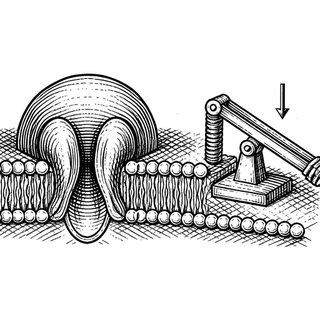
PIEZO channels are mechanosensitive ion channels. Translation: they open when physical force distorts the cell membrane. That matters for touch, pain, proprioception, organ stretch, and vascular flow. PIEZO2 helps with touch and body-position sensing. PIEZO1 shows up all over the place, including blood vessels and red blood cells (Xiao, 2024; Lacroix and Wijerathne, 2025).
For years, scientists had a strong model for how PIEZO works: the channel sits in the membrane like a curved dome, and membrane tension tends to flatten that dome. Flattening changes the channel and helps open it. Nice model. Also the kind that keeps scientists awake until somebody proves it with more than tasteful cartoons.
Mission Brief: What This New Paper Actually Did
Liu and colleagues went after that problem using Caenorhabditis elegans, a worm that has served in more biological campaigns than most of us realize. The team studied natural splice isoforms of the worm PIEZO channel, called PEZO-1, that differ in length. Same basic hardware, different attachments.
They combined patch-clamp electrophysiology with cryo-EM structural measurements and asked a clean question: do these different isoforms respond to different levels of membrane tension in the way the membrane-dome model predicts? Answer: yes. The isoforms showed different mechanosensitivity ranges, and those differences matched the predicted effects of changing the dome area. In plain English, changing the size of the bent membrane footprint changes how easily the channel opens under force (Liu et al., 2025).
That is the part worth underlining. The study does not just say PIEZO forms a dome. It argues that cells can tune sensitivity by changing the dome itself through alternative splicing. Same channel class, different mechanical setting.
Execution: Why This Is More Than Worm Trivia
This matters because mechanical life is not one-size-fits-all. A sensory ending in skin, a gut cell feeling stretch, and a neuron embedded in a stiff or squishy local environment do not face the same battlefield. They need different thresholds. Too sensitive, and every nudge becomes a five-alarm memo. Not sensitive enough, and important signals never make it up the chain of command.
Recent work keeps pointing in that direction. A 2024 review in Nature Reviews Molecular Cell Biology framed PIEZO channels as central machinery for converting membrane mechanics into biology across development, touch, pain, proprioception, and organ function (Xiao, 2024). A 2025 review in Biochemical Society Transactions argued that PIEZO channels may interpret distinct mechanical cues in distinct ways (Lacroix and Wijerathne, 2025, PMCID: PMC12010695). And a 2024 Science paper showed PIEZO-dependent mechanosensing helps intestinal stem cells read stiffness in their niche and maintain tissue homeostasis (Baghdadi et al., 2024).
There is also a human angle here. People with rare PIEZO2 defects struggle with aspects of touch and proprioception, which is the brain’s running estimate of where your limbs are without you watching them like a customs officer. NIH reporting has also highlighted PIEZO2 as part of why inflammation can make light touch hurt, which gives this whole field a direct line to pain research (NIH, 2025; NIH, 2024).
Assessment: The Real Payoff
The challenge this paper addresses is simple to state and hard to solve: how do cells tune a mechanosensor for different physical environments without reinventing the protein from scratch? Liu and colleagues offer a credible answer. They can edit the geometry. If the dome area changes, the force threshold changes.
If this mechanism holds up across more systems, it could help explain how related PIEZO channels support very different jobs in touch circuits, viscera, epithelia, and other tissues. It could also shape drug design. If researchers learn how cells naturally dial mechanosensitivity up or down, they may get better at calming channels involved in pain or abnormal tissue mechanics without shutting down the whole operation.
So the big takeaway is not just that a worm channel bends membranes. It is that membrane shape itself may act like a built-in regulator. Neuroscience usually gets the headlines for electrical drama. This paper reminds us that some of the best plot twists happen earlier, when a cell membrane changes curvature and a protein decides the pressure is now official business.
References
- Liu Y, Liu B, Zhan W, Zhang L, Shi A, Lin L, Jiang M, Guo YR. Membrane dome-based regulation mechanism of the mechanosensitive PIEZO channel. Cell Reports. 2025;44(2):116651. DOI: 10.1016/j.celrep.2025.116651
- Xiao B. Mechanisms of mechanotransduction and physiological roles of PIEZO channels. Nature Reviews Molecular Cell Biology. 2024;25(11):886-903. DOI: 10.1038/s41580-024-00773-5. PubMed: PMID 39251883
- Lacroix JJ, Wijerathne TD. PIEZO channels as multimodal mechanotransducers. Biochemical Society Transactions. 2025;53(1):293-302. DOI: 10.1042/BST20240419. PMCID: PMC12010695
- Baghdadi MB, Houtekamer RM, Perrin L, Rao-Bhatia A, Whelen M, Decker L, et al. PIEZO-dependent mechanosensing is essential for intestinal stem cell fate decision and maintenance. Science. 2024;386(6725):eadj7615. DOI: 10.1126/science.adj7615. PubMed: PMID 39607940
- Qin L, He T, Chen S, Yang D, Yi W, Cao H, et al. Roles of mechanosensitive channel Piezo1/2 proteins in skeleton and other tissues. Bone Research. 2021;9:44. DOI: 10.1038/s41413-021-00168-8. PMCID: PMC8526690
- NIH National Center for Complementary and Integrative Health. NIH study reveals how inflammation makes touch painful. April 23, 2025. https://www.nccih.nih.gov/news/press-releases/nih-study-reveals-how-inflammation-makes-touch-painful
- NIH News in Health. Trouble With Touch? April 2024. https://newsinhealth.nih.gov/2024/04/trouble-touch
Disclaimer: The image accompanying this article is for illustrative purposes only and does not depict actual experimental results, data, or biological mechanisms.