
Tiny pain alarms go up the spinal cord. Tiny brain commanders decide whether to turn the volume down or crank the room into DEFCON 1. That is the kid-version. The adult version is that a midbrain region called the periaqueductal gray, or PAG, sends orders into the locus coeruleus, or LC, and this new mouse study argues those orders do not get one uniform response. They get sorted, routed, and turned into different behavioral outcomes - one track for pain control, another for anxiety, because apparently even the brain runs on departmental politics.
The LC is a tiny blue-gray nucleus in the brainstem that sprays norepinephrine across the brain. It helps regulate arousal, vigilance, stress, and pain. The PAG sits nearby in the midbrain and helps run descending pain control. The headache has been figuring out why LC activity sometimes seems pain-relieving and other times looks like it is helping chronic pain and anxious behavior throw a house party nobody wanted.
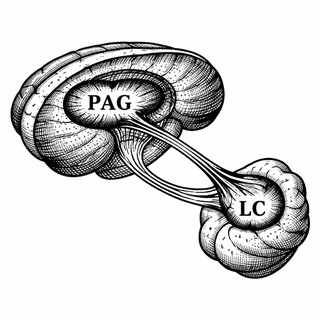
Harding and colleagues tackled that contradiction by looking at a specific input: projections from the ventrolateral PAG to the LC in mice with neuropathic pain. They combined optogenetics, electrophysiology, calcium imaging, and behavior testing. In plain English, they traced who talks to whom, watched the cells fire, then checked whether the mice acted less pain-sensitive, more anxious, or both.
Mission: Separate Pain Orders from Panic Orders
The key finding is not just that the PAG talks to the LC. We knew those two were acquainted. The interesting part is that glutamatergic and GABAergic PAG inputs were processed differently inside and around the LC. The paper argues this microcircuit sorting helps split output into distinct behavioral effects on pain and anxiety. Translation: one incoming message does not automatically produce one outgoing brain-state.
That matters because chronic pain is rarely just pain. It drags anxiety, low mood, poor sleep, and hypervigilance behind it like a bad convoy. Public health data keep making the same unpleasant point: chronic pain is common, and it often travels with anxiety and depression rather than politely staying in its lane (CDC; NINDS).
Execution: Why This Paper Is More Than Mouse Brain Origami
This study helps explain why older LC theories kept tripping over themselves. Recent reviews have argued that the LC is functionally heterogeneous, meaning different LC cell groups and projections can do very different jobs depending on the circuit involved (Torres-Berrio et al., 2022). A 2021 Brain paper also showed that different LC modules can support early analgesia on one timeline and later mood-related problems on another (Llorca-Torralba et al., 2022).
More specifically, a 2024 Science Advances study found that excitatory vlPAG input to the LC is a major driver of opioid antinociception, helping revise older descending pain models that focused heavily on serotonergic routes (Lubejko et al., 2024). The new Cell Reports paper pushes that story forward. The peri-LC region joins the operation, inhibitory and excitatory inputs are not interchangeable, and the downstream consequences for pain versus anxiety can diverge.
That is the kind of detail drug developers care about. If you can target the branch of the circuit that quiets pain without also ramping up anxiety, sedation, or stress responses, that is a better tactical plan than blasting the whole norepinephrine system and hoping for the best. Hope is not a mechanism.
Assessment: What This Could Mean in Real Life
If these findings hold up across labs and eventually connect to human biology, they point toward a more precise view of chronic pain treatment. Not "turn the LC on" or "turn the LC off." More like "engage this input, avoid that output." That distinction is huge, because for many patients the anxiety wrapped around chronic pain is not a side quest. It is part of the main battle.
There are limits. This is a mouse study. Mouse anxiety tests are useful, but they are not the same thing as a human lying awake at 3 a.m. bargaining with a lumbar disc and their insurance portal. Also, circuits this small do not usually volunteer for simple therapies. Still, this is the kind of work that turns a vague brainstem blob into an actionable map.
Bottom line: the LC is not one unit with one opinion. It is a cluster of strategic assets taking different orders from the PAG and sending them into different theaters. That makes the system messier. It also makes it more treatable. In neuroscience, that counts as a very good day.
References
- Harding EK, Zhang Z, Yu WL, Ferron L, van den Hoogen NJ, Trang T, Zamponi GW. Locus coeruleus microcircuitry processes periaqueductal gray inputs into distinct outputs for regulation of pain and anxiety. Cell Reports. 2025;45(1):116699. DOI: 10.1016/j.celrep.2025.116699. PubMed: 41391146.
- Torres-Berrio A, Lopez-Canul M, Sicre M, et al. The Role of the Locus Coeruleus in Pain and Associated Stress-Related Disorders. Biological Psychiatry. 2022;91(9):786-797. DOI: 10.1016/j.biopsych.2021.11.023.
- Lubejko ST, Livrizzi G, Buczynski SA, Patel J, Yung JC, Yaksh TL, Banghart MR. Inputs to the locus coeruleus from the periaqueductal gray and rostroventral medulla shape opioid-mediated descending pain modulation. Science Advances. 2024;10(17):eadj9581. DOI: 10.1126/sciadv.adj9581. PMCID: PMC11084283.
- Llorca-Torralba M, Camarena-Delgado C, Suarez-Pereira I, et al. Pain and depression comorbidity causes asymmetric plasticity in the locus coeruleus neurons. Brain. 2022;145(1):154-167. DOI: 10.1093/brain/awab239. PMCID: PMC8967092.
- Sirucek L, De Schoenmacker I, Gorrell LM, et al. The periaqueductal gray in chronic low back pain: dysregulated neurotransmitters and function. Pain. 2025;166(7):1690-1705. DOI: 10.1097/j.pain.0000000000003617.
- Donertas-Ayaz B, Caudle RM. Locus coeruleus-noradrenergic modulation of trigeminal pain: Implications for trigeminal neuralgia and psychiatric comorbidities. Neurobiology of Pain. 2023;13:100124. DOI: 10.1016/j.ynpai.2023.100124. PMCID: PMC10038791.
Disclaimer: The image accompanying this article is for illustrative purposes only and does not depict actual experimental results, data, or biological mechanisms.