
Trehalose dimycolate, or TDM, has the vibe of a very smug counterfeit security consultant. Its day job is sitting on the surface of mycobacteria, but in this new study it seems to moonlight as the thing that sweet-talks the brain's vascular bouncers into cracking the door open. Not by smashing through. That would be too obvious. More like leaning on the velvet rope until security suddenly decides, for reasons nobody loves, that the guest list is optional.
Tuberculous meningitis is one of the nastiest versions of tuberculosis. It happens when Mycobacterium tuberculosis gets into the central nervous system, and the outcome can be brutal: death, stroke, hydrocephalus, long hospital stays, and lasting cognitive problems. Recent reviews still describe it as the most lethal form of TB, with high mortality and a lot of survivors left with disability (Lourens et al., 2025; Barnacle et al., 2024). Meanwhile, TB overall remains a global heavyweight, with the World Health Organization reporting 1.23 million deaths in 2024 alone (WHO, 2025). So yes, this is not some obscure microbial side quest.
What makes this paper fun, in the scientific sense of "well that is unsettling," is that it zooms in on the very first step of brain invasion. Using transparent zebrafish larvae, Hayes and colleagues watched mycobacteria reach the brain's microvessels and start behaving like tiny, stubborn squatters. The surprise was that the bacteria reaching the brain were not hitching a ride inside immune cells, which is the classic "Trojan horse" idea people often discuss for TB dissemination. Instead, the brain-bound microbes were extracellular. Loose. Freelancing. Causing problems on their own time.
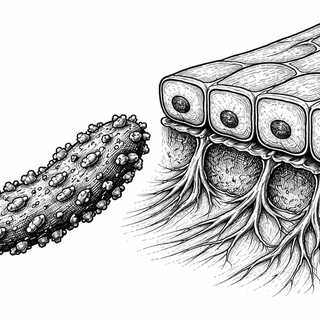
The Blood-Brain Barrier Is Supposed To Be A Control Freak
Normally, the blood-brain barrier is picky to the point of rudeness. Brain endothelial cells are stitched together by tight junctions, which act like molecular caulk between neighboring cells. That selectivity is great when you enjoy not having random blood-borne nonsense rummaging through your cortex.
Background sources on the blood-brain barrier and cord factor help here: the barrier's whole identity is built around selective passage, and TDM, also known as cord factor, has long been recognized as a major mycobacterial surface glycolipid with outsized effects on host immunity (Wikipedia: Blood-brain barrier; Wikipedia: Cord factor). In other words, the paper is not inventing a weird new molecule from nowhere. It is taking an old bacterial troublemaker and catching it doing a new crime.
Hayes et al. show that once mycobacteria stick to brain endothelial cells, they grow into microcolonies and trigger a reorganization of those tight junctions. Brief gaps appear between endothelial cells, and the bacteria slip through that paracellular route into the brain tissue. Then microglia, the brain's resident immune cells, get infected and the process that seeds Rich foci begins. Which is a rough start to a very bad story.
Meet Mincle, The Receptor With Terrible Houseguests
The host receptor at the center of this is Mincle, a C-type lectin receptor involved in innate immune recognition. TDM on the bacterial surface binds Mincle on the host side, and that interaction appears to be what reshapes the endothelial junctions enough to let bacteria through (Hayes et al., 2025). So the same molecular badge that helps mycobacteria survive elsewhere may also help them gain entry to the brain. Efficient. Rude, but efficient.
One especially intriguing twist is that this was not limited to the headline pathogen M. tuberculosis. M. marinum and even the usually nonpathogenic M. smegmatis could use the same route. That suggests this mechanism may rely on an old, conserved bit of mycobacterial biology rather than some fancy pathogen-only gadget. Evolution loves recycling. Why invent a new lockpick when the ancient one still opens doors?
Why This Matters Outside The Fish Tank
The obvious caveat is that zebrafish larvae are not tiny aquatic people, tempting though that mental image may be. But zebrafish are powerful for watching infection unfold in real time, and this study gives researchers a concrete mechanism to test in mammalian systems and, eventually, human disease.
That matters because TB meningitis still suffers from two giant problems. First, diagnosis is hard and often delayed. Second, even when treatment starts, outcomes are often poor, which is why recent expert commentary keeps calling for new approaches and better clinical guidance (Wasserman and Harrison, 2023; Donovan et al., 2025 guideline news). If this Mincle-TDM interaction turns out to be central in humans, it points to something rare and valuable: an early mechanistic choke point. Not a vague "inflammation is bad" hand-wave, but a specific handshake between bacterium and host that might be interrupted.
That does not mean we are one clever inhibitor away from solving TB meningitis. Biology is rarely that polite. Blocking Mincle could have immune side effects. Preventing barrier opening without trapping bacteria elsewhere might be tricky. And brain invasion is only the opening act. Still, identifying how the bacteria get in is a huge upgrade over shrugging and saying, more or less, "the pathogen somehow ends up in the brain, which seems suboptimal."
The big takeaway is simple: this paper makes TB meningitis feel less like an unavoidable catastrophe and more like a sequence of events with parts you can actually study, challenge, and maybe someday block. For a disease this deadly, that is a meaningful shift. Sometimes progress looks like a grand cure. Sometimes it looks like catching the burglar at the door.
References
Hayes MI, Ravishankar S, Shanahan JK, Fountain AJ, Ramakrishnan L, Madigan CA. Mycobacteria trehalose dimycolate interactions with host Mincle remodel blood-brain barrier junctions for brain invasion. Cell Reports. 2025;44(12):116661. DOI: https://doi.org/10.1016/j.celrep.2025.116661
Lourens R, Singh G, Arendse T, Thwaites G, Rohlwink U. Tuberculous Meningitis Across the Lifespan. The Journal of Infectious Diseases. 2025;231(5):1101-1111. DOI: https://doi.org/10.1093/infdis/jiaf181
Barnacle JR, Davis AG, Wilkinson RJ. Recent advances in understanding the human host immune response in tuberculous meningitis. Frontiers in Immunology. 2024;14:1326651. PMCID: https://pmc.ncbi.nlm.nih.gov/articles/PMC10803428/ DOI: https://doi.org/10.3389/fimmu.2023.1326651
Upton CM, Wiesner L, Dooley KE, Maartens G. Cerebrospinal Fluid and Tuberculous Meningitis. Clinical Infectious Diseases. 2023;77(1):158. PMCID: https://pmc.ncbi.nlm.nih.gov/articles/PMC11487151/ DOI: https://doi.org/10.1093/cid/ciad186
Sy MCC, Espiritu AI, Pascual JLR 5th. Global Frequency and Clinical Features of Stroke in Patients With Tuberculous Meningitis: A Systematic Review. JAMA Network Open. 2022;5(9):e2229282. PMCID: https://pmc.ncbi.nlm.nih.gov/articles/PMC9437750/ DOI: https://doi.org/10.1001/jamanetworkopen.2022.29282
Wasserman S, Harrison TS. Tuberculous Meningitis - New Approaches Needed. New England Journal of Medicine. 2023;389(15):1425-1426. DOI: https://doi.org/10.1056/NEJMe2310262
World Health Organization. Tuberculosis fact sheet. Updated April 2025. https://www.who.int/news-room/fact-sheets/detail/tuberculosis
Oxford University Nuffield Department of Medicine. Researchers develop first international clinical practice guideline for tuberculous meningitis. Published August 22, 2025. https://www.ndm.ox.ac.uk/news/researchers-develop-first-international-clinical-practice-guideline-for-tuberculous-meningitis
Disclaimer: The image accompanying this article is for illustrative purposes only and does not depict actual experimental results, data, or biological mechanisms.