
Boomers worry about memory. Millennials worry about burnout. Gen Z worries the buffering wheel in their head might be permanent. Different branding, same core issue: your synapses need to keep neurotransmitter-filled vesicles parked in exactly the right place, at exactly the right time, or the whole conversation between neurons gets sloppy fast.
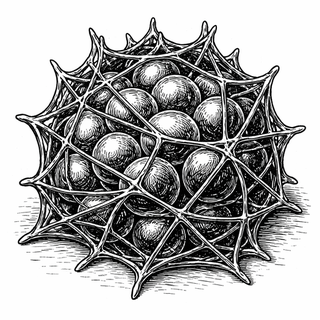
The new paper by Lennart Brodin and Oleg Shupliakov asks a sneaky question: when a synapse is firing hard, what keeps its vesicle stash from drifting away from the release site like shopping carts in a windy parking lot? Activity triggers an actin filament cage that wraps around the synaptic vesicle cluster and keeps that cluster anchored at the active zone, where release happens [1].
That matters because this vesicle cluster is not just a random pile of little spheres. Evidence has been building that synaptic vesicles behave more like a liquid-like condensate - a dense, organized blob held together by proteins such as synapsin, rather than by a membrane wall [2-5]. Which is elegant. Also mildly rude.
In this study, the authors used the giant reticulospinal synapse of the lamprey, a favorite system for ultrastructural work because the synapse is big enough to inspect in detail. They found that stimulation makes actin filaments grow from the periactive zone toward and over the vesicle cluster. When they disrupted that F-actin cage with cytochalasin D, latrunculin A, or botulinum C2 toxin, the vesicle cluster detached from the release site during activity [1].
The vesicle mass can still exist, but without the cage, it no longer stays where it is most useful.
Not A Bag Of Marbles, More Like Bubble Tea
If "liquid phase" sounds like something a physicist says right before ruining dessert, here is the simple version. Synapses need order and speed. A rigid scaffold is stable, yet slow. A free-floating slurry is flexible, yet chaotic. A liquid-like condensate gives you both: molecules can move around inside the cluster, while the cluster still behaves as a coherent body [2-4].
That idea has been getting stronger. A 2024 review in Trends in Biochemical Sciences argued that liquid-liquid phase separation may help organize not just synaptic vesicle clusters, but also the active zone and endocytic zone [2]. A 2024 Nature Communications paper showed that disturbing phase-separated organization selectively impairs evoked neurotransmission while largely sparing spontaneous release [3]. Another 2025 study in The EMBO Journal linked synapsin-vesicle condensates directly to actin sequestration and polymerization, making the new actin-cage result feel less like an oddity and more like part of a broader presynaptic design principle [5].
So the emerging picture looks like this: synapses use liquid-like organization for flexibility, then deploy actin as a temporary retaining wall when traffic gets heavy.
Why You Should Care, Even If You Are Not A Lamprey
This is basic neuroscience, not a near-term therapy paper. No one is about to prescribe "extra actin cage" to improve your Monday meeting.
Synapses face a nasty logistics problem. They must release vesicles in milliseconds, recycle components, restock supply, and keep doing it through bursts of activity without losing spatial precision. Synaptic vesicles are organized into functional pools, and the active zone is the release-specialized patch of presynaptic membrane where that traffic jam somehow works [6-8]. The new paper suggests actin is not just generic scaffolding. It acts like a positioning system that preserves the vesicle condensate at the release site during use [1].
Why does that matter outside a lamprey spinal cord? Because synaptic failure is one of the earliest themes in a long list of brain disorders. If presynaptic organization breaks down, signaling reliability breaks down with it. Reviews of presynaptic phase separation now connect these condensates to synaptic dysfunction and neurodegenerative disease [2]. That does not mean this paper explains Alzheimer’s or Parkinson’s by itself. It means it identifies one more piece of the machinery that healthy synapses rely on.
The machinery is intricate. Your neurons are sending messages by managing tiny membrane bubbles inside a liquid-like protein assembly, wrapped by an actin cage. You were hoping for "brain cells talk to each other." The brain said best I can do is molecular stagecraft.
The Catch, Because There Is Always One
This work was done in a specialized vertebrate synapse, using acute perturbations and structural readouts. That makes it powerful for mechanism, but not universal by decree. The next questions are whether the same cage dynamics show up across mammalian synapses and how they interact with synapsin and active-zone proteins in real time.
Still, the core idea is sharp: synapses may keep their vesicle "liquid" exactly where it needs to be by building a temporary actin fence during activity. Not glamorous. Just one more example of the brain solving impossible engineering problems with microscopic hardware.
References
- Brodin L, Shupliakov O. Actin cage for the synaptic vesicle liquid phase. Cell Reports. 2025. DOI: https://doi.org/10.1016/j.celrep.2025.116630
- Choi J, Rafiq NM, Park D. Liquid-liquid phase separation in presynaptic nerve terminals. Trends in Biochemical Sciences. 2024;49(10):888-900. DOI: https://doi.org/10.1016/j.tibs.2024.07.005
- Guzikowski NJ, et al. Functional specificity of liquid-liquid phase separation at the synapse. Nature Communications. 2024. DOI: https://doi.org/10.1038/s41467-024-54423-7
- McDonald NA, Shen K. Finding functions of phase separation in the presynapse. Current Opinion in Neurobiology. 2021;69:178-184. DOI: https://doi.org/10.1016/j.conb.2021.04.001
- Chhabra A, et al. Condensates of synaptic vesicles and synapsin-1 mediate actin sequestering and polymerization. The EMBO Journal. 2025;44(18):5112-5148. DOI: https://doi.org/10.1038/s44318-025-00516-y
- Wu X, Qiu H, Zhang M. Interactions between Membraneless Condensates and Membranous Organelles at the Presynapse: A Phase Separation View of Synaptic Vesicle Cycle. Journal of Molecular Biology. 2023;435(1):167629. DOI: https://doi.org/10.1016/j.jmb.2022.167629
- Held RG, Liang J, Brunger AT. Nanoscale architecture of synaptic vesicles and scaffolding complexes revealed by cryo-electron tomography. Proceedings of the National Academy of Sciences of the United States of America. 2024;121(27):e2403136121. DOI: https://doi.org/10.1073/pnas.2403136121. PMCID: https://pmc.ncbi.nlm.nih.gov/articles/PMC11228483/
- Shibata T, et al. Single-vesicle imaging reveals actin-dependent spatial restriction of vesicles at the active zone, essential for sustained transmission. Proceedings of the National Academy of Sciences of the United States of America. 2024. DOI: https://doi.org/10.1073/pnas.2402152121
Disclaimer: The image accompanying this article is for illustrative purposes only and does not depict actual experimental results, data, or biological mechanisms.