
While your eyes jump across this sentence, visual circuits are parsing shapes, working memory is hanging onto the last few words, and deeper brain loops are quietly helping decide what deserves attention. All of that is happening fast, messily, and with the confidence of a group project that somehow still turns in an A. A new paper asks a wild question: can you build a brain model detailed enough to reproduce some of that chaos and still teach you something new?
That is the pitch behind a new Nature Communications study from Anand Pathak and colleagues, who built a biomimetic model of corticostriatal micro-assemblies - small, biologically grounded neural circuits meant to preserve actual brain-ish details instead of sanding everything down into abstract math (Pathak et al., 2025). In plain English, it tries to connect spikes, rhythms, synapses, dopamine, and acetylcholine to behavior like working memory, categorization, and decision-making.
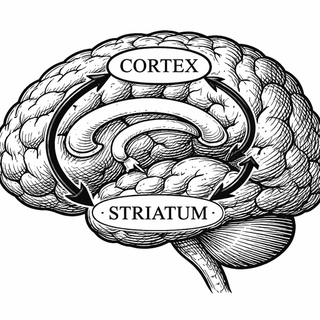
The team modeled loops between cortex and striatum, two regions involved in choosing actions, learning from outcomes, and keeping relevant information online for a few seconds. If the cortex is the office where ideas get pitched, the striatum is the colleague who says, "Fine, but are we actually doing this?"
Tiny Circuits, Big Behavior
The model was built from small recurring circuit motifs - little assemblies of excitatory and inhibitory neurons that act like biological building blocks. Put enough of those together, add cortex-striatum loops, let synapses change with experience, and you can ask whether larger cognitive functions emerge.
In this case, they did. The model generated simulated spiking, field-like activity, synchrony, learning-related synaptic change, and behavior during a categorization task. Then came the impressive part: it was compared against macaque data it had never been trained on, and it matched the animals surprisingly well. Not perfectly. But well enough to suggest it captured something real rather than producing decorative equations with commitment issues.
That matters because the field keeps splitting into elegant but biologically thin models on one side and rich but hard-to-interpret data on the other. Recent work suggests decision-making comes from distributed, flexible population dynamics, not one brain region pulling a giant lever (Okazawa and Kiani, 2023) (Shih et al., 2023). This paper tries to bridge that gap.
The Plot Twist: Error Neurons
Here is the plot twist. The simulation turned up a group of so-called "incongruent neurons" whose activity predicted upcoming mistakes. Not after the mistake. Before it.
Even better, the researchers then went back to real macaque recordings and found evidence for the same pattern there. That is the kind of result modelers want: not just fitting old data, but pointing humans toward something they missed in the real brain.
Why would a brain have neurons that seem to foreshadow errors? One possibility is that they are not merely "bad." They may reflect competing representations or exploratory tendencies that sometimes help when conditions change. That idea lines up with broader corticostriatal work showing a split between fast, action-biased signals and slower, more deliberative ones (Balewski et al., 2022). Brains are not clean little logic engines.
Why You Should Care Even If You Are Not a Monkey Doing Dot Homework
The long-term appeal here is not just "neat, a model did a trick." If this kind of framework keeps holding up, it could become a test bed for studying disorders where corticostriatal loops go sideways - Parkinson's disease, OCD, addiction, Huntington's disease, maybe parts of schizophrenia. Researchers could perturb a realistic model and ask which changes in receptors, rhythms, or synapses produce which behavioral failures.
That could also matter for drug development. In principle, you might simulate how a circuit responds before spending mountains of money on animal studies or early clinical trials. Emphasis on in principle. The direction is interesting because neuroscience increasingly needs tools that link neural activity to behavior in interpretable ways, not just high-accuracy black boxes (Schneider et al., 2023).
There is still plenty to be cautious about. This is one model, validated on a limited task, in relation to nonhuman primate data. And working memory is complicated enough that newer evidence points to mixed coding schemes rather than one simple persistent-activity story (Malleret et al., 2024). So no, this is not "we solved the brain." It is more like "we found a map that finally includes some side streets."
That is a big deal. Not because it solves the brain, but because it shows a model can preserve biological guts, reproduce real behavior, and uncover something scientists had not noticed.
References
Pathak A, Brincat SL, Organtzidis H, Strey HH, Senneff S, Antzoulatos EG, Mujica-Parodi LR, Miller EK, Granger R. Biomimetic model of corticostriatal micro-assemblies discovers a neural code. Nature Communications. 2025. DOI: https://doi.org/10.1038/s41467-025-67076-x
Balewski ZZ, Knudsen EB, Wallis JD. Fast and slow contributions to decision-making in corticostriatal circuits. Neuron. 2022;110(13):2170-2182.e4. DOI: https://doi.org/10.1016/j.neuron.2022.04.005 PMCID: https://pmc.ncbi.nlm.nih.gov/articles/PMC9262822/
Okazawa G, Kiani R. Neural mechanisms that make perceptual decisions flexible. Annual Review of Physiology. 2023;85:191-215. DOI: https://doi.org/10.1146/annurev-physiol-031722-024731 PMCID: https://pmc.ncbi.nlm.nih.gov/articles/PMC10308708/
Shih WY, Yu HY, Lee CC, Chou CC, Chen C, Glimcher PW, Wu SW. Electrophysiological population dynamics reveal context dependencies during decision making in human frontal cortex. Nature Communications. 2023;14:7821. DOI: https://doi.org/10.1038/s41467-023-42092-x
Schneider S, Lee JH, Mathis MW. Learnable latent embeddings for joint behavioural and neural analysis. Nature. 2023;617(7960):360-368. DOI: https://doi.org/10.1038/s41586-023-06031-6 PMCID: https://pmc.ncbi.nlm.nih.gov/articles/PMC10172131/
Malleret G, Salin P, Mazza S, Plancher G. Working memory forgetting: Bridging gaps between human and animal studies. Neuroscience and Biobehavioral Reviews. 2024;163:105742. DOI: https://doi.org/10.1016/j.neubiorev.2024.105742
Disclaimer: The image accompanying this article is for illustrative purposes only and does not depict actual experimental results, data, or biological mechanisms.