
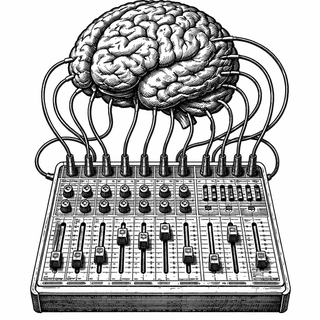
Brains do not evolve by slapping a brand-new "be smarter" button onto a skull and calling it a day. There is no hidden switch labeled add opera, tool use, and anxiety about email. What actually happens is messier and much more interesting: evolution tweaks the regulatory networks that tell brain cells when to turn genes on, off, up, or down - like a cosmic sound engineer adjusting thousands of sliders and somehow ending up with bats, whales, mice, and us.
That is the big idea in a recent review by Rajee Ganesan and Andreas Pfenning on how mammalian brain regulatory networks evolve.[1] If that phrase sounds like it was designed in a lab to scare away normal people, fair enough. But stick with me, because this is really about one of biology's sneakiest tricks: using mostly the same genes to build wildly different minds.
Same Parts, Different Playlist
Mammalian brains are made of many distinct cell types - neurons, glia, and a whole cast of microscopic weirdos with highly specific jobs. Most mammals share a lot of the same genes, which raises an obvious question: if the ingredients are so similar, why does one animal echolocate, another hibernate, and another invent LinkedIn?
A big part of the answer lies in gene regulatory networks. These are the systems that control gene activity - which genes get used, in which cells, at what time, and how strongly.[2] Think less "different hardware" and more "same keyboard, wildly different playlist." A tiny regulatory change in a specific brain cell type can ripple outward into altered circuits and behavior.
The review argues that modern tools are finally letting scientists connect these levels - from DNA regulation, to cell types, to circuits, to behavior. Which is ambitious. Also a little rude to the rest of biology, frankly.
Scientists Are Now Eavesdropping on Individual Brain Cells
Older methods often blended together huge numbers of cells, which is a bit like trying to understand a symphony by recording the parking lot. Newer approaches - especially single-cell RNA sequencing and spatial transcriptomics - let researchers measure gene activity in individual cells and map where those cells sit in the brain.[3,4]
That matters because evolution does not act on a generic blob called "brain tissue." It acts on specific cell populations in specific regions. One neuron type in the cortex may stay highly conserved across species, while another in the hypothalamus may show major divergence tied to ecology or social behavior.
Recent comparative studies have shown both deep conservation and surprising innovation across vertebrate brains. Cell types can persist across vast evolutionary timescales, yet the regulatory programs inside them can drift, split, or acquire new features.[3,5] It is a little like discovering that your favorite dive bar and a Michelin-starred restaurant both still rely on onions, heat, and regret - but the menu outcomes are not remotely the same.
Why This Is a Big Deal for Behavior
If researchers can trace how regulatory networks changed over evolution, they may be able to explain how complex behaviors emerge without pretending there is a single "gene for" intelligence, parenting, vocal learning, or whatever headline writers are yelling about this week.
This matters for basic science, because behavior is one of the hardest things to connect back to molecules without losing your mind in the process. It also matters for medicine. Many neuropsychiatric and neurodevelopmental disorders involve altered gene regulation, often in particular cell types rather than across the whole brain.[6,7] So understanding regulatory networks across species could help identify what is deeply conserved biology and what is uniquely human, or at least uniquely primate and annoyingly difficult to model in mice.
And yes, mice remain extremely useful. But if you're asking a mouse to explain human language or schizophrenia, you are already leaning pretty hard on its job description.
The Cool Part - and the Headache
The review is optimistic, but not in the fake "science has solved everything" way. The field faces real problems.
First, cross-species comparisons are hard. Brain regions do not always line up neatly. Cell types do not come with little name tags. Data sets are huge, noisy, and generated with methods that change every six months because scientists apparently enjoy chaos.[1]
Second, regulatory networks are difficult to infer confidently. Just because two genes appear active together does not mean one controls the other. Biology loves correlation almost as much as the internet does.
Third, perturbation experiments - actually changing regulatory elements to test what they do - are still much easier in simplified systems than in living brains across diverse species.[1,8] In other words, we are getting better at reading the brain's rulebook, but editing it in the wild remains a high-stakes, many-tools-flying-off-the-table situation.
So What Happens Next?
If these methods keep improving, researchers may be able to build a far more precise map of how evolution reshapes brain cell identity and behavior. Not a cartoon version where "humans got bigger brains and became special," but a detailed account of which regulatory programs shifted, in which cells, and with what consequences.
That could reshape how we study evolution, animal behavior, and brain disease all at once. It might even help explain why some traits remain stable for millions of years while others take off into bizarre new territory. Nature, as usual, is less like an engineer building from scratch and more like a sleep-deprived coder patching legacy software that somehow still runs the planet.
References
-
Ganesan R, Pfenning AR. Evolution of Mammalian Regulatory Networks in the Brain. Annu Rev Anim Biosci. 2025. doi:10.1146/annurev-animal-111523-102317
-
Gene regulatory network. Wikipedia. https://en.wikipedia.org/wiki/Gene_regulatory_network
-
Bakken TE, Jorstad NL, Hu Q, et al. Comparative cellular analysis of motor cortex in human, marmoset and mouse. Nature. 2021;598:111-119. doi:10.1038/s41586-021-03465-8 PMCID: PMC9729112
-
Spatial transcriptomics. Wikipedia. https://en.wikipedia.org/wiki/Spatial_transcriptomics
-
Siletti K, Hodge RD, Bakken TE, et al. Universal principles of brain cell-type evolution revealed by comparative analysis of bird and mammal brains. Science. 2024;384:eadl2947. doi:10.1126/science.adl2947
-
Satterstrom FK, Kosmicki JA, Wang J, et al. Large-scale exome sequencing study implicates both developmental and functional changes in the neurobiology of autism. Cell. 2020;180(3):568-584.e23. doi:10.1016/j.cell.2019.12.036 PMCID: PMC7287879
-
Bryois J, Skene NG, Hansen TF, et al. Genetic identification of cell types underlying brain complex traits yields insights into the etiology of Parkinson's disease. Nat Genet. 2020;52:482-493. doi:10.1038/s41588-020-0610-9 PMCID: PMC7642879
-
Broome BM, Zhang B, Liu Y, et al. Functional interrogation of enhancers in the native chromatin and cellular context. Nat Rev Genet. 2024;25:183-200. doi:10.1038/s41576-023-00667-y
Disclaimer: The image accompanying this article is for illustrative purposes only and does not depict actual experimental results, data, or biological mechanisms.