
As a kid, you probably learned early that the classroom felt different depending on who was in it. Same walls, same desks, same suspicious smell near the art supplies - but swap out the loud kids, the quiet kids, the one tiny tyrant who treated group projects like a hostage situation, and suddenly the whole room runs on a different logic. Neuroscientists are now making a similar point about the brain: the big sweeping networks we see on scans may look like architecture, but architecture alone tells you very little unless you know who lives there.
That is the charm of a new Nature Communications paper by Guozheng Feng and colleagues. The team stitched together gene-expression atlases, single-nucleus RNA sequencing, neurotransmitter maps, mitochondrial measures, and functional MRI to ask a deliciously awkward question: when we talk about the brain's large-scale networks, are we seeing abstract circuitry, or the consequences of local cellular and molecular neighborhoods doing their thing? [1]
The Brain's Seating Chart
The headline finding is simple enough to tell your smartest insomniac friend over a late drink: intrinsic connectivity networks line up with distinct mixes of cell types, neurotransmitter systems, and metabolic features. Not just locally, either. Networks that resemble each other in their cellular and molecular makeup also tend to resemble each other in how they connect and fluctuate together.
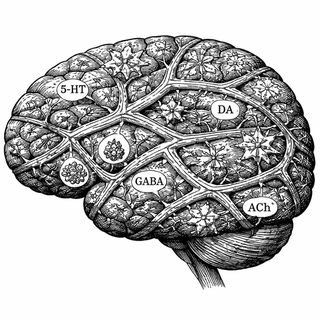
In other words, the brain is not merely a map of roads. It is a map of roads shaped by zoning laws, power stations, and a cast of characters with very different temperaments. A sensorimotor network is not the default mode network wearing a fake mustache. It is built from somewhat different biological ingredients, and those ingredients appear to matter. Recent reviews have been arguing for exactly this kind of "biologically annotated" connectome, where network maps come with gene, receptor, and cellular context attached [2,3].
Why This Is More Than Fancy Cartography
One of the most interesting parts of the paper is that these biological signatures do not just track where networks are. They also relate to what those networks do. The authors report that certain intrinsic networks mediate links between microscale cell-type patterns and domain-specific cognitive functions, while functional network connectivity helps bridge cell-type and neurotransmitter similarity to cognitive organization [1].
That sounds technical because it is technical. But the basic point is wonderfully human: thinking may depend not only on which brain areas talk, but on the molecular accent of the neighborhoods doing the talking.
The brain hates being explained at one scale only. This is rude of it, but consistent.
Neuroscience has lived for years with a split-screen problem. Molecular biology tells us about receptors, genes, and cell classes. Neuroimaging gives us large-scale network dynamics. Both are valuable, yet they often pass each other like exes at a wedding. This study tries to get them back into the same room.
Why You Should Care, Even If You're Not Dating an fMRI Scanner
If these findings hold up and generalize, they could make brain imaging less descriptive and more explanatory. Instead of saying, "this network looks altered," researchers could start asking which cell populations, neurotransmitter systems, or metabolic constraints may be helping produce that altered pattern.
That is where the real-world stakes enter. Recent work has already linked molecularly informed network analyses to psychiatric heterogeneity, including schizophrenia, bipolar disorder, and ADHD, with the hope of finding biomarkers closer to mechanism than a blurry symptom checklist [4]. Large meta-analytic work also suggests that robust functional hubs carry distinctive transcriptomic signatures tied to neurodevelopment, signaling, and metabolism [5]. We may be inching toward a world where a brain scan is not just a weather report, but a clue about the machinery generating the weather.
There are still obvious problems. Most of these cellular and molecular maps come from postmortem datasets with limited donors. Spatial alignment across modalities is hard. Correlation is not causation, no matter how elegant the heatmap looks at 2 a.m. And the brain, ever the diva, changes across development, aging, sex, disease state, and probably mood.
Still, the direction is hard to ignore. Recent reporting on cortical network mapping, gene-regulation atlases, and expert calls for clinically useful imaging biomarkers all point the same way: neuroscience wants maps that are not only bigger, but biologically legible.
And perhaps that is the paradox this paper helps resolve. The brain feels unified because its networks coordinate at grand scale, yet that unity may be constrained by tiny local details: specific cells, specific receptors, specific metabolic habits, each one doing its small, fussy job. Grandeur, apparently, is assembled from gossip at the cellular level.
References
- Feng G, Chen J, Sui J, Calhoun VD. Cellular and molecular associations with intrinsic brain organization. Nature Communications. 2025;16(1):11641. DOI: 10.1038/s41467-025-66291-w. PubMed: 41298470.
- Bazinet V, Hansen JY, Misic B. Towards a biologically annotated brain connectome. Nature Reviews Neuroscience. 2023;24(12):747-760. DOI: 10.1038/s41583-023-00752-3. PubMed: 37848663.
- Lawn T, Howard MA, Turkheimer F, Misic B, Deco G, Martins D, Dipasquale O. From neurotransmitters to networks: Transcending organisational hierarchies with molecular-informed functional imaging. Neuroscience and Biobehavioral Reviews. 2023;150:105193. DOI: 10.1016/j.neubiorev.2023.105193. PMCID: PMC10390343.
- Lawn T, Giacomel E, Martins D, Veronese M, Howard MA, Turkheimer F, Dipasquale O. Normative modelling of molecular-based functional circuits captures clinical heterogeneity transdiagnostically in psychiatric patients. Communications Biology. 2024;7:689. DOI: 10.1038/s42003-024-06391-3. PubMed: 38839931.
- Xu Z, Xia M, Wang X, Liao X, Zhao T, He Y. Meta-connectomic analysis maps consistent, reproducible, and transcriptionally relevant functional connectome hubs in the human brain. Communications Biology. 2022;5(1):1056. DOI: 10.1038/s42003-022-04028-x. PMCID: PMC9532385.
Disclaimer: The image accompanying this article is for illustrative purposes only and does not depict actual experimental results, data, or biological mechanisms.