
Visual cortex is decoding these letters. Auditory regions may be ghost-reading them in your head. Frontal areas are deciding whether to stay with this paragraph or go check your phone. Meanwhile deeper arousal systems are fiddling with the gain knob. Reading is never just reading. It is a committee meeting in meat.
A new study in Cell Reports asks what happens when decision-making slides from crisp to crooked. Akhil Bandi and colleagues trained mice on a navigation-based sound-localization task, then tracked behavior while recording and perturbing activity in the posterior parietal cortex, or PPC - a region that helps link sensation, attention, and action [1].
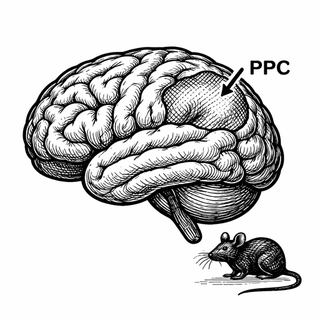
Their answer is blunt: PPC is not just watching decisions happen. It helps keep the animal in a better decision-making state.
Not all bad decisions are equal
The mice were good at the task, but not consistently good. Sometimes they used the sound cue well and landed in a high-performance state. Other times they slipped into low-performance states, where bias started steering the wheel. Less "I heard the sound" and more "left feels right for mysterious reasons."
The team used a hidden Markov model to identify those latent states. That matters because average accuracy can hide a messy reality. A mouse can look competent overall while quietly alternating between focused and biased modes. So can a person. Ask anyone who has replied all by mistake.
The parietal cortex is not a bystander
Then came the useful part: causality. The researchers temporarily inactivated PPC with optogenetics. Accuracy dropped, and the mice spent more time in those biased, low-performance states [1].
That is the paper's cleanest point. Lots of neuroscience studies find a correlation, nod gravely, and leave. This one pushed the circuit and watched behavior sag. If PPC were only echoing a decision made somewhere else, silencing it should not so neatly shove the animals toward worse decision modes.
This fits a broader trend. A 2022 Nature Communications paper argued that evidence accumulation is computed locally in parietal cortex [2]. A 2024 Nature study mapped synaptic wiring motifs in mouse PPC that seem suited for learned decisions [3]. The region looks less like a passive relay and more like a working part of the machine.
Brain state is the invisible coworker
The imaging results add the second half of the story. Performance state strongly changed population activity in PPC, but much less in primary auditory cortex [1]. So the main action was not in the region hearing the sound. It was in an association area where the brain mixes evidence with context and internal conditions.
That lines up with other work on fluctuating brain states. In children with attention problems, latent frontoparietal and salience-network states predict differences in evidence accumulation and attention [4]. In humans, parietal stimulation can also alter how ambiguity is handled during decisions [5].
The useful picture is not "the brain gets information and makes a choice." It is "the brain gets information while already being alert, distracted, biased, tired, motivated, or half somewhere else, and that state changes what the information gets to mean."
Why this matters outside a mouse maze
If this line of work holds up, it matters anywhere decision quality rises and falls with internal state: fatigue, stress, ADHD, anxiety, overload, maybe just ordinary bad days. The practical goal is not to crown PPC as the single decision boss. That would be lazy. The better goal is to understand how brain circuits stabilize a high-performance state, detect when it is slipping, and maybe one day push it back.
That could matter for clinical disorders, for brain-computer interfaces, and for the broader shift toward studying decisions in more natural settings. A 2023 review on perceptual and sequential decision-making makes that point clearly: the field is moving beyond toy tasks and toward behavior that looks more like real life [6]. This paper fits that move well.
There is still a caveat the size of a lab mouse. These are mice in a specialized task, and "internal state" is inferred rather than directly measured. But the study does something solid. It ties behavior, population activity, and causal intervention into one story. And the story is that a parietal circuit helps decide whether evidence gets a fair hearing.
Which is more than some committees manage.
References
- Bandi AC, McCann JP, Carpenter RM, Lower MJ, Long JN, Runyan CA. Parietal cortex is causally required for state-dependent decisions. Cell Reports. 2025;44(12):116672. DOI: https://doi.org/10.1016/j.celrep.2025.116672
- Zhang Z, Yin C, Yang T. Evidence accumulation occurs locally in the parietal cortex. Nature Communications. 2022;13:4426. DOI: https://doi.org/10.1038/s41467-022-32210-6
- Kuan AT, Bondanelli G, Driscoll LN, et al. Synaptic wiring motifs in posterior parietal cortex support decision-making. Nature. 2024;627:367-373. DOI: https://doi.org/10.1038/s41586-024-07088-7
- Cai W, Warren SL, Duberg K, et al. Latent brain state dynamics distinguish behavioral variability, impaired decision-making, and inattention. Molecular Psychiatry. 2021;26(9):4944-4957. DOI: https://doi.org/10.1038/s41380-021-01022-3 PMCID: https://pmc.ncbi.nlm.nih.gov/articles/PMC8589642/
- Valdebenito-Oyarzo G, Martínez-Molina MP, Soto-Icaza P, et al. The parietal cortex has a causal role in ambiguity computations in humans. PLOS Biology. 2024;22(1):e3002452. DOI: https://doi.org/10.1371/journal.pbio.3002452
- Jerjian SJ, Harsch DR, Fetsch CR. Self-motion perception and sequential decision-making: where are we heading? Philosophical Transactions of the Royal Society B. 2023;378(1886):20220333. DOI: https://doi.org/10.1098/rstb.2022.0333 PMCID: https://pmc.ncbi.nlm.nih.gov/articles/PMC10404932/
Disclaimer: The image accompanying this article is for illustrative purposes only and does not depict actual experimental results, data, or biological mechanisms.