
While your eyes skid across these words, neurons are firing, synapses are trading tiny chemical gossip, and some overworked molecular custodian is probably already muttering about tonight's cleanup shift. That is the strange promise of sleep - not just that it makes you less likely to become a daytime goblin, but that it may exist because nerve cells need protected time to repair themselves. Which is why this new jellyfish story feels less like trivia and more like philosophy wearing flippers.
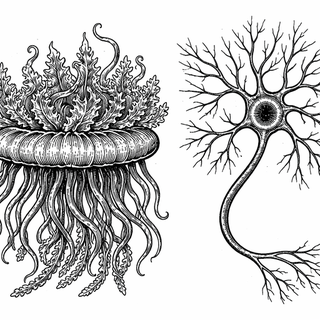
The paper behind the headline is not claiming that jellyfish are out there dreaming about being late to algebra. The real finding is subtler and, honestly, weirder. A 2026 study looked at the upside-down jellyfish Cassiopea andromeda and the sea anemone Nematostella vectensis - animals from ancient cnidarian lineages that have neurons but no centralized brain. The researchers found that both spend about one-third of the day in a sleep-like state, even though their daily schedules differ. The jellyfish mostly slept at night, with quick midday naps, while the sea anemones followed a more crepuscular routine. Sleep deprivation triggered rebound sleep, melatonin promoted sleep, and DNA damage in neurons rose during wakefulness and fell during sleep (Aguillon et al., 2026).
That matters because sleep has always looked a bit like the Ship of Theseus problem in pajamas. Is sleep for memory? For energy? For clearing waste? For keeping neural circuits from turning into a group chat with no moderator? Probably some of all that. But this study pushes one idea forward: maybe one ancient job of sleep was basic cellular maintenance, long before evolution built the deluxe penthouse brains that humans now use to worry about email.
Sleep Before Brains Got Fancy
This is not the first time jellyfish have ruined our tidy categories. Back in 2017, researchers showed that Cassiopea meets classic behavioral criteria for sleep: reduced activity, lower responsiveness, and rebound after deprivation (Nath et al., 2017). The new work sharpens that story. It suggests sleep in these animals is not just a lazy wobble in a tank, but a regulated biological state linked to neuronal wear and tear.
Cnidarians run on a decentralized nerve net rather than a bossy command center. No cortex. No hippocampus. No inner monologue doing dramatic readings of your bad decisions from 2014. And yet they still seem to need downtime. That is the part that should make you sit up a little straighter: if creatures without brains still need sleep, then sleep probably did not evolve for consciousness, dreams, or cleverness. It may have evolved because neurons are delicate, non-dividing prima donnas, and staying electrically active all the time is rough on their DNA.
That idea has been gaining traction. In zebrafish and mice, sleep appears to help reduce neuronal DNA damage, and the enzyme PARP1 seems to help convert that damage into sleep pressure - basically turning molecular trouble into a biological "go to bed" signal (Zada et al., 2021). A 2022 Nature Reviews Neuroscience highlight boiled that down neatly: DNA damage can help drive sleep itself (Lewis, 2022).
Why You Should Care, Even If You Are Not a Jellyfish
The practical lesson is not "buy melatonin for your aquarium." It is that sleep may be less like an optional lifestyle upgrade and more like scheduled maintenance on excitable cells. Skip enough of it, and the cost may show up not only in mood, memory, and attention, but in the long-term bookkeeping of cellular health. Recent reviews argue that sleep homeostasis is deeply tied to metabolism, redox balance, and mitochondrial state - which is science-speak for the idea that cells can only run hot for so long before they need repair time (Hartmann and Kempf, 2023); (Sarnataro et al., 2025).
There is also a useful dose of humility here. Human sleep is full of elaborate stage changes, local brain rhythms, and the sort of physiological choreography that makes sleep scientists gently sigh when the rest of us say, "I dunno, I was unconscious." A recent review makes the point that sleep is not one monolithic thing even in humans (Andrillon and Oudiette, 2023). So no, jellyfish are not "sleeping exactly like humans." But they may be doing a version of the oldest part of the job.
That opens a bigger question. If sleep began as a way to protect neurons from accumulated damage, when did all the extra features get bolted on - memory consolidation, dreaming, emotional recalibration, the whole nighttime software patch? Evolution loves this sort of mission creep. First you invent a hut to keep out the rain; a few million years later someone has added marble columns and a panic room.
For now, the challenge is not overclaiming. These are not human brains in miniature, and sleep in simple animals is defined behaviorally and molecularly, not by the full menu of mammalian sleep stages. But as a clue to why sleep exists at all, this is a good one. It suggests that before sleep became poetic, psychological, or cinematic, it may have been something more basic: a ceasefire that lets vulnerable cells stop improvising and start repairing.
Which is funny, in a mildly existential way. You spend the day thinking your mind is a grand theater of ideas; then a jellyfish drifts by, brainless and translucent, to remind you that part of the whole operation may just be janitorial.
References
Peeples L. Jellyfish sleep like humans - even though they don't have brains. Nature. 2026;649(8097):538-539. https://doi.org/10.1038/d41586-026-00044-7
Aguillon R, Harduf A, Sagi D, Simon-Blecher N, Levy O, Appelbaum L. DNA damage modulates sleep drive in basal cnidarians with divergent chronotypes. Nature Communications. 2026;17:3. https://doi.org/10.1038/s41467-025-67400-5
Nath RD, Bedbrook CN, Abrams MJ, et al. The Jellyfish Cassiopea Exhibits a Sleep-like State. Current Biology. 2017;27(19):2984-2990.e3. https://doi.org/10.1016/j.cub.2017.08.014
Zada D, Sela Y, Matosevich N, et al. Parp1 promotes sleep, which enhances DNA repair in neurons. Molecular Cell. 2021;81(24):4979-4993.e7. https://doi.org/10.1016/j.molcel.2021.10.026
Lewis S. DNA damage drives sleep. Nature Reviews Neuroscience. 2022;23(2):69. https://doi.org/10.1038/s41583-021-00550-9
Hartmann C, Kempf A. Mitochondrial control of sleep. Current Opinion in Neurobiology. 2023;81:102733. https://doi.org/10.1016/j.conb.2023.102733
Andrillon T, Oudiette D. What is sleep exactly? Global and local modulations of sleep oscillations all around the clock. Neuroscience & Biobehavioral Reviews. 2023;155:105465. https://doi.org/10.1016/j.neubiorev.2023.105465
Sarnataro R, Velasco CD, Monaco N, Kempf A, Miesenbock G. Mitochondrial origins of the pressure to sleep. Nature. 2025;645:722-728. https://doi.org/10.1038/s41586-025-09261-y
Disclaimer: The image accompanying this article is for illustrative purposes only and does not depict actual experimental results, data, or biological mechanisms.