
Dementia may begin as a traffic-control problem, not a memory problem. Long before a neuron fully falls apart, its internal rail system can slip out of time. And when timing fails inside a cell that stretches like a weird biological extension cord, bad things pile up fast.
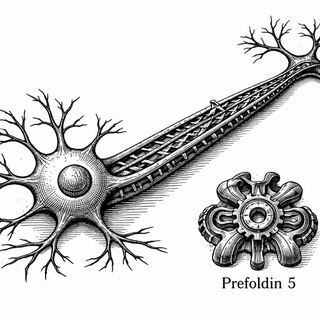
That is the setup behind a paper on tau, the microtubule-loving protein that normally helps neurons keep their tracks in working order. When tau goes rogue, it can clump into aggregates linked to tauopathies, including Alzheimer’s disease. In this study, researchers used fruit flies carrying a toxic human tau variant and found that Prefoldin 5, or Pfdn5, acts like an unexpected maintenance tech for that system. Lose it, and tau aggregation gets worse. Add more of it, and some of tau’s damage eases up.[1]
Tau Is Supposed to Be the Helpful One
Under ordinary conditions, tau is part scaffold, part traffic cop. It helps microtubules stay organized so cargo can move up and down neurons on schedule. That matters because neurons are built like absurdly overengineered train networks. A signal has to leave one end, supplies have to arrive at another, and nobody gets to call a contractor when the line backs up.
The trouble starts when tau stops behaving like a track-stabilizer and starts behaving like damp confetti. It detaches, misfolds, and can seed larger aggregates. Recent reviews tie tau pathology closely to neurodegeneration, synapse loss, and cognitive decline.[2][3]
Meet Prefoldin 5, the Surprise Shop Foreman
Prefoldin is usually introduced as a molecular chaperone, meaning it helps other proteins fold properly instead of becoming biochemical spaghetti. It is especially known for helping handle tubulin, the building block of microtubules. So you might expect Pfdn5 to matter in a respectable way, like a warehouse manager who labels every box correctly.
Bisht and colleagues found something more interesting. In their fly model, Pfdn5 did not just influence tubulin levels. It also associated with axonal microtubules themselves. When the researchers removed Pfdn5, microtubule-related defects appeared, tau aggregates increased, neurotoxicity worsened, and memory problems got sharper. When they overexpressed Pfdn5 in neurons, they saw less age-dependent neurodegeneration and better learning and long-term memory outcomes.[1] The protein that looked like a backstage folding assistant may also be standing right on the tracks, helping keep the timing system from turning into a Rube Goldberg disaster.
Why This Is More Than Fly Drama
No, fruit flies are not tiny retirees with Alzheimer’s. But they are excellent for asking mechanistic questions fast. If a protein consistently changes tau toxicity in an animal nervous system, that gives researchers a lead.
This matters because tau biology has been frustrating in the way expensive watches are frustrating. The pieces all clearly interact, but if one spring slips by half a millimeter the whole thing lies to your face. Other studies point the same way: tau aggregation depends heavily on its relationship with the microtubule system and with the proteins that police folding and assembly. MAP2 can cap tau fibrils and block further growth.[4] A 2026 Nature Communications paper showed that tubulin can push tau-containing condensates away from pathological states and toward more physiological ones.[5] Even when chaperones help break aggregates apart, the story is messy, because disaggregation can create new seeds instead of neatly solving the problem.[6]
In other words, tau is not just "bad protein clumps happen." It is a timing, structure, and quality-control problem. Very on-brand for the brain, that overcomplicated little machine that never met a simple solution it could not ignore.
What Could This Lead To?
If these findings hold up in mammals and human systems, Pfdn5 or pathways like it could become attractive therapeutic targets. Not because anyone should sprint from fruit flies to miracle cure headlines, but because this gives scientists a more precise handle on where to intervene. Maybe you boost a protective chaperone. Maybe you mimic the part of its function that keeps tau from leaving the rails. Maybe you support microtubule stability while also reducing toxic aggregation.
The larger clinical picture is still unsettled. As of May 26, 2026, tau PET imaging is already part of the clinical toolkit, and tau-targeting therapies are moving forward, but there is still no FDA-approved disease-modifying therapy that specifically targets tau itself.[7][8] That makes studies like this useful in a very practical way. They help define which piece of the clockwork to grab next.
So the headline here is not that scientists found a magic anti-tangle switch. It is that they identified a plausible protein that seems to protect neurons from tau chaos by helping the microtubule system keep time. In neurodegeneration research, that counts as real progress. Sometimes the biggest insight is not a new villain. It is finding the mechanic who was quietly holding the machine together.
References
- Bisht A, Pippadpally S, Majumder S, et al. Prefoldin 5 is a microtubule-associated protein that suppresses Tau aggregation and neurotoxicity. eLife. 2026;13:RP104691. doi:10.7554/eLife.104691. PMCID:PMC12803513
- Samudra N, Lane-Donovan C, VandeVrede L, Boxer AL. Tau pathology in neurodegenerative disease: disease mechanisms and therapeutic avenues. J Clin Invest. 2023;133(12):e168553. doi:10.1172/JCI168553. PMCID:PMC10266783
- Boyko S, Surewicz WK. Tau liquid-liquid phase separation in neurodegenerative diseases. Trends Cell Biol. 2022;32(7):611-623. doi:10.1016/j.tcb.2022.01.011. PMCID:PMC9189016
- Holden MR, Krzesinski BJ, Weismiller HA, et al. MAP2 caps tau fibrils and inhibits aggregation. J Biol Chem. 2023;299(7):104891. doi:10.1016/j.jbc.2023.104891. PMCID:PMC10404690
- Lucas L, Tsoi PS, Quan MD, et al. Tubulin transforms Tau and α-synuclein condensates from pathological to physiological. Nat Commun. 2026;17:3362. doi:10.1038/s41467-026-69618-3. PMCID:PMC13065850
- Saha I, Yuste-Checa P, Da Silva Padilha M, et al. The AAA+ chaperone VCP disaggregates Tau fibrils and generates aggregate seeds in a cellular system. Nat Commun. 2023;14(1):560. doi:10.1038/s41467-023-36058-2
- Courade JP, Zetterberg H, Höglinger GU, Dewachter I. The evolving landscape of Alzheimer's disease therapy: From Aβ to tau. Cell. 2025;188(26):7337-7354. doi:10.1016/j.cell.2025.11.033
- Alzheimer's Association. Updated Appropriate Use Criteria for Amyloid and Tau PET Imaging. 2025. Available at: https://pro.alz.org/hub/care-pathway/detection-diagnosis/updated-appropriate-use-criteria-for-amyloid-and-tau-pet
Disclaimer: The image accompanying this article is for illustrative purposes only and does not depict actual experimental results, data, or biological mechanisms.