
In basically every superhero movie, the loud one gets the poster and the quiet one ends up saving the city while everyone else is busy making speeches. That is more or less what has happened in neuroscience. Neurons got the celebrity treatment for decades, while astrocytes - star-shaped brain cells long filed under "support staff" - were treated like the intern who brings snacks and never gets credit.
That is the big takeaway from a recent Nature feature on astrocytes, the so-called "silent" brain cells that help shape behaviour, memory and health.[1] They do not fire electrical spikes like neurons, so for a long time they looked passive.
Not Brain Glue. Brain Staff.
Astrocytes are a type of glial cell, and they are everywhere. Wikipedia is a decent reminder here: they help maintain chemical balance, feed neurons, support blood flow, and help manage the blood-brain barrier.[6][7]
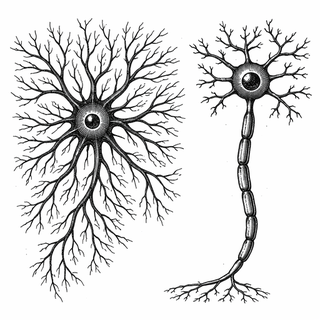
What changed is that scientists finally got better tools to watch astrocytes in action. Once researchers stopped treating them like beige office carpet, the cells started showing up in all kinds of important jobs: tuning synapses, shaping circuits, regulating metabolism, and responding to inflammation. They also work on slower time scales than neurons. Neurons send frantic late-night texts. Astrocytes write the follow-up message the next morning that actually changes the relationship.
Memory Is Apparently a Group Project
One of the wildest recent papers came from Ken-Ichi Dewa and colleagues in Nature in 2025. They found that astrocytes can form a kind of multiday trace after an emotional experience and help stabilize memory when that experience gets recalled again.[2] Memory is not a frozen screenshot. Every time you pull it up, your brain briefly makes it editable again, which is a mildly cursed design choice.
The idea here is that astrocytes may help lock a memory back down after recall, especially for emotionally important events. So memory is not just neurons yelling across synapses like a chaotic group chat. Astrocytes may be the friend who quietly screenshots everything and makes sure the story stays consistent.
Another 2024 Nature paper showed that astrocytes are also metabolic support with opinions. Shefeeq Theparambil and colleagues found that adenosine signaling in astrocytes helps coordinate brain energy use, supports synaptic function, and affects both recognition memory and sleep.[3] Which is rude, frankly, because it means your bad sleep and your fuzzy memory may be part of the same astrocyte-fueled office crisis.
Behaviour Has More Than One Driver
Astrocytes also seem to influence behavior in ways that would have sounded borderline heretical not long ago. In a 2024 Nature study, Matthias Ollivier and colleagues identified a striatal astrocyte population that helps prevent repetitive, inflexible behavior in mice.[4] Knock down the relevant astrocyte program, and behavior gets weirdly stuck.
That does not mean astrocytes are the single master switch for compulsions or psychiatric disease. The brain is never that cooperative. But it does mean neurons are not the whole cast. Reviews have been pointing this way too: a 2022 review in Neuroscience and Biobehavioral Reviews linked astrocytes and microglia to cognitive control, reward-seeking, and circadian regulation,[5] while a 2022 Trends in Neurosciences review emphasized that astrocytes are diverse and specialized, not interchangeable little stars sprinkled evenly through the brain.[8]
Why This Matters Outside the Mouse House
The real-world hook is not just "wow, weird cell biology." It is that astrocytes sit at the intersection of memory, metabolism, inflammation, and disease. That makes them interesting for conditions like Alzheimer's disease, where cognitive decline, altered brain energy use, and chronic inflammation all pile into the same awful group project. A 2024 review on astrocyte-neuron interactions in Alzheimer's argues that astrocytes are not just bystanders. They may actively shape how pathology spreads and how neurons cope with it.[9]
There is also early evidence that astrocytes can retain a kind of inflammatory memory, which may amplify later disease responses.[10] Your brain's support crew may remember old insults and change how it reacts the next time trouble shows up. Very "I have not forgotten what you said in 2019" energy.
The catch is the usual one. Much of this work is still in mice, cell models, or early-stage mechanistic studies. So nobody should read this and conclude that astrocyte-targeting treatments are around the corner. Still, the field has clearly moved past the old neuron-only story. Astrocytes are not scenery. They are active players in how the brain stores experience, fuels thought, and falls apart in disease.
And honestly, it tracks. The brain was never going to be run by just one cell type. That would be too tidy, too sensible, and far too unlike the rest of biology.
References
- Abbott A. The 'silent' brain cells that shape our behaviour, memory and health. Nature. 2025;648(8092):23-25. doi:10.1038/d41586-025-03912-w. PubMed: 41339508.
- Dewa KI, Kaseda K, Kuwahara A, et al. The astrocytic ensemble acts as a multiday trace to stabilize memory. Nature. 2025;648(8092):146-156. doi:10.1038/s41586-025-09619-2. PubMed: 41094146. PMCID: PMC12675280.
- Theparambil SM, Kopach O, Braga A, et al. Adenosine signalling to astrocytes coordinates brain metabolism and function. Nature. 2024;632(8023):139-146. doi:10.1038/s41586-024-07611-w. PubMed: 38961289.
- Ollivier M, Soto JS, Linker KE, et al. Crym-positive striatal astrocytes gate perseverative behaviour. Nature. 2024;627(8003):358-366. doi:10.1038/s41586-024-07138-0. PubMed: 38418885. PMCID: PMC10937394.
- Ortinski PI, Reissner KJ, Turner J, Anderson TA, Scimemi A. Control of complex behavior by astrocytes and microglia. Neurosci Biobehav Rev. 2022;137:104651. doi:10.1016/j.neubiorev.2022.104651. PubMed: 35367512. PMCID: PMC9119927.
- Wikipedia contributors. Astrocyte. Wikipedia. https://en.wikipedia.org/wiki/Astrocyte
- Wikipedia contributors. Blood-brain barrier. Wikipedia. https://en.wikipedia.org/wiki/Blood%E2%80%93brain_barrier
- Schober AL, Wicki-Stordeur LE, Murai KK, Swayne LA. Foundations and implications of astrocyte heterogeneity during brain development and disease. Trends Neurosci. 2022;45(9):692-703. doi:10.1016/j.tins.2022.06.009. PubMed: 35879116.
- Muñoz-Castro C, Serrano-Pozo A. Astrocyte-Neuron Interactions in Alzheimer's Disease. Adv Neurobiol. 2024;39:345-382. doi:10.1007/978-3-031-64839-7_14. PubMed: 39190082.
- Lee HG, Quintana FJ. NR3C1 limits the imprinting of astrocyte epigenetic inflammatory memory early in life. Nat Commun. 2025;16(1):8302. doi:10.1038/s41467-025-64102-w. PubMed: 40962821. PMCID: PMC12443986.
Disclaimer: The image accompanying this article is for illustrative purposes only and does not depict actual experimental results, data, or biological mechanisms.