
This is going to sound strange, but a scientist is standing in a fluorescent lab, poking at stressed mouse circuits and a famously temperamental brain receptor, trying to answer a rude little question: what if depression is not just about "too little serotonin," but about the brain hitting the brakes in the wrong places at the wrong time? Very normal Tuesday behavior. The paper by Troppoli and Thompson follows that question to one very specific target - the alpha5-containing GABA-A receptor - where things get weird. Two kinds of drugs that do opposite things at this receptor might both help mood, depending on which circuit has gone off the rails (Troppoli and Thompson, 2025).
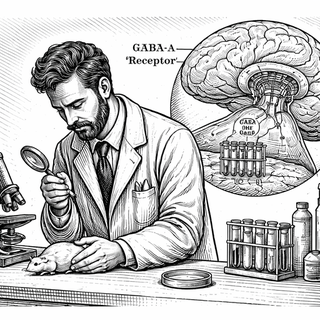
GABA is the brain's main inhibitory neurotransmitter. If glutamate is the friend yelling "go, go, go," GABA is the one gently confiscating the car keys. But the brain does not use one generic brake everywhere. GABA-A receptors come in many subtypes, and the alpha5 version shows up heavily in places tied to memory, emotion, and stress regulation, especially the hippocampus. That makes it far more targeted than old-school benzodiazepines, which tend to stroll in like drunk wedding guests and bother half the room.
This matters because depression increasingly looks less like one neat chemical shortage and more like a circuit problem - different regions becoming too loud, too quiet, or badly synchronized. A 2023 systematic review in Molecular Psychiatry found broad evidence that major depression involves altered excitation-inhibition balance across multiple brain regions, with both GABA and glutamate systems implicated (Hu et al., 2023). Translation: the orchestra is still playing, but the brass section is in a fistfight with the conductor.
Opposite Drugs, Same Plot Twist
Here is the odd part. Positive allosteric modulators, or PAMs, make GABA work better at its receptor. Negative allosteric modulators, or NAMs, do the reverse and dial GABA's effect down. On paper, that sounds like choosing between "more brake" and "less brake," which should not both help. And yet the review argues that both can make sense because depression and anxiety are not single-circuit disorders. They are more like a citywide traffic problem caused by different intersections breaking in different ways.
If a stress-sensitive circuit is overactive and jittery, boosting inhibition with an alpha5-preferring PAM could restore order. But if another circuit has become too suppressed - especially one involved in reward or motivation - then easing off alpha5-mediated inhibition with a NAM might free those neurons up to do their jobs again. Same receptor family. Different neighborhood. Entirely different office politics.
That is not just a theoretical shrug. In a 2022 Biological Psychiatry study, alpha5-targeted negative modulation reversed stress-induced anhedonia and weakened synaptic function in mice (Troppoli et al., 2022). Then a 2024 mouse study with basmisanil, another alpha5-NAM, reported rapid and sustained antidepressant-like effects - encouraging, even if mice remain the world's furriest overachievers and not tiny licensed psychiatrists (Prevot et al., 2024).
Why This Is More Than Receptor Trivia
What makes this line of work interesting is that it breaks from the old one-size-fits-all mood-drug idea. The review's core message is not "PAM good" or "NAM good." It is "which circuit is broken, and how is it broken?"
Recent work backs up that circuit-first view. A 2025 Molecular Psychiatry study showed that boosting specific GABAergic microcircuits promoted stress resilience in a sex-dependent way - medial prefrontal cortex circuits mattered more in males, while ventral hippocampal circuits mattered more in females (Jiang et al., 2025).
There is also a real-world hint that GABA-focused antidepressant ideas are not just academic fog. GABA-A positive modulators already matter clinically in postpartum depression: brexanolone was approved by the FDA on March 19, 2019, and zuranolone on August 4, 2023. Those drugs are not alpha5-selective, and postpartum depression is not the same thing as major depressive disorder, but they do show that GABAergic antidepressant strategies can make it out of the lab alive. A 2025 Biological Psychiatry review on neuroactive steroids makes that translational point clearly (Deligiannidis et al., 2025).
The Catch, Because Of Course There Is One
This field is still mostly preclinical. We are looking at animal models, circuit physiology, and mechanistic arguments that are promising but not yet a treatment menu for your local clinic. Selectivity also matters a lot. Broad GABA drugs can cause sedation, memory problems, tolerance, and dependence - useful if your goal is "sleep through a long-haul flight," less ideal if your goal is "restore motivation and emotional range."
So the real promise here is precision. Not smashing the whole inhibitory system with a hammer, but nudging a very particular receptor population in a very particular circuit. Depression has spent decades humiliating simple theories. This alpha5 story works precisely because it is not simple.
References
Troppoli TA, Thompson SM. A Comparison of Positive and Negative Allosteric Modulators of alpha5-Containing GABA-A Receptors in the Treatment of Affective Disease. Biological Psychiatry. 2025. DOI: https://doi.org/10.1016/j.biopsych.2025.10.036
Troppoli TA, Prevot TD, Cook JM, et al. Negative Allosteric Modulation of Gamma-Aminobutyric Acid A Receptors at alpha5 Subunit-Containing Benzodiazepine Sites Reverses Stress-Induced Anhedonia and Weakened Synaptic Function in Mice. Biological Psychiatry. 2022;91(10):865-877. DOI: https://doi.org/10.1016/j.biopsych.2021.11.024
Prevot TD, Li G, Taylor CT, et al. Basmisanil, an alpha5-GABAAR negative allosteric modulator, produces rapid and sustained antidepressant-like responses in male mice. Neuroscience Letters. 2024;833:137828. DOI: https://doi.org/10.1016/j.neulet.2024.137828
Hu YT, Tan ZL, Hirjak D, Northoff G. Brain-wide changes in excitation-inhibition balance of major depressive disorder: a systematic review of topographic patterns of GABA- and glutamatergic alterations. Molecular Psychiatry. 2023;28(8):3257-3266. DOI: https://doi.org/10.1038/s41380-023-02193-x
Jiang T, Feng M, Hutsell A, et al. Sex-specific GABAergic microcircuits that switch vulnerability into resilience to stress and reverse the effects of chronic stress exposure. Molecular Psychiatry. 2025;30:2297-2308. DOI: https://doi.org/10.1038/s41380-024-02835-8
Deligiannidis KM, Peng L, Hanusa BH, et al. GABAergic Neuroactive Steroids and Network States: Relevance to Peripartum Depression. Biological Psychiatry. 2025. DOI: https://doi.org/10.1016/j.biopsych.2025.09.019
Disclaimer: The image accompanying this article is for illustrative purposes only and does not depict actual experimental results, data, or biological mechanisms.