
Scientists love naming things, and this one's called a "corticospinal pain sensitivity signature," which sounds less like a neuroscience finding and more like a limited-edition synth pedal. But the idea is surprisingly clean: some people feel pain more intensely than others, and this study suggests part of the reason may live not just in the brain, but in the live chat between the brain and the spinal cord.[1]
That matters because pain research has spent years acting a bit like the spinal cord was just the elevator shaft while the brain got to be the penthouse. Meanwhile, the spinal cord has been downstairs doing traffic control, deciding which signals get amplified, muted, or shoved into awareness like an overcaffeinated intern. This paper argues that if you want to know why one person shrugs off a hot stimulus and another reacts like the stove insulted their family, you need both ends of the system in the frame.[1]
Pain Is Not Just "In Your Head"
The researchers used simultaneous imaging of the brain, brainstem, and cervical spinal cord, then trained a model on resting-state connectivity patterns, basically the background chatter of the nervous system when a person is not doing a task. They built this model using pain-threshold data and then tested it across independent groups: 723 healthy participants in total across validation datasets, plus 46 patients with clinical pain conditions.[1]
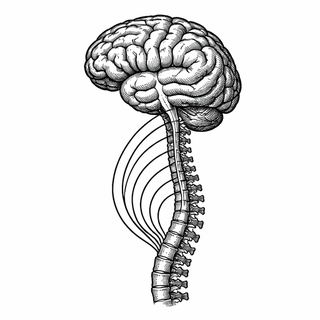
The result was a corticospinal signature that predicted individual pain sensitivity better than models that looked only at the brain or only at the spinal cord. It also separated painful from non-painful sensation and tracked clinical pain in patient cohorts.[1] So this was not just a lab trick for sorting who says "ouch" faster. It hints at a bridge between experimental pain and the real-world kind that ruins sleep and patience.
This fits with a broader shift in the field. A 2025 JAMA Neurology study showed that a sensorimotor cortical biomarker could predict prolonged pain sensitivity in healthy people.[2] A 2024 review in Nature Mental Health argued that the motor cortex is not just a movement machine. It appears to plug into multiple pain-modulation circuits, which is inconvenient if you liked the neat textbook boxes labeled "motor" and "sensory."[3]
The Motor Cortex Plot Twist
One of the coolest parts of the paper is the motor cortex angle. The authors did not stop at "here is a correlation, good luck everybody." They used repetitive transcranial magnetic stimulation, or rTMS, to perturb motor cortex activity and found that changes in motor cortex-spinal connectivity tracked changes in pain perception.[1]
That is a big deal because pain biomarkers often flirt with clinical usefulness and then vanish into the fog of "more work is needed." Here, the stimulation result gives the story some causal muscle.
Why the motor cortex? Weirdly enough, this is not out of nowhere. A 2022 Science paper mapped pathways from primary motor cortex that can suppress pain-related negative affect in animal models.[4] In plain English: the part of the brain best known for helping you move your arm may also help regulate how miserable pain feels. Your nervous system, as usual, refuses to stay in its lane.
That overlap may explain why movement, exercise, and motor-cortex stimulation sometimes change pain in ways that seem bigger than the body part being treated. The system is not just registering damage. It is editing the experience.
Why This Could Matter Outside the Scanner Room
If this line of research holds up, clinicians could eventually use corticospinal biomarkers to identify people at higher risk of severe pain, tailor neuromodulation treatments more intelligently, or sort patients into more meaningful subtypes instead of tossing very different pain problems into one giant "chronic pain" bucket and hoping for the best.[1][3]
Pain is notoriously subjective, which is medically true and also the source of approximately twelve thousand bad arguments. A biologically informed marker would not replace what patients say. It could add another layer of evidence about the circuitry shaping their pain, especially when choosing treatments like TMS or other neuromodulation approaches.[1][5]
Still, nobody should start calling this a pain mind-reader. The study linked a lab-derived signature to clinical pain, but it does not yet prove that the marker can forecast who will develop chronic pain over years, or which treatment will work for which patient on Tuesday at 2 p.m. Pain is messy. The nervous system is basically electrified spaghetti trying its best.
Even so, this paper makes a strong point: if you keep treating pain as a brain-only story, you are probably missing half the group chat. And in neuroscience, missing the group chat is how you end up confidently explaining the plot while the spinal cord quietly runs the season finale.
References
- Lin XM, Guo LF, Ni B, et al. A corticospinal signature for interindividual pain sensitivity. Nature Communications. 2025. DOI: https://doi.org/10.1038/s41467-025-67132-6
- Chowdhury NS, Bi C, Furman AJ, et al. Predicting Individual Pain Sensitivity Using a Novel Cortical Biomarker Signature. JAMA Neurology. 2025. DOI: https://doi.org/10.1001/jamaneurol.2024.4857 . PubMed: https://pubmed.ncbi.nlm.nih.gov/39869323/
- Bai Y, Pacheco-Barrios K, Pacheco-Barrios N, Liang G, Fregni F. Neurocircuitry basis of motor cortex-related analgesia as an emerging approach for chronic pain management. Nature Mental Health. 2024. DOI: https://doi.org/10.1038/s44220-024-00235-z
- Gan Z, Gangadharan V, Liu S, et al. Layer-specific pain relief pathways originating from primary motor cortex. Science. 2022;378(6626):1336-1343. DOI: https://doi.org/10.1126/science.add4391 . PubMed: https://pubmed.ncbi.nlm.nih.gov/36548429/
- Chen C, Niehaus JK, Dinc F, et al. Neural circuit basis of placebo pain relief. Nature. 2024;632(8027):1092-1100. DOI: https://doi.org/10.1038/s41586-024-07816-z . PubMed: https://pubmed.ncbi.nlm.nih.gov/39048016/
Disclaimer: The image accompanying this article is for illustrative purposes only and does not depict actual experimental results, data, or biological mechanisms.