
Okay, buckle up. If the brain is a basketball team, neurons get all the highlight reels, but this paper is about the assistant coach whispering strategy changes from the sideline and somehow changing the whole game. The molecule is H2BE, a histone variant. Histones are the spool-like proteins DNA wraps around, so they help decide which genes run the next play and which ones stay on the bench. In a new mouse study, researchers found that H2BE does not just matter in neurons. It also piles up in astrocytes, the star-shaped brain cells once treated like venue staff and now increasingly revealed to be running half the arena.
Tiny Gene Managers, Big Brain Drama
Here is the core idea. Genes are not just "on" or "off" because the DNA sequence says so. They are also controlled by packaging. Histones help pack DNA into chromatin, and histone variants are slightly different versions that can change how tightly that packaging works. Think of them as tiny managers with strong opinions about filing systems.
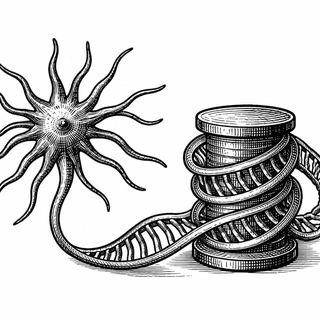
H2BE has already been linked to neuronal gene expression and long-term memory in earlier work from the same group, suggesting it helps keep synapse-related genes available when neurons need them (Feierman et al., 2024/2026 update). This new study asked a sharper question: what happens across age, and what happens outside neurons?
That matters because aging brains are not just "older." They are running different molecular software. Recent reviews argue that age-related cognitive decline may partly reflect slipping control over the epigenome, meaning the machinery that keeps gene expression disciplined gets a little more chaotic, a little more "group project without a leader" (Zocher, 2024).
Astrocytes Walk Onto the Field
The headline finding is deliciously rude to old assumptions: H2BE is enriched in astrocytes and increases with age in both astrocytes and neurons (Louzon et al., 2025). Astrocytes are not backup wallpaper. They help regulate synapses, metabolism, blood flow, and the brain's local environment. So finding an aging-linked histone variant in both neurons and astrocytes is a bit like discovering the team trainer has been editing the playbook too.
In young brains, H2BE supports expression of synaptic genes in both cell types and is important for proper synaptic function. Translation: it helps brain cells keep the molecular parts list for communication in working order. Lose H2BE, and the synaptic machinery gets wobbly.
That fits neatly with the broader astrocyte-aging literature. Recent reviews describe aging astrocytes as less reliably supportive, more inflammatory, and increasingly weird in ways neuroscientists are still trying to map without setting the whole glossary on fire (Duveau et al., 2025; Gildea and Liddelow, 2025). This paper adds an epigenetic lever to that story.
Aging's Plot Twist
Now for the part that makes the brain feel like a theme park designed by a committee of magicians. In aging mice, losing H2BE still disrupted synaptic gene programs in neurons, but it also dampened some age-related transcriptional changes in both neurons and astrocytes. So H2BE is not simply "good" or "bad."
And behaviorally, the effects split too. Older mice without H2BE had worse long-term memory but better working memory. Which is a wonderfully inconvenient result. We all want a clean movie villain. The brain keeps handing us a morally complicated side character.
This is exactly why aging biology is so hard. The same molecular change can support one kind of brain function and interfere with another, depending on cell type, timing, and context. A tweak that helps the brain hold information for a moment might still hurt the machinery needed to lock an experience into durable memory.
Why This Paper Is Interesting Outside Mouse World
No, this does not mean we have found a memory pill. It does mean something more useful: the study gives researchers a more precise suspect. Instead of talking vaguely about "epigenetics in aging," we now have evidence that one specific histone variant changes with age, acts in more than one brain cell type, and shifts memory outcomes in different directions.
If those findings hold up in human-relevant systems, therapies aimed at brain aging may need to stop treating neurons like solo performers and start accounting for astrocytes as active partners. They may also need to target specific kinds of memory rather than pretending memory is one giant bucket labeled "brain good."
That is the challenge this paper addresses. Brain aging is not just cell death or protein junk buildup. It is also a regulation problem. The instructions are still there, but the brain may be reading some pages too loudly, others too softly, and a few upside down.
Mouse study caveat firmly in place, of course. But as molecular clues go, this one has real bite.
References
Louzon S, Feierman ER, Qiu Q, Maroni MJ, Quaye CN, Perez-Tremble R, Wu H, Korb E. Age- and cell-type-specific effects of histone variant H2BE in the brain. Cell Reports. 2025. DOI: https://doi.org/10.1016/j.celrep.2025.116655
Feierman ER, Paranjapye A, Sangree AK, Ahmad R, Maroni MJ, Qiu Q, Choi K, Fuccillo M, Wu H, Korb E. Histone variant H2BE controls activity-dependent gene expression and homeostatic scaling. Cell Reports. 2026;45(1):116694. DOI: https://doi.org/10.1016/j.celrep.2025.116694. Preprint/PMC context: https://pubmed.ncbi.nlm.nih.gov/39553997/
Zocher S. Targeting neuronal epigenomes for brain rejuvenation. The EMBO Journal. 2024;43(16):3312-3326. DOI: https://doi.org/10.1038/s44318-024-00148-8. PMCID: https://pmc.ncbi.nlm.nih.gov/articles/PMC11329789/
Duveau V, Rheaume BA, Holt LM, Morel L. Astrocytes in aging. Neuron. 2025;113(1):109-126. PubMed: https://pubmed.ncbi.nlm.nih.gov/39788083/
Gildea HK, Liddelow SA. Mechanisms of astrocyte aging in reactivity and disease. Molecular Neurodegeneration. 2025;20(1):21. DOI: https://doi.org/10.1186/s13024-025-00810-7. PMCID: https://pmc.ncbi.nlm.nih.gov/articles/PMC11844071/
Disclaimer: The image accompanying this article is for illustrative purposes only and does not depict actual experimental results, data, or biological mechanisms.