
There are two types of people: the ones who hear "brain stimulation" and picture Frankenstein with a grant budget, and the ones who hear "ultrasound" and think of baby photos taped to a fridge. This paper sits in the awkward overlap, where scientists use sound waves to nudge one of the brain's deepest reward hubs without opening the skull.
The target here is the nucleus accumbens, or NAcc, a small structure buried deep in the brain that helps track reward, motivation, and the habit of repeating things that paid off five minutes ago. It helps you learn, "that was good, do that again," which is useful for food, social bonding, and, less ideally, doomscrolling at 1:13 a.m. [1][6]
In a Nature Communications study published on November 27, 2025, researchers tested whether transcranial ultrasound stimulation, or TUS, could influence that system in healthy adults without surgery. Twenty-six participants completed three sessions: ultrasound aimed at the NAcc, ultrasound aimed at the dorsal anterior cingulate cortex as a comparison target, and a sham session where the machine basically cosplayed as science equipment. Then everyone did a probabilistic learning task during fMRI to track behavior and brain activity. [1]
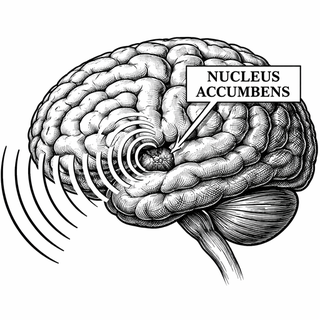
Sound Waves, Not Mind Control
The idea behind TUS is simple enough to explain over fries: ultrasound can reach deeper brain regions more precisely than many other non-invasive stimulation methods. That has made the field very interested in whether you can affect specific circuits without implanting electrodes in someone's head. Reviews over the past few years have framed low-intensity focused ultrasound as promising, but still very much in its "please standardize the methods before we all get too excited" era. [2][3][4]
This new paper pushes that story forward because it did not just ask whether ultrasound changes something. It asked whether stimulation of a very specific deep target changes the kind of reward-related learning that target is supposed to handle. That is a much better question.
What Actually Changed
After NAcc stimulation, people became more sensitive to rewards. They were more likely to use a "win-stay" strategy, meaning that if a choice paid off, they were more likely to repeat it on the next round. Their model-based learning rate for positive feedback also increased. On fMRI, the NAcc showed stronger reward-expectation signals, with related effects in nearby reward circuitry. [1]
That sounds good until you remember the reward system is not a saint. More reward sensitivity can sharpen learning, but it can also make people stick with choices that happened to pay off even when those choices are not smart in the long run. The paper saw hints of that too: after NAcc stimulation, participants were more likely to repeat some rewarded low-probability choices. Your reward circuit, it turns out, is not a wise monk. Sometimes it is a raccoon with a slot-machine problem. [1]
Why This Is More Than a Cool Party Trick
The interesting part is not just that behavior moved. It moved in a way that matched what we already think the NAcc does. The authors also compared the behavioral signature with patients who already had nucleus accumbens deep brain stimulation. Direct electrical stimulation perturbed the same reward-related features, which strengthens the case that the ultrasound was hitting the intended circuit. [1]
That matters because deep brain stimulation can help in severe neurological and psychiatric illness, but surgery is surgery. If ultrasound can eventually modulate some deep circuits with useful precision from outside the skull, that opens doors for research and maybe, later, treatment. Think addiction, depression, obsessive-compulsive disorder, and other conditions where reward processing, motivation, or maladaptive learning go sideways. [1][4][5]
The Buzzkill Section, Because Science
Before anyone starts pitching "motivation ultrasound" between cold plunge videos, the limits matter.
This was a small study in 26 healthy adults. It measured short-term changes. It does not show clinical benefit. It does not tell us how durable the effects are. And the broader ultrasound neuromodulation literature still has real issues with parameter tuning, dose, targeting, replication, and cross-study consistency. That is not a scandal. It is just what an emerging field looks like. [2][3][4]
Still, this is one of the cleaner demonstrations yet that non-invasive ultrasound can reach a deep human reward structure and shift both neural signals and behavior in a target-relevant way. Not long ago, that sentence would have sounded ridiculous. Now it sounds like a roadmap.
If the finding holds up, the long game is obvious: more precise tools for testing how deep brain circuits actually cause behavior, and maybe one day, less invasive ways to tune those circuits when they start steering people somewhere bad. Your brain remains weird. Scientists have now added "aimed sound waves" to the list of ways they can interrogate that weirdness. Very normal species.
References
[1] Yaakub SN, Eraifej J, Bault N, et al. Non-invasive ultrasonic neuromodulation of the human nucleus accumbens impacts reward sensitivity. Nature Communications. 2025;16(1):10192. DOI: 10.1038/s41467-025-65080-9. PMCID: PMC12660320
[2] Qin PP, Jin M, Xia AW, et al. The effectiveness and safety of low-intensity transcranial ultrasound stimulation: A systematic review of human and animal studies. Neuroscience and Biobehavioral Reviews. 2024;156:105501. DOI: 10.1016/j.neubiorev.2023.105501
[3] Legon W, Strohman A. Low-intensity focused ultrasound for human neuromodulation. Nature Reviews Methods Primers. 2024;4:91. DOI: 10.1038/s43586-024-00368-6
[4] Darmani G, Fomenko A, Lozano AM, et al. Individualized non-invasive deep brain stimulation of the basal ganglia using transcranial ultrasound stimulation. Nature Communications. 2025;16:2693. DOI: 10.1038/s41467-025-57883-7. PMCID: PMC11923056
[5] Barksdale BR, Enten L, DeMarco A, et al. Low-intensity transcranial focused ultrasound amygdala neuromodulation: a double-blind sham-controlled target engagement study and unblinded single-arm clinical trial. Molecular Psychiatry. 2025;30:4497-4511. DOI: 10.1038/s41380-025-03033-w
[6] Nucleus accumbens. Wikipedia. https://en.wikipedia.org/wiki/Nucleus_accumbens
Disclaimer: The image accompanying this article is for illustrative purposes only and does not depict actual experimental results, data, or biological mechanisms.