
The usual story says age-related neurodegeneration is basically random wear and tear, like your brain is an old couch slowly losing stuffing in whatever cushion fate feels like bullying that day. This paper says not so fast. A small region called the hypothalamus may be sending protective molecular care packages that help keep neurons from falling apart. If that sounds like your brain runs a tiny shipping department, yes, that is a bad joke, and yes, I am apologizing immediately. [1]
The Myth That Just Got Smacked
Most people hear "Alzheimer's" or "neurodegeneration" and picture damage building up locally in memory circuits, as if the problem starts and ends where symptoms show up. But the hypothalamus is more like the body’s bossy kitchen manager. It helps regulate hunger, sleep, temperature, hormones, and other homeostatic basics. In other words, it is not just sitting there looking decorative. It is coordinating a lot of the recipe. [6]
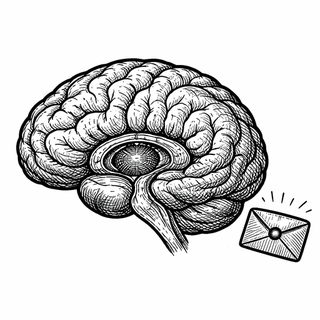
That matters because aging brains do not merely collect junk. They also lose systems that normally keep cells repaired, fed, and calm. One of those systems may involve extracellular vesicles, or EVs. These are tiny membrane bubbles cells release to pass around cargo like proteins and RNA. Scientists have been increasingly interested in EVs because they can carry either good news or absolute chaos depending on what is packed inside. Tiny gossip networks, basically. [2,3]
What This Study Actually Found
The new Cell Reports paper focused on a protein called parathymosin, abbreviated PTMS. PTMS already had a strange resume: it can work in the nucleus, but it also shows up as a secreted factor in the brain. Jung and colleagues asked whether PTMS might help explain how the hypothalamus influences brain aging. [1]
In mice, losing PTMS was bad news in a very thorough way. The animals developed age-dependent neurodegeneration and had shorter lifespans. Boosting PTMS in the hypothalamus did the opposite: it reduced aging-related brain problems and extended lifespan. That is already interesting, but the really fun plot twist is how PTMS seems to travel. The team found it inside hypothalamic extracellular vesicles, especially vesicles released by hypothalamic neural stem and progenitor cells. [1]
Those vesicles were not empty little Uber rides. They carried PTMS along with small nuclear and nucleolar RNAs, and that combination appeared to protect recipient neurons from DNA damage. DNA damage is one of aging’s least charming habits because it accumulates over time in cells that do not get many chances to replace themselves, like neurons. When neurons lose the ability to manage that damage, the whole neural stew starts to scorch. [1,7]
The authors then pushed the idea toward therapy. In mouse models, including the 5xFAD Alzheimer’s model, these PTMS-containing hypothalamic vesicles eased neurodegenerative changes. So the headline is not "we cured Alzheimer’s." The headline is more like "the hypothalamus may be sending anti-breakdown packets, and we should probably stop ignoring the mailroom." [1]
Why Neuroscientists Are Paying Attention
This paper lands in a research area that has been heating up for a while. Reviews from the past few years describe EVs as double agents: they can spread toxic proteins and inflammatory signals, but they can also deliver protective cargo and maybe become therapies themselves. That tension is what makes the field so interesting. EVs are not saints or villains. They are envelopes. The contents matter. [2-4]
There is also a stem-cell angle here. A 2023 review in Ageing Research Reviews argued that stem cell-derived EVs are especially appealing as "cell-free" therapies because they may capture some benefits of stem cells without the full logistical drama of transplanting living cells into people’s brains, which is the sort of sentence that makes regulatory agencies reach for aspirin. [3] A 2024 overview in Alzheimer’s & Dementia also highlighted just how much interest there is in brain-derived EVs as biomarkers for age-related neurodegenerative disease. If researchers can reliably read these vesicles from blood, that could eventually help with earlier detection as well as treatment design. [4]
The Part Where Reality Clears Its Throat
Before anyone starts bottling designer brain bubbles, several problems remain. This is a mouse study. Mouse models are useful, but they are not tiny furry prophets. Human brains are messier, slower, and much less cooperative.
There is also a manufacturing problem. EVs are heterogeneous, hard to purify, and annoyingly sensitive to how they are isolated and measured. Recent reviews keep making the same point: standardization, purity, targeting, dosing, storage, and large-scale production are still major obstacles for clinical translation. The field knows the menu. It has not fully nailed the kitchen workflow. [2,5]
Still, the idea is hard to ignore. If aging-related neurodegeneration is influenced not just by local damage but by long-range support signals from the hypothalamus, that changes the map. It suggests the brain’s "control room" may help decide whether neurons age like a well-tended stock or like something forgotten on the stove.
That does not make this paper a miracle. It makes it a sharp new clue. And in brain aging research, a sharp new clue is often how the whole recipe changes.
Disclaimer: The image accompanying this article is for illustrative purposes only and does not depict actual experimental results, data, or biological mechanisms.
References
- Jung HG, Yu B, Choi Y, Go G, Zhang Q, Tang Y, Kim MW, Cai D. Control of aging-associated neurodegeneration via hypothalamic extracellular vesicles containing parathymosin. Cell Reports. 2025;44(11):116561. DOI: https://doi.org/10.1016/j.celrep.2025.116561
- Wang L, Zhang X, Yang Z, Wang B, Gong H, Zhang K, Lin Y, Sun M, et al. Extracellular vesicles: biological mechanisms and emerging therapeutic opportunities in neurodegenerative diseases. Translational Neurodegeneration. 2024;13:60. DOI: https://doi.org/10.1186/s40035-024-00453-6
- Rather HA, Almousa S, Craft S, Deep G. Therapeutic efficacy and promise of stem cell-derived extracellular vesicles in Alzheimer's disease and other aging-related disorders. Ageing Research Reviews. 2023;92:102088. DOI: https://doi.org/10.1016/j.arr.2023.102088. PMCID: https://pmc.ncbi.nlm.nih.gov/articles/PMC10842260/
- Badhwar A, Hirschberg Y, Valle-Tamayo N, Iulita MF, Udeh-Momoh CU, Matton A, Tarawneh R, Rissman RA, Ledreux A, Winston CN, Haqqani AS, et al. Assessment of brain-derived extracellular vesicle enrichment for blood biomarker analysis in age-related neurodegenerative diseases: an international overview. Alzheimer's & Dementia. 2024;20(7):4411-4422. DOI: https://doi.org/10.1002/alz.13823. PMCID: https://pmc.ncbi.nlm.nih.gov/articles/PMC11247682/
- Rao S, He Z, Wang Z, Yin H, Hu X, Tan Y, Wan T, Zhu H, Luo Y, Wang X, Li H, et al. Extracellular vesicles from human urine-derived stem cells delay aging through the transfer of PLAU and TIMP1. Acta Pharmaceutica Sinica B. 2024;14(3):1166-1186. DOI: https://doi.org/10.1016/j.apsb.2023.12.009
- Hypothalamus. Wikipedia. Accessed May 16, 2026. https://en.wikipedia.org/wiki/Hypothalamus
- DNA repair. Wikipedia. Accessed May 16, 2026. https://en.wikipedia.org/wiki/DNA_damage