What if the way you pick a snack at 11:07 p.m. could help predict how you would behave in a totally different decision a day later? Not in a fortune-cookie way. More in a "your brain has habits it keeps dragging from room to room like an emotional support ottoman" way. That is basically the itch behind a new eLife paper by Hiroshi Higashi: can a model learn the distinctive style of one person's choices in one task, then use that to predict their choices in another? [1]
That sounds abstract until you remember how often science studies "the average person," who is a bit of a fraud. The average person has 1.9 children, decent risk tolerance, and apparently exists mostly to make bar charts look tidy. Real humans are messier. Some of us over-explore. Some play it safe. Some react fast and sloppy; others take forever and still choose the wrong thing. Decision science knows this. The hard part is turning those quirks into something a model can actually use. [2,3]
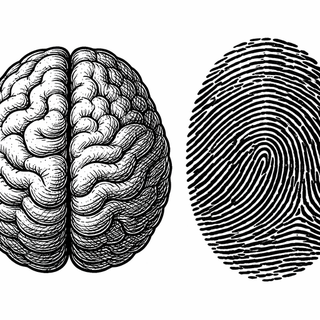
Higashi's idea is to give each person an "individual latent representation," which is machine-learning language for a compressed fingerprint of how that person tends to decide. "Latent" is one of those words scientists use when they mean "the useful thing is real, but you cannot point at it with a stick." Think of it as a tiny coordinates card for your decision style.
The framework has four parts. An encoder looks at your behavior in a source task and distills it into that latent representation. A decoder then uses the representation to generate the settings for a task-specific neural network, called the task solver. That solver predicts what you will do in the target task. So instead of saying "people usually do X," the model tries to say "this specific gremlin, given their past habits, will probably do Y." Respectfully.
Two tasks, one personality
The paper tests this idea in two kinds of decisions. One is a value-guided sequential task, basically a reward-learning setup where people have to figure out which choices pay off over time. The other is a perceptual task, where people make category judgments from visual input. Different jobs, same human attached.
In the value-guided task, the dataset included 81 participants who completed both 2-step and 3-step versions of a Markov decision process. The key question was whether behavior from one condition could help predict behavior in the other. According to the paper, the answer was yes: the EIDT framework outperformed baseline individualized cognitive models in cross-condition transfer, and it also beat a simpler average-participant approach in within-condition prediction. The model's predictions also got worse when it borrowed another participant's latent representation instead of the correct person's, which is exactly what you would hope if the model is capturing something genuinely individual rather than just doing statistical karaoke. [1]
Why this is actually a big deal
This matters because the field keeps running into the same problem: group averages are useful, but they flatten the very differences we often care about most. Recent reviews in Neuroscience & Biobehavioral Reviews argue that computational models aimed at individual differences often struggle with reliability, validity, and overreliance on single-task snapshots. In other words, a lot of models are trying to summarize a person after watching them make one awkward choice in one artificial lab setup. That is not a personality profile. That is Tuesday. [2]
Higashi's paper goes after that problem directly. Instead of treating each task condition like an island, it asks whether there is a transferable core beneath the surface. That lines up with a broader push toward more precise, individual-level modeling in decision science and psychiatry, where researchers want tools that can predict how one person, not just one population, is likely to behave. [2,4]
If that kind of transfer proves robust, the real-world implications get interesting fast. Personalized mental health assessment is one obvious lane: decision-making styles show up in disorders involving reward learning, uncertainty, and cognitive control. Training or educational systems could also benefit from models that recognize whether someone learns by cautious accumulation or chaotic button-mashing with confidence. Human-AI systems might eventually adapt to your decision style instead of treating you like a generic user with a pulse and a browser tab. [4,5]
The catch, because there is always a catch
This is still early. The tasks here are controlled laboratory tasks, not the full carnival of real life. A model that predicts how you handle a 2-step reward task has not yet predicted how you choose a job, a partner, or whether you will insist on reading restaurant reviews for 47 minutes before ordering the same burger. Reviews in the field also warn that individual-difference measures can look more stable and informative than they really are if you do not test them across time, tasks, and contexts. [2,3]
Still, the paper lands a sharp point: individuality might be portable. Your decision-making style may not live inside one task only. It may echo across situations in a way that a well-built model can capture. Which is exciting, slightly unnerving, and honestly very on-brand for brains. They hate being simple, but every so often they leave a pattern lying around and science gets to pounce on it.
References
- Higashi H. Predicting human decision-making across task conditions via individuality transfer. eLife. 2026;14:RP107163. doi:10.7554/eLife.107163. PMCID:PMC12815462.
- Karvelis P, Paulus MP, Diaconescu AO. Individual differences in computational psychiatry: A review of current challenges. Neurosci Biobehav Rev. 2023;148:105137. doi:10.1016/j.neubiorev.2023.105137.
- Frömer R, Shenhav A. Filling the gaps: Cognitive control as a critical lens for understanding mechanisms of value-based decision-making. Neurosci Biobehav Rev. 2022;134:104483. doi:10.1016/j.neubiorev.2021.12.006. PMCID:PMC8844247.
- Schulze C, Aka A, Bartels DM, et al. A timeline of cognitive costs in decision-making. Trends Cogn Sci. 2025;29(9):827-839. doi:10.1016/j.tics.2025.04.004.
- Peterson JC, Bourgin DD, Agrawal M, Reichman D, Griffiths TL. Using large-scale experiments and machine learning to discover theories of human decision-making. Science. 2021;372(6547):1209-1214. doi:10.1126/science.abe2629.
Disclaimer: The image accompanying this article is for illustrative purposes only and does not depict actual experimental results, data, or biological mechanisms.