
Can you build an AI that makes visual decisions without inhaling a mountain of training data? Can you make it keep working when the input gets noisy or parts of the system get knocked around? Can you tune that AI using MRI scans from humans who are especially good at the task? And can a monkey-inspired circuit act a little less like a spreadsheet with confidence issues and a little more like a brain? That is the lane this new PNAS paper barrels into.
Alright, let us talk about something wild. Su and colleagues built a neural network modeled on the primate dorsal visual pathway - the motion-heavy route that helps turn "something moved over there" into "do I look, dodge, or commit?" In the real brain, motion information flows through areas including the LGN, V1, MT, and LIP.
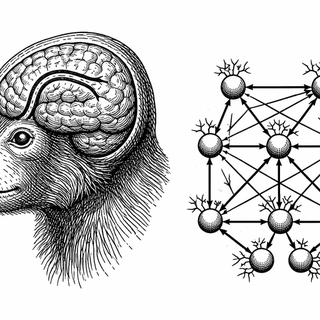
The researchers built a spiking neural network around that layout and tested it on a classic random-dot motion task, where some dots drift in one direction and the rest behave like tiny drunk confetti.
Their model, called a primate-informed neural network or PINN, uses biologically grounded neuron and synapse dynamics instead of the usual giant soup of weights. According to the paper, it reproduced human-like decision behavior and neural activity patterns, needed less training than conventional artificial networks, and stayed more robust when hit with noise or simulated damage (Su et al., 2026).
Less Black Box, More Nervous System
Why is that interesting? Because standard deep learning is very good at looking impressive right up until reality throws a chair. Modern vision models can be capable, but they are often data-hungry, hard to interpret, and oddly fragile.
This paper takes a different bet: maybe robustness comes from structure, not just scale. The authors borrowed known features of the primate motion pathway, including direction-selective processing and evidence accumulation. That matters because perceptual decision-making in brains is a running tally. Sensory evidence trickles in, neural activity ramps up, and eventually one interpretation wins. Recent human and animal studies back that picture, showing evidence accumulation spread across multiple brain regions rather than one tiny "decision button" hidden in the attic (Gherman et al., 2024; Khilkevich et al., 2024).
The other clever move is the MRI-guided fine-tuning. Instead of searching the model’s parameter space like a guy patting every pocket in a dark bar for lost keys, the team used neuroimaging features linked to better behavioral performance to steer the tuning process. In plain English: they asked whether strong human performers had brain features that could hint at better settings for the artificial model. That fits a broader push toward turning neural data into mechanistic, testable models rather than prettier black boxes (Mathis et al., 2024).
Why You Should Care, Even If You Do Not Collect Monkey Data for Fun
If results like this hold up, the practical upside is not "the brain has been solved," because honestly that sentence should get your drink taken away. The real promise is narrower and more useful.
Brain-inspired models could make AI systems more resilient in messy settings - low-quality video, partial sensor failure, changing environments, and edge devices that cannot afford brute-force computation. Models with interpretable internal dynamics are also easier to debug, and this kind of work gives neuroscience something back: a model you can poke, lesion, and compare against real brains.
That said, nobody should pretend this one model closes the case. Random-dot motion decisions are a beautiful neuroscience workhorse, but they are not the whole circus of vision, reasoning, memory, and behavior. Even so, this study tackles a real problem: how to build systems that are not just accurate when the lab is clean, but stable when the world gets rude.
So the headline is not "AI becomes brain." It is that neuroscience may finally be graduating from mood board to design manual. Honestly, about time.
References
- Su J, Cai F, Zhao SK, Wang XY, Qian TY, Wang DH, Hong B. Primate-informed neural network for visual decision-making. Proc Natl Acad Sci U S A. 2026;123(2):e2426883123. DOI: https://doi.org/10.1073/pnas.2426883123. PMCID: https://pmc.ncbi.nlm.nih.gov/articles/PMC12799151/
- Gherman S, Markowitz N, Tostaeva G, et al. Intracranial electroencephalography reveals effector-independent evidence accumulation dynamics in multiple human brain regions. Nat Hum Behav. 2024;8(4):758-770. DOI: https://doi.org/10.1038/s41562-024-01824-9. PMCID: https://pmc.ncbi.nlm.nih.gov/articles/PMC12188985/
- Khilkevich A, Lohse M, Low R, et al. Brain-wide dynamics linking sensation to action during decision-making. Nature. 2024;634(8035):890-900. DOI: https://doi.org/10.1038/s41586-024-07908-w.
- Mathis MW, Perez Rotondo A, Chang EF, Tolias AS, Mathis A. Decoding the brain: From neural representations to mechanistic models. Cell. 2024;187(21):5814-5832. DOI: https://doi.org/10.1016/j.cell.2024.08.051. PMCID: https://pmc.ncbi.nlm.nih.gov/articles/PMC11637322/
Disclaimer: The image accompanying this article is for illustrative purposes only and does not depict actual experimental results, data, or biological mechanisms.