
The cerebellum may age more gracefully than other brain regions because its resident immune cells seem to adapt instead of just getting grumpier. Let me explain how we got here. Think of a kid who looks totally chaotic from across the room, but up close you realize they have invented a very specific system for lining up dinosaurs, crackers, and one sock for reasons known only to them. Aging brains can look like that too - messy at a glance, surprisingly organized once you zoom in.
The brain's backstage crew
This paper looks at microglia, the brain's built-in cleanup crew, security team, and occasional overinvolved neighbors all rolled into one. They patrol tissue, clear debris, and react when something looks off. The surprise is where the action showed up. The cerebellum is usually treated like the brain's reliable middle child - famous for movement and coordination, increasingly linked to cognition too, but often assumed to be relatively spared in aging and Alzheimer's compared with places like the hippocampus [1][5].
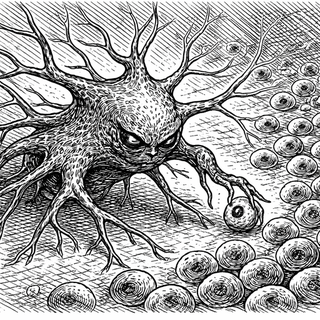
Tsai and colleagues took a closer look at that assumption in aged mice using three tools that sound like they were named by a committee with a caffeine budget: single-nucleus RNA sequencing, bulk RNA sequencing of microglia, and MERFISH-based spatial transcriptomics [1]. In plain English, they measured which genes cells were using and, with the spatial method, where those cells were sitting in the tissue. That last part matters. Knowing a cell's gene activity without location is like knowing somebody sent 43 texts without seeing the group chat. Context changes everything.
Not all aging is the same flavor
The big finding was that cerebellar microglia changed a lot with age, but not in the same way microglia do in more vulnerable regions. Compared with microglia in the hippocampus, aged cerebellar microglia showed more of a neuroprotective gene signature and less of a lipid-droplet-accumulating signature [1]. That second label matters because lipid-droplet-rich microglia have been tied to inflammatory, dysfunction-prone states in aging and neurodegeneration. In other words, these cerebellar microglia looked less like burnt-out custodians and more like veteran staff who still know where the breaker box is.
Then came the spatial plot twist. In old cerebellum, microglia sat closer to granule cells, the tiny but wildly numerous neurons packed into the cerebellar granule layer [1]. The researchers used that proximity to identify a neuron-associated microglial state. So this was not just "microglia age." It was "microglia age differently depending on the neighborhood they're in." Brain aging, because of course, refuses to be simple.
That idea fits with newer atlas-scale work showing that aging is intensely local. A pair of 2025 Nature studies mapped mouse brain aging at massive scale and showed both broad cell-type-specific aging signatures and local effects of cell proximity on those patterns [2][3]. Another 2025 study in Nature Neuroscience found region-specific inflammatory changes in the aging hippocampus, where immune activity ramps up in ways that can choke off neurogenesis [4]. Same brain, different zip codes, very different drama.
Why this is more than mouse gossip
If these findings hold up and extend to humans, they could help explain why the cerebellum often looks relatively resilient in Alzheimer's disease. That does not mean untouched. Recent human work suggests the cerebellum can show meaningful changes in dementia, including atrophy in the granule cell layer that tracks with disease severity [5]. But resilience is not the same as invincibility. It is more like the kid who still melts down, just 20 minutes later and with better snacks.
The real-world appeal here is that microglia are druggable in a way that "entire brain region aging" is not. If researchers can learn what keeps cerebellar microglia in a more protective state, they might be able to borrow that playbook for more vulnerable regions. That could mean nudging microglia away from inflammatory, lipid-droplet-heavy states and toward tissue-supportive ones. Related work in 2025 has already tied microglial lipid biology to worse Alzheimer's-related changes and cognitive performance, which makes this line of thinking feel less like sci-fi and more like a very early blueprint [6].
The hard part, naturally
There are still some important caveats. This study was done in mice, and mouse brains are helpful but not tiny furry undergraduates standing in for humans one-to-one. The gene signatures are suggestive, not proof that these microglia directly cause cerebellar resilience. And transcriptomics, for all its power, tells you what cells seem prepared to do, not always what they actually did on game day.
Still, the paper tackles a real problem in brain aging research: we often talk about "the aging brain" as if every region got the same memo. It did not. Some regions seem to spiral faster. Some adapt. Some may have local cell relationships that soften the blow. The cerebellum, long treated as the quiet kid in the back of the classroom, may have been doing a lot more strategic coping than anyone gave it credit for.
The upshot is oddly comforting. Aging in the brain is not just wear and tear. It is also negotiation - between cells, between neighborhoods, between damage and repair. And in the cerebellum, microglia may be some of the best little negotiators on the block.
References
- Tsai AP, et al. Spatial and single-cell transcriptomics reveal the reorganization of cerebellar microglia with aging. Cell Reports. 2025. DOI: 10.1016/j.celrep.2025.116624. PubMed: https://pubmed.ncbi.nlm.nih.gov/41307999/
- Ximerakis M, et al. Brain-wide cell-type-specific transcriptomic signatures of healthy ageing in mice. Nature. 2025. DOI: 10.1038/s41586-024-08350-8. PubMed: https://pubmed.ncbi.nlm.nih.gov/39743592/
- Sun ED, et al. Spatial transcriptomic clocks reveal cell proximity effects in brain ageing. Nature. 2025. DOI: 10.1038/s41586-024-08334-8.
- Lin H, et al. Multimodal transcriptomics reveal neurogenic aging trajectories and age-related regional inflammation in the dentate gyrus. Nature Neuroscience. 2025. DOI: 10.1038/s41593-024-01848-4. PubMed: https://pubmed.ncbi.nlm.nih.gov/39762661/
- Samstag CL, et al. Neuropathological correlates of vulnerability and resilience in the cerebellum in Alzheimer's disease. Alzheimer's & Dementia. 2025. DOI: 10.1002/alz.14450. PubMed: https://pubmed.ncbi.nlm.nih.gov/39713867/. PMCID: https://pmc.ncbi.nlm.nih.gov/articles/PMC11848203/
- Farmer BC, et al. Triglyceride metabolism controls inflammation and microglial phenotypes associated with APOE4. Cell Reports. 2025. DOI: 10.1016/j.celrep.2025.115961. PubMed: https://pubmed.ncbi.nlm.nih.gov/40644302/
Disclaimer: The image accompanying this article is for illustrative purposes only and does not depict actual experimental results, data, or biological mechanisms.