
Last week, Brown researchers reported that New York neighborhoods chopped up by traffic and road design had more schizophrenia-related hospital visits, even after accounting for air pollution. Let me show you something. We keep acting like mental health lives only in therapists' offices and pill bottles, when some of it may also live in crosswalks, tree cover, noise, and whether your block feels built for humans or for speeding metal boxes.
Simon Makin's Nature piece, "Building mentally healthy cities with neuroscience," is not a lab paper with one clean result. It is a field report from neurourbanism - the mash-up of neuroscience, psychology, landscape design, and city planning that asks a blunt question: what if your surroundings are quietly tuning your brain all day long? [1]
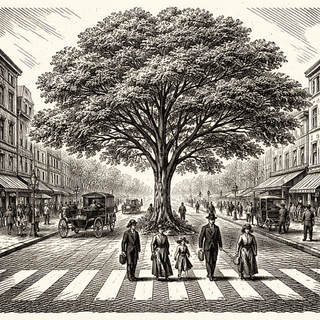
That idea sounds obvious once you say it out loud. A street that feels safe, shaded, and easy to walk is not the same machine as a six-lane asphalt griddle with traffic roaring by like it has a personal grudge. Neuroscience gives researchers a way to measure that difference with more than vibes. Wearables can track stress. Mobile EEG can go outside. Imaging studies can look at regions involved in threat and rumination. The city stops being "background" and starts looking more like part of the wiring diagram. [1,2]
Your Brain Likes Fewer Dumb Fights
One of the cleaner findings in this area comes from a 2022 Molecular Psychiatry study: after a one-hour walk in nature, people's amygdala activity dropped, while an urban walk did not produce the same effect. The amygdala is one of the brain's alarm systems. If that alarm system settles down after a forest walk, that is a measurable shift in stress-related brain function. [2]
Other work suggests the story starts early. A 2021 Nature Human Behaviour study linked urbanicity in young people to differences in brain structure, brain connectivity, perspective-taking, and depression symptoms. The strongest associations showed up during childhood and adolescence. In plain English: the city does not just annoy adults on their commute. It may help shape the brains growing up inside it. [3]
This is where the Nature article gets interesting. The interview centers on Agnieszka Olszewska-Guizzo, who argues that "more green" is too crude. A park is not automatically a mental health device just because someone planted shrubs and called it wellness. Some features may matter more than others: depth of view, varied skylines, water, seasonal vegetation, visible shade, less crowding, less harsh geometry. Measure twice, cut once. If you want a mentally healthier park, you cannot just dump sod behind an apartment block and declare victory. [1]
It Is Not Just Trees - It Is the Whole Setup
That point lines up with a 2025 Nature Cities meta-analysis on the acute mental health benefits of urban nature. Urban nature helped, but the biggest benefits did not come from just cranking greenery to the maximum like a teenager discovering the volume knob. A moderate "dose" often worked best, which hints that quality, access, and context matter as much as raw quantity. [4]
Recent reviews make the same broader point from different angles. A 2023 review in Current Opinion in Psychiatry argues that urbanization is racing ahead of the support systems people need, especially for new urban migrants. Another 2023 review, in Dialogues in Clinical Neuroscience, says city life can stack risk through social stress, inequality, exclusion, pollution, and fragmented community life. The problem is not "cities are bad." The problem is badly built, badly distributed, badly connected cities. [5,6]
That matters in the real world. If these findings keep holding up, city design stops looking like a cosmetic extra and starts looking like preventive mental health infrastructure. Better sidewalks are not just about steps. Parks are not just pretty. Traffic calming is not just a bike-lane argument on local Facebook. These things may change stress load, social contact, physical activity, and the everyday mental friction people carry around.
What Still Needs Work
Nobody should pretend this field is finished. Cities are messy. People choose neighborhoods for reasons that also affect health. Brain measures are useful, but they are not magic truth machines. A nice park can help and still fail if it feels unsafe, inaccessible, or designed for rich people with very expensive strollers. Equity matters. A "healthy city" that only works for the zip codes with mature trees and artisan bread has missed the assignment.
Still, the central idea is hard to shake. Mental health is not only something that happens inside skulls. It also happens between buildings, along sidewalks, near roads, under trees, and in the small repeated experiences that tell your nervous system whether to unclench or stay on guard. Neuroscience is now giving city planners better tools to test that idea instead of just admiring it from across the street.
References
- Makin S. Building mentally healthy cities with neuroscience. Nature. 2025;648(8092):S11. doi:10.1038/d41586-025-03929-1
- Sudimac S, Sale V, Kuhn S. How nature nurtures: Amygdala activity decreases as the result of a one-hour walk in nature. Molecular Psychiatry. 2022;27:4446-4452. doi:10.1038/s41380-022-01720-6
- Xu J, Liu X, Li Q, et al. Global urbanicity is associated with brain and behaviour in young people. Nature Human Behaviour. 2021. doi:10.1038/s41562-021-01204-7
- Li Y, Mao Y, Mandle L, et al. Acute mental health benefits of urban nature. Nature Cities. 2025;2:720-731. doi:10.1038/s44284-025-00286-y
- Halbreich U. Impact of urbanization on mental health and well being. Current Opinion in Psychiatry. 2023;36(3):200-205. doi:10.1097/YCO.0000000000000864
- Pignon B, Szoke A, Ku B, Melchior M, Schurhoff F. Urbanicity and psychotic disorders: Facts and hypotheses. Dialogues in Clinical Neuroscience. 2023;25(1):122-138. doi:10.1080/19585969.2023.2272824 PMCID:PMC10986450
Disclaimer: The image accompanying this article is for illustrative purposes only and does not depict actual experimental results, data, or biological mechanisms.