
On a cortical heat map, the brain looks like a weather system with personality problems: some patches flash and vanish like summer lightning, while others hold a slow, smoky glow. That contrast is the whole plot here. In a new study of the marmoset cortex, researchers found that different parts of the primate brain run on different built-in clocks, and that this uneven timing may be exactly what lets signals travel without the whole system turning into neural soup (Li et al., 2025).
The basic idea is simple, even if the brain insists on making it weird. Sensory areas need to react fast. If something moves in front of your face, you do not want your visual cortex saying, "Let me circle back next quarter." Association areas, on the other hand, need to hold onto information longer so they can integrate context, memory, goals, and all the other expensive executive nonsense that makes life complicated.
Neuroscientists call these built-in windows of persistence "intrinsic timescales." Short timescales are good for quick updates. Long timescales are good for accumulation and integration. This general hierarchy has been reported before across primate cortex, and more recent work in visual systems suggests later-stage regions tend to hang onto information longer than early sensory ones, with attention able to reshape those local clocks on the fly (Zeraati et al., 2023).
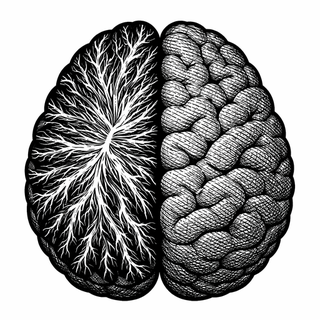
What Li and colleagues add is a primate-wide look in the common marmoset, using electrocorticography recordings plus a multi-area computational model anchored to anatomy and physiology. They found a neat timing ladder across the neocortex: sensory regions behaved like impatient interns, while higher association regions acted more like senior staff who keep the meeting going long after everyone else has checked out. The joke hides a real computational benefit. A brain that mixes fast and slow regions can both notice what just happened and keep enough context around to decide what it means.
Slightly Unstable, In a Good Way
The most interesting part of the paper is not just that the clocks differ. It is the claim that the cortex works best near a "critical" regime - specifically, slightly subcritical, or near-critical. That sounds like something you tell a mechanic right before your engine falls out, but in neuroscience it means the system sits near the boundary between activity that dies too quickly and activity that runs away.
That middle ground is useful. Too quiet, and signals fade before they get anywhere interesting. Too excitable, and every message becomes the neural equivalent of someone hitting Reply All with conspiracy energy. In the model, near-critical dynamics gave the marmoset cortex the best of both worlds: local circuits could integrate information over time, and long-range signals could still propagate reliably across regions (Li et al., 2025).
This fits a broader trend in the field. A 2025 Neuron viewpoint argues that criticality may be a unifying principle for healthy brain computation, and that departures from it show up in conditions like anesthesia and brain disorders (Hengen and Shew, 2025). Meanwhile, reviews on intrinsic timescales suggest that these timing properties may matter for psychiatric and neurological health, not just for abstract modeling contests conducted between very determined people and very expensive graphs (Ibanez and Northoff, 2024).
Why This Matters Outside Monkey Cortex
One quietly cool result is that association areas showed a weaker match between structural connectivity and functional connectivity than sensory areas. Translation: in higher-order cortex, who is physically connected to whom tells you less about who is actually coordinating with whom at a given moment. That makes sense if association cortex is doing more flexible, context-heavy computation. It is less like fixed plumbing and more like a jazz ensemble with deadlines.
That flexibility matters because real cognition is messy. You need fast channels for sensation, slower ones for memory and planning, and long-range coordination that does not collapse every time information has to cross the brain. The marmoset is useful here because it gives researchers a primate cortex with a rich connectome and growing experimental toolkit, including increasingly detailed maps of prefrontal circuits and long-distance cortical organization (Watakabe et al., 2023).
If these ideas keep holding up, the real-world payoff is not "we found the brain's master stopwatch." It is better models of how large neural systems balance stability with flexibility. That has implications for disorders where timing and coordination go sideways, for interpreting resting-state brain data, and even for building more brain-like AI systems that need both quick reactions and longer memory. The cortex, in other words, may succeed not because every region does the same thing faster, but because different regions keep different kinds of time and somehow avoid stepping on each other's toes. Which, frankly, is more than most group projects can say.
References
Li G, Li S, Wang XJ. A hierarchy of time constants and reliable signal propagation in the marmoset cerebral cortex. Nature Communications. 2025. DOI: https://doi.org/10.1038/s41467-025-66699-4
Zeraati R, Shi YL, Steinmetz NA, et al. Intrinsic timescales in the visual cortex change with selective attention and reflect spatial connectivity. Nature Communications. 2023;14(1):1858. DOI: https://doi.org/10.1038/s41467-023-37613-7
Miller JA, Constantinidis C. Timescales of learning in prefrontal cortex. Nature Reviews Neuroscience. 2024;25(9):597-610. DOI: https://doi.org/10.1038/s41583-024-00836-8
Ibanez A, Northoff G. Intrinsic timescales and predictive allostatic interoception in brain health and disease. Neuroscience and Biobehavioral Reviews. 2024;157:105510. DOI: https://doi.org/10.1016/j.neubiorev.2023.105510
Hengen KB, Shew WL. Is criticality a unified setpoint of brain function? Neuron. 2025. DOI: https://doi.org/10.1016/j.neuron.2025.05.020
Watakabe A, Skibbe H, Nakae K, et al. Local and long-distance organization of prefrontal cortex circuits in the marmoset brain. Neuron. 2023;111(14):2258-2273.e10. DOI: https://doi.org/10.1016/j.neuron.2023.04.028
Disclaimer: The image accompanying this article is for illustrative purposes only and does not depict actual experimental results, data, or biological mechanisms.