
People say the brain is like a computer. It's not. A computer does not swell, leak, call in immune cells, and then quietly leave a pile of bad protein drywall in the attic after one hit to the head. Your brain is more like a building under constant maintenance, and this new mouse study asks a sharp question: what if traumatic brain injury trashes the cleanup drains, then lets tau protein pile up like busted plaster in the walls?
The paper looked at traumatic brain injury, or TBI, and tauopathy, the family of diseases where tau protein goes from scaffold to demolition hazard. Tau normally helps stabilize the internal skeleton of neurons. When it gets altered and starts clumping, things go sideways fast. Alzheimer's disease is one famous example, but not the only one.
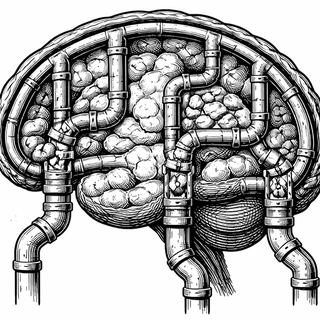
Researchers already knew that TBI raises later risk for dementia and tau-related disease. What has been fuzzier is the middle step. The authors focused on the brain's drainage system, especially meningeal lymphatic vessels. These are channels in the membranes around the brain that help carry fluid, waste, and immune signals out for disposal. Think less "mystical mind palace" and more "basement sump pump you pray keeps working during a storm."
That idea is not coming out of nowhere. Other work has shown that meningeal lymphatics help clear toxic material and shape brain immune responses, including in Alzheimer's models (Da Mesquita et al., 2021). Reviews over the past few years have also tied disrupted glymphatic and lymphatic clearance to TBI-related neurodegeneration and tau buildup (Peters and Lyketsos, 2023; Flavin et al., 2023).
One hit, worse tau, angrier immune cells
In this study, the team used PS19 mice, a tauopathy model. They gave the mice a single mild TBI and found that later on those mice showed worse tau pathology, more activation of brain macrophages and microglia, more neurodegeneration, and worse cognitive performance than sham-injured animals. So even one mild injury was enough to pour gasoline on an already risky setup.
Then came the key move. Twenty-four hours after injury, the researchers delivered VEGFC into the meningeal compartment using a viral vector. VEGFC is a growth factor known to support lymphatic vessels. In plain English, they tried to repair the drainage hardware before the whole site flooded.
That treatment did not magically make biology stop being weird. But it did help. The VEGFC-treated mice showed improved lymphatic drainage, less tau pathology, reduced inflammatory activation, less tissue loss, and better performance on memory testing compared with injured control mice (Royo Marco et al., 2025). Plot twist: the janitors might be part of the structural crew.
Why this paper is interesting without turning into sci-fi
The real appeal here is timing. The treatment was given one day after injury, not months later after the house already has mushrooms in the drywall. If a brief repair window exists after TBI, that is a very different kind of clinical opportunity.
It also tackles a problem the field keeps running into: TBI is common, messy, and hard to predict. Some people recover well. Some do not. Some develop long-term cognitive trouble years later. Human studies still support a link between TBI and later dementia risk, but the story is noisy and depends on injury history, severity, biology, and probably bad luck being rude on purpose (Walter et al., 2025; NINDS, 2025).
The broader research climate also fits. A 2025 mini-review on mild TBI and glymphatic dysfunction argued that impaired waste clearance may be one route from concussion to later neurodegenerative disease (Miettinen et al., 2025). UVA highlighted this paper the same month as evidence that fixing brain drainage after head trauma might reduce later Alzheimer's-like changes (University of Virginia, December 15, 2025).
Before anyone starts ordering miracle drain cleaner
Important reality check. This was a mouse study. The mice were genetically primed for tauopathy. The treatment used viral-vector delivery into the meningeal space, which is not the sort of thing your urgent care clinic is going to offer between a concussion handout and a sticker. Human TBI is wildly variable, and the ideal dose, timing, patient selection, and safety profile are all unresolved.
There is also a bigger conceptual challenge. Brain drainage is not one pipe. It is more like a miserable renovation with overlapping contractors: blood vessels, cerebrospinal fluid flow, glymphatic exchange, lymphatics, immune cells, sleep, and inflammation all yelling over each other.
Still, this paper gives the field a clean, testable idea. Head injury may worsen tau disease partly by damaging the brain's waste-removal routes, and boosting lymphatic repair after injury may blunt that damage. That is not a cure. It is a blueprint. In neuroscience, getting a decent blueprint before the ladder falls over is already real progress.
References
- Royo Marco A, Bruch KR, Cowan MN, et al. Therapeutic VEGFC treatment provides protection against traumatic-brain-injury-driven tauopathy pathogenesis. Cell Reports. 2025;44(11):116521. DOI: https://doi.org/10.1016/j.celrep.2025.116521
- Da Mesquita S, Papadopoulos Z, Dykstra T, et al. Meningeal lymphatics affect microglia responses and anti-Aβ immunotherapy. Nature. 2021;593(7858):255-260. DOI: https://doi.org/10.1038/s41586-021-03489-0
- Peters ME, Lyketsos CG. The glymphatic system's role in traumatic brain injury-related neurodegeneration. Molecular Psychiatry. 2023;28(7):2707-2715. DOI: https://doi.org/10.1038/s41380-023-02070-7
- Flavin WP, Hosseini H, Ruberti JW, et al. Traumatic brain injury and the pathways to cerebral tau accumulation. Frontiers in Neurology. 2023;14:1239653. DOI: https://doi.org/10.3389/fneur.2023.1239653
- Miettinen P, Utz B, Bañuelos-Cabrera I, et al. Glymphatic system and mild traumatic brain injury: a mini review. Frontiers in Neuroscience. 2025;19:1705690. DOI: https://doi.org/10.3389/fnins.2025.1705690. PMCID: https://pmc.ncbi.nlm.nih.gov/articles/PMC12572939/
- Walter AE, Pike JR, Coresh J, et al. Traumatic brain injury, changes in plasma amyloid, tau, and neurodegenerative biomarkers, and dementia risk. Alzheimer's & Dementia. 2025;21(9):e70611. DOI: https://doi.org/10.1002/alz.70611
- University of Virginia. Why a mild brain injury can trigger Alzheimer's. Published December 15, 2025. https://news.virginia.edu/content/why-mild-brain-injury-can-trigger-alzheimers
- National Institute of Neurological Disorders and Stroke. Traumatic Brain Injury (TBI). Accessed May 26, 2026. https://www.ninds.nih.gov/health-information/disorders/traumatic-brain-injury-tbi
Disclaimer: The image accompanying this article is for illustrative purposes only and does not depict actual experimental results, data, or biological mechanisms.