
A neurologist walks into a bar and says, "I need something strong enough to explain why chemotherapy can save your life and still leave your socks feeling like they were designed by a sadist." Fair point. One of the nastier side effects of oxaliplatin is chemotherapy-induced peripheral neuropathy, or CIPN - the numbness, tingling, burning, and pain that can stick around long after treatment is over. A new paper suggests some of that trouble starts in the dorsal root ganglion, where sensory neurons sit beside immune cells that apparently moonlight as chaos goblins [1].
The DRG: where nerves and immune cells stop being polite
The dorsal root ganglion, or DRG, is a cluster of sensory neuron cell bodies parked just outside the spinal cord. It relays information about heat, touch, and pain. Not glamorous, but essential - like the person backstage running the whole concert while everyone else gets the applause.
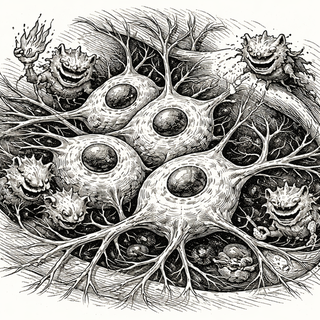
What makes the DRG especially interesting is that neurons there live shoulder-to-shoulder with immune cells, including tissue-resident macrophages. Those macrophages are supposed to help with cleanup and damage control. When things go wrong, they can become the neighborhood group chat that turns one weird rumor into a five-alarm panic. Reviews over the last few years have increasingly framed CIPN as a neuroimmune problem, not just damaged wiring [2,3].
Meet the molecule with terrible bedside manners
The star troublemaker here is HMGB1, a protein that usually lives inside cells and helps manage DNA. But when it shows up outside cells, it can act like a danger signal. This study focuses on a specific version called disulfide HMGB1, or ds-HMGB1, which is the inflammatory one - same protein, much worse attitude.
Yang and colleagues found that in mice treated with oxaliplatin, microglia-like tissue-resident macrophages in the DRG were a major source of ds-HMGB1. The paper lays out a pretty mean little sequence. PDIA3 helps convert HMGB1 into the disulfide form. Gasdermin D then helps release it through pyroptosis, an inflammatory form of cell death with absolutely no chill. Once released, ds-HMGB1 binds TLR4 on a subset of sensory neurons, kicks on NF-kB signaling, raises TRPV1 levels, and makes the whole system more pain-ready [1].
Why this is more than mouse drama
This matters because CIPN is one of the main reasons cancer treatment gets dose-reduced, delayed, or stopped. It can make walking miserable, wreck sleep, and turn ordinary things - buttoning a shirt, typing, holding a cold drink - into irritating little boss fights. Reviews keep landing on the same frustrating point: we still do not have many great options once painful CIPN is established [2,4].
That is why this paper is interesting. It does not just say "inflammation is involved" in the vague horoscope sense of the phrase. It names players: resident macrophages in the DRG, ds-HMGB1, TLR4, and TRPV1. That fits with earlier work showing that TLR4-TRPV1 signaling can boost DRG neuron excitability in chemotherapy neuropathy, and that DRG macrophages can help maintain chronic pain states [5,6].
The part researchers and patients will both care about
The most practical finding is that blocking PDIA3, gasdermin D, or ds-HMGB1 reduced pain behavior in the model without obviously weakening oxaliplatin's anti-tumor effect [1]. That is the dream: keep the cancer-killing part, lose the collateral damage.
There is also a biomarker angle. The team reports that serum ds-HMGB1 correlated with pain severity in oxaliplatin-treated patients. Correlated is doing a lot of work there - it does not mean a blood test is ready for prime time next Thursday - but it hints at something useful. Right now, CIPN often gets measured after the fact, when the damage has already made itself at home and started rearranging the furniture. A blood marker that tracks risk or severity could help clinicians adjust treatment earlier.
The catch, because science always brings a catch, is that this is still a translational bridge rather than a finished highway. Much of the mechanistic work is in mice. Human neuropathy is messier, and pain biology has a long history of looking simple in a figure and rude in a clinic. Still, this is exactly the kind of study the field needs - specific enough to test, and close enough to the clinic to matter.
So the big idea is not that chemotherapy pain comes from "the nerves" in some abstract way. It may come from a tense little argument between immune cells and sensory neurons, happening right beside the spinal cord, with ds-HMGB1 acting like the guy at the bar who keeps yelling "fight, fight, fight." If future studies hold up, shutting that guy up could make cancer treatment a lot more bearable.
References
- Yang Y, Zhao B, Huo J, et al. Microglial macrophage-derived ds-HMGB1 in DRG orchestrates neuropathic pain through immune-neural signaling. Cell Reports. 2025;44:116671. DOI: https://doi.org/10.1016/j.celrep.2025.116671
- Tao Z, Chen Z, Zeng X, Cui J, Quan M. An emerging aspect of cancer neuroscience: A literature review on chemotherapy-induced peripheral neuropathy. Cancer Letters. 2024;611:217433. DOI: https://doi.org/10.1016/j.canlet.2024.217433
- Shatunova S, Aktar R, Peiris M, Lee JYP, Vetter I, Starobova H. The role of the gut microbiome in neuroinflammation and chemotherapy-induced peripheral neuropathy. European Journal of Pharmacology. 2024;979:176818. DOI: https://doi.org/10.1016/j.ejphar.2024.176818
- Burgess J, Ferdousi M, Gosal D, et al. Chemotherapy-Induced Peripheral Neuropathy: Epidemiology, Pathomechanisms and Treatment. Current Treatment Options in Oncology. 2021;22(12):116. DOI: https://doi.org/10.1007/s40487-021-00168-y
- Navia-Pelaez JM, Lemes JBP, Gonzalez L, et al. AIBP regulates TRPV1 activation in chemotherapy-induced peripheral neuropathy by controlling lipid raft dynamics and proximity to TLR4 in dorsal root ganglion neurons. Pain. 2023;164(6):e274-e285. DOI: https://doi.org/10.1097/j.pain.0000000000002834. PMCID: https://pmc.ncbi.nlm.nih.gov/articles/PMC10182209/
- Raoof R, Gil CM, Lafeber FPJG, et al. Dorsal Root Ganglia Macrophages Maintain Osteoarthritis Pain. Journal of Neuroscience. 2021;41(39):8249-8261. DOI: https://doi.org/10.1523/JNEUROSCI.1787-20.2021. PMCID: https://pmc.ncbi.nlm.nih.gov/articles/PMC8482866/
Disclaimer: The image accompanying this article is for illustrative purposes only and does not depict actual experimental results, data, or biological mechanisms.