
What if the hardest part of listening to a neuron is not the neuron, but parking the microphone? That sounds backwards, but it is basically the problem this new paper tries to solve: researchers can build exquisitely sensitive neural probes, yet once those devices are in place, they often just... stay there, like a very expensive lawn chair.
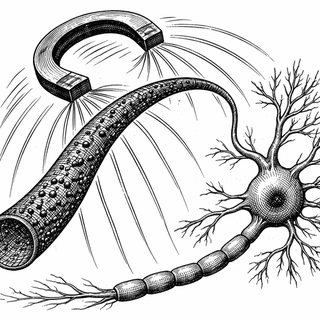
In a new Advanced Materials study, Ju-Young Kim and colleagues describe a flexible, magnetically guided bioelectronic probe called Mag-N-Probe that can be remotely steered with very fine control to record from individual neurons and also interface with brain organoids - those lab-grown clumps of brain-like tissue that have become neuroscience's favorite weird little overachievers.1 The trick is simple in concept and very not simple in execution: build a soft mesh-like probe, load it with ferromagnetic nanoparticles, and move it around with magnetic fields instead of treating it like a fixed piece of hardware.
Why This Is More Than Gadget Theater
A lot of neural recording tech has one big personality flaw: rigidity. Traditional setups can capture beautiful electrical signals, but they are often structurally static, which is bad news when your target is a living system that is soft, three-dimensional, and inconveniently not arranged like a tidy circuit board. Neurons do not line up for inspection. Organoids definitely do not. They are more like biological dumplings with opinions.
That is where Mag-N-Probe gets interesting. According to the paper, the device can navigate over centimeter-scale distances and then make sub-micrometer adjustments, which let the team repeatedly target specific parts of single neurons for compartment-specific electrophysiology.1 In plain English: this is less "drop a sensor somewhere nearby and hope" and more "guide a soft probe right where you want it." That level of repositioning matters because different parts of a neuron do different jobs. The soma is not the axon, the axon is not the dendrite, and the brain remains committed to being delightfully extra about all of it.
Brain Organoids Need Better Eavesdropping
This also plugs into a bigger trend in neuroscience. Brain organoids are useful because they let researchers study human-like neural development and disease in ways animal models cannot always capture. The problem is that reading their electrical activity well has been awkward. You can use patch clamp, planar arrays, or penetrating electrodes, but each comes with tradeoffs in invasiveness, geometry, or long-term stability.23
Other groups have been attacking this from different angles. In 2024, researchers reported kirigami-inspired electronics that unfold into a three-dimensional basket and record from neural organoids for up to 120 days while preserving their architecture.2 In 2025, another team showed magnetically reshapable liquid-metal electrode arrays for brain organoids, again pushing toward recording that adapts to tissue instead of bullying tissue into adapting to hardware.4 You can feel the field inching toward a shared conclusion: if the tissue is soft, curved, and alive, your device should stop acting like a nail gun.
Mag-N-Probe fits neatly into that story, but with a useful twist. Instead of only conforming to tissue, it can actively move through complex spaces and retarget cells in real time. That gives it a sort of "gentle drone camera for neurons" vibe, except smaller, smarter, and far less likely to ruin a wedding.
Why Anyone Outside a Clean Room Should Care
If this approach keeps working and scales well, it could make lab studies much more precise. Researchers could map how signals differ across parts of the same neuron, follow changes over time in organoids, and test how drugs or disease models alter activity without relying on one fixed recording position. That is valuable because biology is messy, and one static snapshot often misses the plot.
There is also a longer-horizon implication. Soft bioelectronics has been moving toward devices that better match tissue mechanics, reduce damage, and support chronic recordings.35 Current expert commentary and recent research coverage suggest the field is increasingly focused on interfaces that are adaptive rather than merely miniaturized - especially for organoids, closed-loop systems, and eventually less invasive brain technologies.678 Mag-N-Probe looks like part of that migration from "smaller electrode" to "smarter, steerable interface."
Of course, this is not a green light for tiny magnetic probes joyriding through human cortex next week. The paper points to promising in vitro and minimally invasive future applications, but there are still obvious questions about scaling, long-term biocompatibility, control in living tissue, and how much useful information the system can gather in harder real-world settings.1 Neuroscience is full of devices that look amazing in a paper and then meet reality, which is usually where reality wins a few rounds.
Still, the central idea is strong: if neural tissue is dynamic, the tool that listens to it should be dynamic too. That sounds obvious once you hear it, which is annoying, because those are often the ideas that matter most.
References
-
Kim JY, Kim H, Kim MH, et al. Magnetically Guided Flexible Bioelectronic Probe for Single-Cell Recordings in Multi-Scale Biosystems. Advanced Materials. 2026;38(4):e11700. DOI: https://doi.org/10.1002/adma.202511700 ↩
-
Yang X, Forro C, Li TL, et al. Kirigami electronics for long-term electrophysiological recording of human neural organoids and assembloids. Nature Biotechnology. 2024;42:1836-1843. DOI: https://doi.org/10.1038/s41587-023-02081-3 ↩
-
Ahnood A, Chambers A, Gelmi A, Yong KT, Kavehei O. Semiconducting electrodes for neural interfacing: a review. Chemical Society Reviews. 2023;52(4):1491-1518. DOI: https://doi.org/10.1039/D2CS00830K ↩
-
Kim E, et al. Magnetically reshapable 3D multi-electrode arrays of liquid metals for electrophysiological analysis of brain organoids. Nature Communications. 2025;16:2011. DOI: https://doi.org/10.1038/s41467-024-55752-3 ↩
-
Duan W, Aregueta Robles U, Poole-Warren L, Esrafilzadeh D. Bioelectronic Neural Interfaces: Improving Neuromodulation Through Organic Conductive Coatings. Advanced Science. 2024;11(27):e2306275. DOI: https://doi.org/10.1002/advs.202306275 ↩
-
Wang Q, Jiang D, Tian S, et al. Bioelectronic Interfaces and Sensors for Neural Organoids. Microsystems & Nanoengineering. 2025. PMCID: https://pmc.ncbi.nlm.nih.gov/articles/PMC12434145/ ↩
-
UCSC News. Bioelectronics enable precise control of organoids for better understanding of neuro diseases, neuron circuits. February 7, 2024. https://news.ucsc.edu/2024/02/cellreports-23/ ↩
-
Northwestern Now. Living 'mini brains' meet next-generation bioelectronics. February 18, 2026. https://news.northwestern.edu/stories/2026/02/living-mini-brains-meet-next-generation-bioelectronics ↩
Disclaimer: The image accompanying this article is for illustrative purposes only and does not depict actual experimental results, data, or biological mechanisms.