
"Cross-species lesion mapping links a midbrain circuit to vergence dysfunction" sounds like the title of a paper that would charge your soul a parking fee. In plain English, it means scientists found a small patch of midbrain machinery that helps both eyes lock onto the same target at the same time. How much timing does that take? Just enough that if one microscopic gear slips, your visual world can go from clean 3D to "why are there two coffee mugs and which one is mine?"
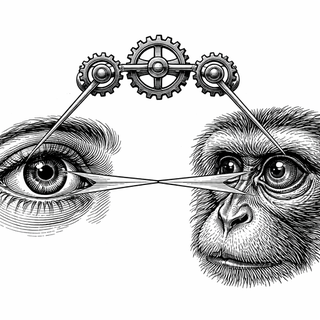
Your Eyes Are Running a Duet, Not Two Solo Acts
Vergence is the coordinated movement that turns both eyes inward for near things and outward for far things. It is what lets you read a menu, thread a needle, or inspect your phone at the deeply dignified distance of six inches from your face. Unlike the fast flick of a saccade, vergence is slower and more negotiated - less drum fill, more watch escapement.
Neurologists have long known vergence can break down in brain disease, but pinning that failure to a specific human circuit has been messy. Friedrich and colleagues looked at lesion locations in 66 humans and 19 monkeys and asked a blunt question: when vergence fails, where is the shared damage? Their answer was a region just rostral to the superior colliculus, centered on the nucleus of the posterior commissure, plus a connected circuit linking visual input to eye-movement output (Friedrich et al., 2026).
The Brainstem, Caught Red-Handed
Lesion mapping asks not just "what lights up?" but "what breaks when this part is gone?" Functional scans are useful, but lesions are the rude audit. If damage knocks out a behavior, the brain has effectively filed a complaint in writing.
This study also bridged species instead of leaving monkey and human work in separate bins. The same midbrain zone showed up across both. That gives old animal literature a firmer handshake with the clinic and fits with recent human observations that midbrain lesions can produce disconjugate gaze and other alignment problems (Friedrich et al., 2024, PMCID: PMC11055718).
Why Anyone Outside Neuro-Ophthalmology Should Care
Because vergence dysfunction is not a cute little lab oddity. It can mean double vision, eye strain, dizziness, headaches, trouble reading, and the surreal feeling that space itself has become unreliable. The paper notes that vergence problems can appear in up to 40% of people with neurodegenerative disorders (Friedrich et al., 2026). That is a lot of people trying to do ordinary near-work while their visual system behaves like a Rube Goldberg machine assembled during a power outage.
There is also a bigger clinical angle here. Eye movements are increasingly being studied as measurable biomarkers for neurological disease because they are fast, noninvasive, and closely tied to distributed brain circuits. Recent reviews argue that better eye-tracking tools could help detect and monitor neurodegenerative disorders, though the field still has technical limits around sensor precision, standardization, and interpretation (Sekar et al., 2024, PMCID: PMC11015840; Band et al., 2024).
The Real Promise - and the Annoying Part
The promise is precision. If clinicians know that a specific midbrain-pretectal circuit is involved in vergence, they can look for sharper imaging signatures and better rehabilitation targets. This kind of map could help sort out whether a patient's reading-related double vision comes from diffuse disease, a focal lesion, or a particular node in the oculomotor network.
The annoying part is that brains are not wristwatches, even when they act like badly serviced ones. Vergence is not handled by one lonely nucleus doing unpaid overtime. It depends on distributed visual, premotor, cerebellar, and brainstem systems all staying in sync. Other work supports that broader picture, showing vergence depends on large cortico-cerebellar computations, not just one anatomical hotspot (Mitsudo et al., 2022, PMCID: PMC9270479). So this paper is not "mystery solved." It is more like "we found the stripped gear."
That is still a big deal. Good neurology often starts by turning vague misery into a map. This study does exactly that. It takes a symptom patients actually feel - blurry, effortful, doubled-up vision in depth - and links it to a specific cross-species circuit in the midbrain. Tiny structure, real consequences, elegant timing. The brain remains gloriously overengineered, but at least one of its smaller troublemakers now has a proper address.
References
Friedrich MU, Horn AKE, Friedrich H, et al. Cross-species lesion mapping links a midbrain circuit to vergence dysfunction. Brain. 2026;149(1):302-316. doi:10.1093/brain/awaf316
Friedrich MU, Schappe L, Prasad S, et al. Midbrain lesion-induced disconjugate gaze: a unifying circuit mechanism of ocular alignment? Journal of Neurology. 2024;271(5):2844-2849. doi:10.1007/s00415-023-12155-6. PMCID: PMC11055718
Sekar A, Panouillères MTN, Kaski D. Detecting abnormal eye movements in patients with neurodegenerative diseases - current insights. Eye and Brain. 2024;16:3-16. doi:10.2147/EB.S384769. PMCID: PMC11015840
Band TG, Bar-Or RZ, Ben-Ami E. Advancements in eye movement measurement technologies for assessing neurodegenerative diseases. Frontiers in Digital Health. 2024;6:1423790. doi:10.3389/fdgth.2024.1423790
Mitsudo H, Hironaga N, Ogata K, Tobimatsu S. Large-scale cortico-cerebellar computations for horizontal and vertical vergence in humans. Scientific Reports. 2022;12(1):11672. doi:10.1038/s41598-022-15780-9. PMCID: PMC9270479
Disclaimer: The image accompanying this article is for illustrative purposes only and does not depict actual experimental results, data, or biological mechanisms.