
The sneakiest result in this paper is not that scientists built another memristor. It is that the same little zinc-ion gadget can make the next signal hit harder or softer depending on what just happened before - basically paired-pulse facilitation and paired-pulse depression in one device, like a veteran point guard reading the defense and calling two completely different audibles off the same look (Tang et al., 2025). That is the kind of buried stat that wins the game film session.
Why This Weird Little Thing Matters
Brains do not compute like your laptop. They store and process signals in the same messy, wet, ion-driven system. That is a big reason neuroscientists and materials scientists keep chasing neuromorphic hardware - machines that act a little more like nervous tissue and a little less like a very tired spreadsheet.
This new device, called a zinc-ion capacitor-based fluidic memristor, plays in that space. A memristor is a resistor with memory. Its current state depends on the path it took to get there, which is honestly a very brain-like trait. The trick here is that the memory does not come from abstract electronics alone. It comes from zinc ions plating onto and stripping off nanoporous carbon under different voltages, which creates hysteresis - a history-dependent loop in the device's electrical behavior (Tang et al., 2025).
If that sounds like electrochemistry trying out for the neuroscience team, yes. That is exactly what is happening.
The Brain Play They Copied
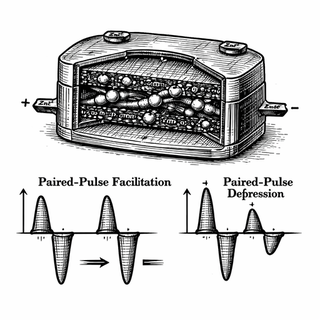
Short-term synaptic plasticity is one of the brain's fastest coaching adjustments. Fire two signals close together and the second can get boosted - paired-pulse facilitation - or toned down - paired-pulse depression. It helps circuits filter timing and prioritize bursts.
Tang and colleagues show their device can mimic both of those short-term responses. Here, the zinc-ion motion itself produces the memory effect. Negative bias encourages zinc plating, positive bias strips it away, and the device's recent past changes how it responds to the next pulse (Tang et al., 2025).
That puts this work in the same broader league as other fluidic and nanofluidic memristors, where ions - not just electrons - do the heavy lifting. A 2023 Science paper showed a polyelectrolyte-confined fluidic memristor could reproduce neuromorphic functions with ultralow energy use and couple chemical and electrical signaling (Xiong et al., 2023). Another Science study found long-term memory and synapse-like dynamics in two-dimensional nanofluidic channels (Robin et al., 2023).
Energy Storage Meets Memory, Which Is a Sneaky Combo
One especially interesting twist is that this device is built from a zinc-ion capacitor architecture. In plain English: it lives in the overlap between energy storage hardware and memory hardware. That is appealing because modern AI systems burn a shocking amount of energy just moving data around. Reviews of electrochemical memory devices keep making the same point - the "think here, store there" model is a bad offensive scheme when efficiency is the whole season (Kwak et al., 2024; Wang et al., 2025).
So imagine hardware that can both hold charge and remember recent activity. Not full human-level intelligence. Not Skynet with electrolytes. But maybe a path toward low-power adaptive sensors, soft biointerfaces, or edge-computing systems that do not need to keep sprinting back to the memory bench after every possession.
Researchers are pushing this idea from several angles. Reviews in ACS Nano and Nano Today describe nanofluidic ionic memristors as promising for brain-inspired computing because ion transport naturally produces analog, history-dependent behavior instead of rigid yes-no logic (Ismail et al., 2024; Noy et al., 2023). A 2025 Nature Communications paper even reported programmable nanofluidic channels that can display all four canonical memristor types in one platform, which is the materials-science version of a quarterback who can also punt (Ismail et al., 2025).
Before We Start Planning the Parade
There are still some very normal, very annoying engineering problems. These devices need reproducibility, durability, tighter control of ion motion, and clean integration with larger circuits. Lab demos often look great right up until you ask them to scale or behave consistently.
Still, this paper is fun because it nudges neuromorphic hardware closer to biology in the right way. Not by slapping a brain metaphor on a generic chip, but by using ions, history, and nonlinear responses - the same general playbook nervous systems have been running forever. The brain is still the defending champion of energy-efficient computation. Materials science is not there yet, but this zinc-ion memristor just put together a solid drive.
References
Tang P, Qiu Z, Zhu Y, et al. A Zinc Ion Capacitor-Based Fluidic Memristor. Advanced Materials. 2025:e12592. doi:10.1002/adma.202512592
Xiong T, Li C, He X, et al. Neuromorphic functions with a polyelectrolyte-confined fluidic memristor. Science. 2023;379(6628):156-161. doi:10.1126/science.adc9150
Robin P, Emmerich T, Ismail A, et al. Long-term memory and synapse-like dynamics in two-dimensional nanofluidic channels. Science. 2023;379(6628):161-167. doi:10.1126/science.ade9046
Kwak H, Kim N, Jeon S, et al. Electrochemical random-access memory: recent advances in materials, devices, and systems towards neuromorphic computing. Nano Convergence. 2024;11:9. doi:10.1186/s40580-024-00415-8
Wang T, Xie H, Yang R, et al. Memristive Ion Dynamics to Enable Biorealistic Computing. Chemical Reviews. 2025;125(3):1794-1871. doi:10.1021/acs.chemrev.4c00587
Ismail A, Nam GH, Lokhandwala A, et al. Nanofluidic Ionic Memristors. ACS Nano. 2024;18(31):20677-20698. doi:10.1021/acsnano.4c06467
Noy A, Li Z, Darling SB. Fluid learning: Mimicking brain computing with neuromorphic nanofluidic devices. Nano Today. 2023;53:102043. doi:10.1016/j.nantod.2023.102043
Ismail A, Nam GH, Lokhandwala A, et al. Programmable memristors with two-dimensional nanofluidic channels. Nature Communications. 2025;16:7683. PMCID:PMC12311041 doi:10.1038/s41467-025-61649-6
Disclaimer: The image accompanying this article is for illustrative purposes only and does not depict actual experimental results, data, or biological mechanisms.